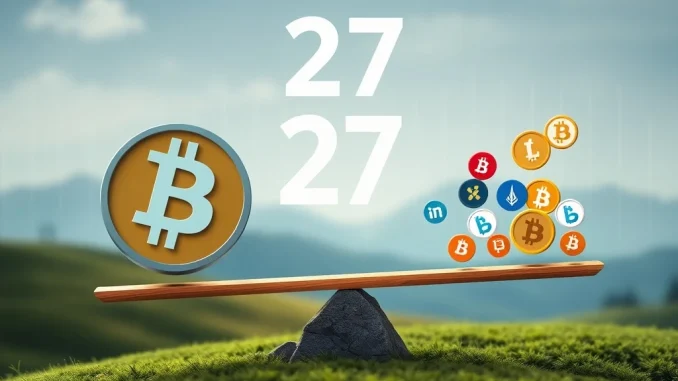
The dynamic world of digital assets constantly shifts, often leaving many wondering about the next big move. Currently, a significant indicator has captured the attention of many: the Altcoin Season Index. This index, a vital metric for understanding market sentiment, recently recorded a notable drop, signaling a potential shift in the broader cryptocurrency market. For crypto investors, understanding this movement is paramount to making informed decisions.
Decoding the Altcoin Season Index Decline
The Altcoin Season Index, provided by CoinMarketCap, currently stands at 27. This marks a two-point decrease from its previous reading, reflecting a noticeable change in market dynamics. To fully grasp its significance, one must understand its definition. An “altcoin season” occurs when 75% of the top 100 cryptocurrencies by market capitalization, excluding stablecoins and wrapped coins, have outperformed Bitcoin over the past 90 days. A score closer to 100 clearly indicates an altcoin season, suggesting broad gains across various digital assets. Conversely, a low reading, like the current 27, typically points towards a dominant Bitcoin season. Therefore, this decline signals a period where Bitcoin’s performance largely overshadows that of most altcoins.
What is an Altcoin Season, Anyway?
An altcoin season is a highly anticipated phase within the crypto community. During this period, numerous alternative cryptocurrencies (altcoins) experience substantial price surges, often outperforming Bitcoin’s gains. This phenomenon usually follows a strong Bitcoin rally, as profits from Bitcoin are often reinvested into altcoins, driving their prices up. Historically, these seasons have presented significant opportunities for diversification and substantial returns for those invested in a wide array of digital assets. However, they are not guaranteed and depend on various market factors.
Understanding the Shift: From Altcoin Season to Bitcoin Season
The current low reading of the Altcoin Season Index indicates a prevailing Bitcoin season. In a Bitcoin season, the leading cryptocurrency demonstrates superior performance. Its market capitalization grows, often increasing its dominance over the entire crypto market. This dominance means that while Bitcoin may be seeing strong gains, many altcoins struggle to keep pace or even decline in value. This trend can be attributed to several factors, including:
- Flight to Safety: During uncertain market conditions, investors often move capital into Bitcoin, viewing it as a more stable and less volatile asset compared to newer, smaller altcoins.
- Institutional Interest: Many institutional investors prefer Bitcoin due to its larger market cap, higher liquidity, and established infrastructure. This preference can drive Bitcoin’s price up independently of altcoins.
- Halving Cycles: Bitcoin’s halving events often precede bull runs, drawing significant attention and capital towards BTC, sometimes at the expense of altcoins.
Consequently, the recent drop in the index highlights Bitcoin’s current strength and market leadership. This dynamic frequently influences the broader cryptocurrency market trends.
Implications for Crypto Investors
For crypto investors, a shift towards a Bitcoin season carries significant implications. Firstly, it suggests that a strategy focused solely on altcoins might underperform compared to one heavily weighted towards Bitcoin. Secondly, it often means increased volatility for altcoins, as their prices can be more susceptible to market fluctuations when Bitcoin is in the driver’s seat. Investors might consider re-evaluating their portfolios, potentially increasing their Bitcoin allocation or taking profits from altcoins that have shown weaker performance. Moreover, this period can also be an opportunity to accumulate promising altcoins at lower prices, anticipating a future return to an altcoin season.
Factors Influencing the Altcoin Season Index
Several critical factors can influence whether the market experiences an altcoin season or a Bitcoin season. Macroeconomic conditions play a significant role. For instance, rising interest rates or global economic uncertainty can lead investors to favor less risky assets, often benefiting Bitcoin. Regulatory developments also have a profound impact; clearer regulations for Bitcoin might attract more traditional investors, boosting its dominance. Technological advancements and upgrades within specific altcoin ecosystems can, however, ignite mini-altcoin rallies, even during a broader Bitcoin-dominated period. Market sentiment, driven by news, social media trends, and influencer opinions, also consistently shapes investor behavior. Therefore, understanding these interconnected factors is essential for predicting future market movements and for crypto investors to adapt their strategies effectively.
Navigating the Current Cryptocurrency Market Landscape
Navigating the current cryptocurrency market landscape requires a nuanced approach. While the Altcoin Season Index points to Bitcoin’s dominance, it does not mean all altcoins will perform poorly. Some niche altcoins with strong fundamentals, active development, and unique value propositions may still find momentum. Investors should focus on thorough research, fundamental analysis, and risk management. Diversification remains a key strategy, but the current environment might warrant a more conservative allocation towards established assets. Regularly monitoring market news and technical indicators can provide valuable insights into potential shifts and opportunities. Furthermore, understanding the correlation between Bitcoin’s price action and specific altcoins can help in timing entries and exits.
Looking Ahead: What Could Trigger the Next Altcoin Season?
While we are currently in a Bitcoin-dominant phase, the market is cyclical. Several catalysts could trigger the next altcoin season. A sustained period of Bitcoin stability or consolidation after a significant rally often precedes an altcoin surge, as capital seeks higher returns. Major technological upgrades or widespread adoption for specific altcoin projects could also ignite interest. For example, a successful Ethereum upgrade or a breakthrough in decentralized finance (DeFi) could draw substantial capital. Furthermore, a renewed wave of retail investor interest, often fueled by positive news or celebrity endorsements, frequently plays a role. Crypto investors should therefore remain vigilant, constantly researching emerging projects and monitoring market sentiment for signs of a potential shift back towards broad altcoin outperformance.
In conclusion, the current drop in the Altcoin Season Index to 27 underscores Bitcoin’s current leadership in the cryptocurrency market. This shift necessitates careful consideration for crypto investors, urging them to adapt their strategies to prevailing conditions. While a Bitcoin season presents its own challenges, it also offers unique opportunities for strategic positioning. The market remains dynamic, and understanding these indices provides a clearer picture for navigating the exciting, yet volatile, world of digital assets.
Frequently Asked Questions (FAQs)
Q1: What does the Altcoin Season Index measure?
A1: The Altcoin Season Index measures the percentage of the top 100 cryptocurrencies (excluding stablecoins and wrapped coins) that have outperformed Bitcoin over the past 90 days. A score of 75 or higher indicates an altcoin season, while a lower score suggests a Bitcoin season.
Q2: How often does the Altcoin Season Index change?
A2: The index is typically updated daily or very frequently, reflecting the constant performance changes in the cryptocurrency market. Its value can fluctuate based on the daily movements of Bitcoin and the top altcoins.
Q3: Does a low Altcoin Season Index mean all altcoins will fall?
A3: Not necessarily. While a low index suggests that Bitcoin is generally outperforming the majority of altcoins, some individual altcoins with strong fundamentals, specific news, or unique use cases may still experience positive price action. It indicates a broader market trend rather than a universal outcome for every altcoin.
Q4: What should crypto investors do during a Bitcoin season?
A4: During a Bitcoin season, crypto investors might consider increasing their allocation to Bitcoin, taking profits from underperforming altcoins, or identifying promising altcoins to accumulate at lower prices. Diversification and risk management remain crucial, along with continuous market research.
Q5: How can I track the Altcoin Season Index?
A5: The Altcoin Season Index is primarily tracked and reported by platforms like CoinMarketCap. You can usually find this metric on their official websites or through reputable crypto analytics platforms.
Q6: Is an Altcoin Season guaranteed to follow a Bitcoin Season?
A6: While the cryptocurrency market is cyclical, and altcoin seasons often follow periods of Bitcoin dominance, it is not a guaranteed sequence. Various macroeconomic factors, technological developments, and investor sentiment can influence market cycles, making it unpredictable when the next altcoin season will commence.