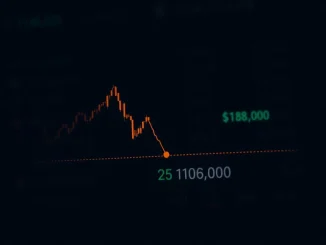
The cryptocurrency market witnessed a significant development today. **Bitcoin (BTC)**, the leading digital asset, **fell below $107,000**. This sudden **Bitcoin price drop** immediately captured the attention of traders and investors globally. According to Coin Pulse market monitoring, BTC now trades at **$106,911.16** on the Binance USDT market. This movement signals potential shifts in broader **market sentiment**.
Understanding the Recent Bitcoin Price Drop
The recent dip below the $107,000 mark represents a crucial moment for the **BTC market**. This price point often serves as a psychological and technical support level for many investors. Consequently, its breach triggers concerns among market participants. Traders closely monitor such levels for signs of trend continuation or reversal. The immediate impact sees increased selling pressure and a cautious outlook.
Furthermore, this specific price action occurs within a broader context. Analysts are now evaluating whether this move signifies a temporary correction or a deeper bearish trend. The speed of the drop often indicates strong selling momentum. Therefore, understanding the underlying factors becomes essential for informed decision-making. Many investors watch these movements carefully.
Factors Influencing Cryptocurrency Volatility
Several elements contribute to the inherent **cryptocurrency volatility**. Macroeconomic factors frequently play a significant role. For instance, changes in global interest rates or inflation concerns can push investors towards or away from riskier assets like Bitcoin. Regulatory news also exerts considerable influence. Positive or negative announcements from governments often lead to swift price reactions.
Moreover, technical indicators guide many trading decisions. When key moving averages or support lines break, algorithmic trading systems may trigger further selling. Liquidation events, particularly from leveraged positions, can also exacerbate downward movements. These cascading effects often amplify a **Bitcoin price drop**. Thus, a complex interplay of forces shapes the market.
Key drivers include:
- **Macroeconomic shifts:** Inflation, interest rates, global economic outlook.
- **Regulatory developments:** New laws or government statements.
- **Technical breaches:** Breaking crucial support levels.
- **Liquidation cascades:** Forced selling of leveraged positions.
Navigating Bitcoin Trading in a Bearish Climate
A bearish climate presents unique challenges and opportunities for **Bitcoin trading**. Investors often adjust their strategies to mitigate risks. Some traders may opt to reduce their exposure to the market. Others might look for short-selling opportunities or consider stablecoin allocations. Risk management becomes paramount during periods of heightened uncertainty.
Long-term holders, however, often view such dips differently. They might see these price drops as opportunities to accumulate more Bitcoin at a lower cost. This strategy, known as dollar-cost averaging, helps smooth out purchase prices over time. Despite the current **BTC market** conditions, fundamental beliefs in Bitcoin’s long-term value persist among many. Education and careful planning are crucial for all participants.
Market Sentiment and Future Outlook
Current **market sentiment** appears cautious, leaning towards bearishness. The breach of $107,000 undoubtedly impacts investor confidence. However, the cryptocurrency market is known for its rapid shifts. Analysts are now looking at the next potential support levels. These could include the $105,000 or even $100,000 marks. A strong bounce from these levels could signal a potential recovery.
Conversely, a sustained break below these levels might indicate further downside. Monitoring trading volumes provides additional insight. High selling volume confirms strong bearish pressure. Conversely, low volume on a price drop might suggest less conviction behind the sell-off. Therefore, staying informed about these metrics is vital for predicting future movements. The market remains highly dynamic.
The **Bitcoin price drop** below $107,000 serves as a stark reminder of **cryptocurrency volatility**. While the immediate outlook suggests caution, the market’s resilience often surprises observers. Traders and investors must remain vigilant, adapting their strategies to prevailing conditions. Understanding the various factors at play helps navigate these turbulent times. The future trajectory of the **BTC market** will depend on a confluence of global economic trends, technical indicators, and evolving **market sentiment**.
Frequently Asked Questions (FAQs)
Q1: What caused the recent Bitcoin price drop below $107,000?
A1: Multiple factors likely contributed to the drop. These include broader macroeconomic concerns, potential liquidations of leveraged positions, and technical selling after breaching a key support level. General market sentiment also plays a significant role in such movements.
Q2: Is a Bitcoin price drop below $107,000 significant?
A2: Yes, the $107,000 level held importance as a psychological and technical support. Its breach often indicates increased selling pressure and can trigger further downward momentum, making it a significant event for traders and investors.
Q3: How does cryptocurrency volatility affect traders?
A3: Cryptocurrency volatility presents both risks and opportunities. Traders must manage risk carefully, potentially using stop-loss orders or adjusting position sizes. However, volatility also creates opportunities for short-term gains for those who can predict market movements accurately.
Q4: What should investors do during a period of high Bitcoin trading volatility?
A4: During high volatility, investors often reassess their portfolios. Some may choose to hold, practice dollar-cost averaging, or reduce exposure. Others might look for short-term trading opportunities. It is crucial to conduct thorough research and consider personal risk tolerance.
Q5: How can I monitor market sentiment for the BTC market?
A5: You can monitor market sentiment by observing trading volumes, analyzing news headlines, tracking social media trends, and consulting technical analysis indicators. Tools like the Crypto Fear & Greed Index also provide insights into prevailing investor emotions.