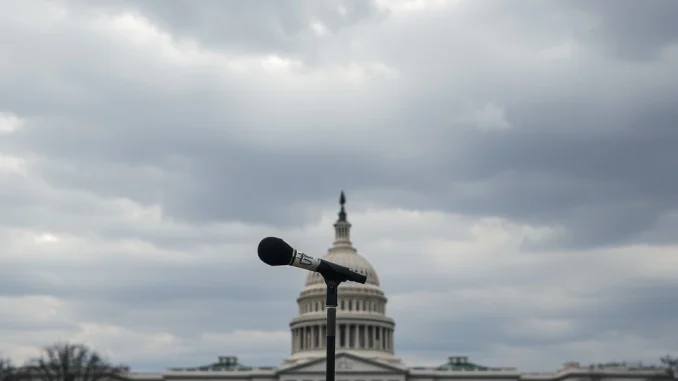
While the cryptocurrency market often operates independently, broader economic and political stability can significantly influence investor sentiment. Recent calls from Donald Trump regarding the ongoing government shutdown highlight significant US political tensions. This situation could have indirect ripple effects across various financial sectors, underscoring the interconnectedness of global markets with domestic policy.
Donald Trump Calls for Swift Action on Government Shutdown
President Donald Trump has publicly urged a rapid conclusion to the current government shutdown. His statements underscore the mounting pressure on lawmakers to find a resolution. The President voiced strong criticisms against the Democratic Party, accusing them of obstruction. He described their actions as effectively holding the government hostage.
During his remarks, Trump asserted that Democrats are intentionally impeding his administration’s progress. He claimed this opposition stems from his administration’s perceived success. Such rhetoric often intensifies partisan divides, making negotiations more challenging. The President’s message was clear: an immediate end to the shutdown is necessary.
The Core of the Political Deadlock
The current political deadlock represents a significant challenge for Washington. It arises when Congress fails to pass appropriation bills, leading to a lapse in funding for federal agencies. This impasse often occurs due to disagreements over spending priorities or policy riders attached to essential legislation. Both sides typically stand firm on their positions, making compromise difficult.
A government shutdown affects numerous federal operations. It impacts services and the livelihoods of federal employees. Resolving such a stalemate requires intense negotiation and a willingness to concede on certain points. The current situation reflects deep-seated ideological differences between the executive branch and congressional leaders. This is a common feature of US politics.
Democratic Party Accused of Obstruction
President Trump’s criticism directly targets the Democratic Party. He characterized their actions as deliberate obstruction. According to Trump, Democrats are using the shutdown as leverage. They are allegedly trying to undermine his policy agenda. He further suggested their tactics are politically motivated, aiming to slow down his administration’s momentum.
This accusation forms a central part of the administration’s narrative. It places the onus of the shutdown squarely on the opposition. The President’s supporters often echo these sentiments. They view the Democrats’ stance as an attempt to resist a popular mandate. This narrative shapes public perception of the ongoing crisis.
Historical Context of US Politics and Shutdowns
Government shutdowns are not new to US politics. They have occurred periodically throughout history, particularly since the 1970s. Each instance typically stems from budgetary disputes or clashes over specific legislative priorities. Past shutdowns have varied in duration and impact. For example, the 1995-1996 shutdown under President Clinton lasted 21 days.
These events highlight the inherent tensions within the American political system. They demonstrate the challenges of governing with divided power. Understanding these historical precedents helps contextualize the current political deadlock. It shows how different administrations and Congresses have navigated similar crises. However, each shutdown presents unique circumstances and political dynamics.
Economic Repercussions of a Prolonged Government Shutdown
A prolonged government shutdown carries significant economic consequences. It immediately impacts hundreds of thousands of federal workers. Many face furloughs or work without pay. This uncertainty can strain household finances and reduce consumer spending. Consequently, local economies reliant on federal employment suffer.
Key economic indicators may also be delayed or suspended. This creates a vacuum of information crucial for businesses and investors. Essential government services can also cease or be curtailed. This includes:
- National park closures
- Delays in loan processing
- Reduced regulatory oversight
These disruptions can ripple through the private sector. They create uncertainty and potentially slow economic growth. The longer the shutdown lasts, the more severe these economic impacts become. Therefore, a swift resolution is paramount for economic stability.
Seeking a Resolution to the Government Shutdown
Resolving the government shutdown requires both sides to engage in meaningful dialogue. Negotiations typically involve leaders from the White House and Congress. Finding common ground on appropriations bills is the primary objective. This often means making concessions or exploring alternative funding mechanisms. A bipartisan approach is generally considered the most effective path forward.
Public pressure also plays a crucial role. As the impacts of the shutdown become more apparent, constituents demand action. This can compel lawmakers to return to the negotiating table with renewed urgency. Ultimately, a resolution depends on the willingness of all parties to prioritize national interest over partisan advantage. The eyes of the nation are on Washington, awaiting a breakthrough in this persistent political deadlock.
President Donald Trump’s recent statements underline the critical need to end the ongoing government shutdown. His sharp criticism of the Democratic Party reflects the deep divisions currently affecting US politics. As the standoff continues, the nation watches for signs of a resolution. The economic and societal costs of this political deadlock continue to mount, emphasizing the urgency for a swift and effective solution.
Frequently Asked Questions (FAQs)
What causes a government shutdown?
A government shutdown occurs when Congress fails to pass annual appropriation bills or a continuing resolution to fund federal government operations. This usually happens due to disagreements between the legislative and executive branches over spending levels, policy riders, or specific budgetary allocations.
Who is affected by a government shutdown?
A wide range of individuals and services are affected. This includes hundreds of thousands of federal employees who may be furloughed or required to work without pay. Essential services continue, but many non-essential government functions cease. Public services like national parks, passport processing, and some scientific research can also be impacted.
How long do government shutdowns typically last?
The duration of a government shutdown varies significantly. Some have lasted only a few days, while others have extended for weeks. The longest shutdown in US history lasted 35 days, from December 22, 2018, to January 25, 2019. The length depends on the political will and ability of negotiating parties to reach a compromise.
What is the role of the Democratic Party in this situation, according to President Trump?
President Trump has accused the Democratic Party of holding the government hostage and obstructing his administration’s progress. He claims they are using the shutdown as a political tool because they believe his administration is performing too well, thereby hindering his policy objectives.
How does this political deadlock impact the economy?
A political deadlock leading to a government shutdown can have several negative economic impacts. It disrupts federal services, delays economic data releases, and creates uncertainty for businesses and investors. Furloughs for federal workers reduce consumer spending, and the overall disruption can slow economic growth, particularly if the shutdown is prolonged.