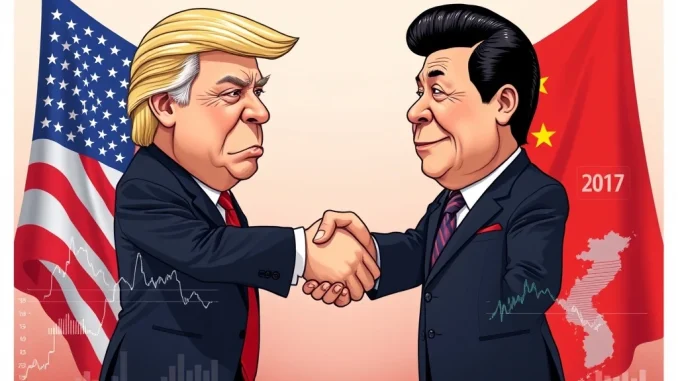
Global markets are bracing for significant news. President Donald Trump has officially reaffirmed his plan to meet with Chinese Chairman Xi Jinping. This pivotal Trump Xi meeting will take place in South Korea. Furthermore, President Trump issued a stark warning: if an agreement is not reached by November 1, he could impose a massive 155% tariff on China. This development introduces considerable uncertainty across financial sectors, including the volatile cryptocurrency markets. Investors often monitor such geopolitical shifts closely. They understand these events can influence asset prices and market sentiment globally.
Understanding the US China Trade War Escalation
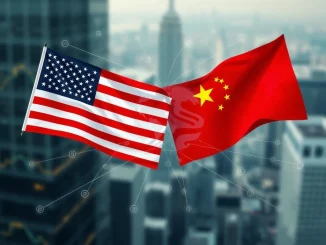
The US China trade war has dominated international headlines for years. It began with a series of tariffs imposed by the United States. These tariffs targeted Chinese goods. The US government cited unfair trade practices. Specifically, it mentioned intellectual property theft and a large trade deficit. China quickly retaliated with its own tariffs. This created a cycle of escalating economic tensions. Consequently, businesses worldwide faced disruptions. Supply chains became increasingly complex. Consumers also felt the impact through higher prices on various goods. This ongoing dispute significantly impacts global economic stability. Many experts worry about its long-term consequences.
Both nations have engaged in multiple rounds of negotiations. However, these talks have often stalled. Trust remains a major hurdle. Each side holds firm on its key demands. The US insists on structural changes to China’s economic policies. China, conversely, seeks a more balanced and respectful trade relationship. Therefore, the upcoming meeting carries immense weight. It could either pave the way for a resolution or deepen the existing rift. Financial analysts are keenly observing every statement. They want to gauge the potential direction of these critical discussions.
The Significance of the South Korea Summit
The upcoming South Korea summit serves as a crucial platform. It allows both leaders to engage directly. Such face-to-face interactions often prove vital. They can break through diplomatic impasses. The choice of South Korea as the venue is also noteworthy. It highlights the regional importance of these discussions. South Korea, a key US ally, shares significant economic ties with China. Thus, it offers a neutral ground for these high-stakes talks. Global leaders hope for productive dialogue. They seek concrete steps towards de-escalation. A successful summit could stabilize international trade relations. Conversely, a failure could trigger further market volatility. This would affect various asset classes.
Previous summits have produced mixed results. Sometimes, they yielded temporary truces. At other times, they led to renewed hostilities. This history makes the current meeting particularly precarious. Investors are looking for clear signals. They want to understand the commitment from both sides. A breakthrough would offer much-needed relief. It could spur economic growth. Conversely, continued deadlock would prolong uncertainty. It might even trigger a global economic slowdown. Therefore, the world watches the South Korea summit with bated breath.
Unpacking the Looming Tariff Threats
President Trump’s declaration of a potential 155% tariff is a significant development. These tariff threats represent a substantial escalation. If implemented, they would target an even broader range of Chinese imports. Such a high tariff rate could cripple Chinese exports to the US. It would make many products prohibitively expensive. This strategy aims to pressure China into concessions. The November 1 deadline adds urgency to the situation. It creates a clear timeline for negotiation. Businesses must prepare for potential disruption. They need contingency plans for their supply chains. This pressure tactic could be effective. However, it also carries substantial risks.
The impact of a 155% tariff would be widespread. It would affect manufacturers, retailers, and consumers. American companies relying on Chinese components would face increased costs. These costs would likely pass on to consumers. Consequently, inflation could rise. Consumer spending might decrease. China would also likely retaliate. This could lead to a full-blown trade war. Such an outcome would harm both economies. Furthermore, it would destabilize the global economy impact. Many industries are already feeling the strain. They face existing tariffs and economic slowdowns. Therefore, these tariff threats are not mere rhetoric. They represent a tangible danger to global trade.
Dynamics of the Trump Xi Meeting
The upcoming Trump Xi meeting is not just a diplomatic formality. It is a clash of negotiating styles. President Trump often favors aggressive tactics. He uses threats and deadlines. Chairman Xi Jinping, on the other hand, typically adopts a more measured approach. He emphasizes long-term strategy. Both leaders understand the high stakes involved. Their respective political legacies are tied to this outcome. For Trump, securing a favorable trade deal is a key promise. For Xi, protecting China’s economic interests is paramount. Therefore, this meeting will test their ability to find common ground. It requires significant diplomatic skill and compromise from both sides.
Past interactions provide some insight. The two leaders have previously engaged in intense discussions. Sometimes, these talks yielded limited progress. Other times, they broke down completely. This history highlights the complexity of their relationship. The personal chemistry between them also plays a role. A constructive rapport could facilitate an agreement. Conversely, a lack of trust could derail negotiations. Analysts will closely scrutinize body language and public statements. These details often reveal the true state of the discussions. Ultimately, the success of the Trump Xi meeting hinges on mutual willingness to compromise. Without it, the trade conflict will surely intensify.
Assessing the Global Economy Impact
The potential global economy impact of these trade tensions is profound. An escalation would send shockwaves across international markets. Global supply chains, already under pressure, would face further disruption. Companies might reconsider their manufacturing locations. This could lead to significant relocation costs. Moreover, consumer confidence would likely decline. Businesses would become hesitant to invest. This slowdown in investment could trigger a global recession. Major economies are interconnected. Therefore, a downturn in the US or China affects everyone. Developing nations, particularly those reliant on trade, would suffer disproportionately. The ripple effect would be undeniable.
Specific sectors face particular risks. The technology industry, for instance, relies heavily on global supply chains. Tariffs could disrupt the flow of components. This would increase production costs. The agricultural sector also faces challenges. China has historically been a major buyer of US agricultural products. Tariffs have already reduced these purchases. Further escalation would devastate many farms. Energy markets could also see volatility. Trade disputes affect demand forecasts. Ultimately, the stability of the entire global financial system is at stake. Resolving the US China trade war is essential for global economic health. Its failure would carry severe consequences.
Cryptocurrency Markets and Geopolitical Ripples
Cryptocurrency markets often react to major geopolitical events. While not directly tied to trade agreements, they are influenced by broader economic sentiment. Bitcoin, for example, is sometimes viewed as a ‘digital gold.’ Investors might seek it as a safe haven asset during times of uncertainty. If the Trump Xi meeting fails, traditional markets could experience a downturn. This could push some investors towards alternative assets. Consequently, Bitcoin’s price might see an uptick. Conversely, some cryptocurrencies correlate with risk assets. A general market panic could drag them down. Therefore, the outcome of the summit could introduce significant volatility into crypto markets. Traders must remain vigilant.
Increased market uncertainty often leads to speculative trading. This can amplify price swings in cryptocurrencies. Regulatory responses also play a role. Governments might react to economic instability by imposing new financial controls. Such actions could impact the crypto space. The decentralized nature of cryptocurrencies offers a degree of insulation. However, they are not entirely immune to global economic forces. Therefore, the looming tariff threats and their potential for a broader global economy impact warrant close attention from crypto enthusiasts. They need to understand the potential for indirect effects on their portfolios.
Potential Outcomes and Future Scenarios
The upcoming Trump Xi meeting presents several possible outcomes. Each scenario carries distinct implications for markets. Firstly, a comprehensive agreement could be reached. This would involve significant concessions from both sides. Such an outcome would likely trigger a strong positive market reaction. Stocks would rally, and investor confidence would surge. Secondly, a partial agreement or de-escalation could occur. This might involve a temporary truce or an agreement on minor issues. It would offer some relief but leave fundamental problems unresolved. Markets might react cautiously, awaiting further developments.
Finally, the most concerning scenario involves a complete breakdown of talks. This would lead to the imposition of the 155% tariff threats. Such an outcome would undoubtedly cause significant market turmoil. A sharp sell-off in equities would be probable. Commodity prices might also fluctuate wildly. Furthermore, the US China trade war would intensify. This would have a severe global economy impact. Businesses would face increased uncertainty. Investment decisions would be delayed. Therefore, the stakes for this South Korea summit are incredibly high. The world awaits the outcome with apprehension.
Ultimately, the decisions made in South Korea will shape the trajectory of global trade. They will also influence economic stability for years to come. The delicate balance of international relations hangs in the balance. All eyes are on the two leaders. Their ability to find common ground will determine the immediate future of the global economy. Investors, businesses, and consumers alike hope for a positive resolution. They understand the potential ramifications of continued conflict.
Frequently Asked Questions (FAQs)
What is the main purpose of the upcoming Trump Xi meeting?
The primary purpose of the Trump Xi meeting is to address the ongoing trade disputes between the United States and China. Both leaders aim to negotiate a resolution to the US China trade war and prevent further escalation, such as the proposed 155% tariffs.
Where will the Trump Xi meeting take place?
President Trump has confirmed that the meeting with Chinese Chairman Xi Jinping will take place in South Korea. This choice of venue provides a neutral and diplomatically significant location for the high-stakes discussions.
What are the potential consequences if no agreement is reached by November 1?
If an agreement is not reached by November 1, President Trump has stated he could impose a 155% tariff on China. This action would significantly escalate the US China trade war, leading to substantial global economy impact and market volatility.
How might these trade tensions affect cryptocurrency markets?
While not directly involved, cryptocurrency markets are often influenced by broader economic sentiment. Increased geopolitical uncertainty and potential traditional market downturns could lead some investors to seek safe-haven assets like Bitcoin, or conversely, cause volatility across the crypto space as risk assets react to global instability.
What specific issues are at the heart of the US China trade war?
The core issues driving the US China trade war include the large trade deficit the US has with China, allegations of intellectual property theft, forced technology transfers, and what the US considers unfair state subsidies and market access restrictions for American companies in China.
Why is the South Korea summit considered so crucial?
The South Korea summit is crucial because it represents a direct, face-to-face opportunity for both leaders to resolve the protracted trade conflict. Its outcome will significantly determine the future direction of international trade relations and the stability of the global economy impact.