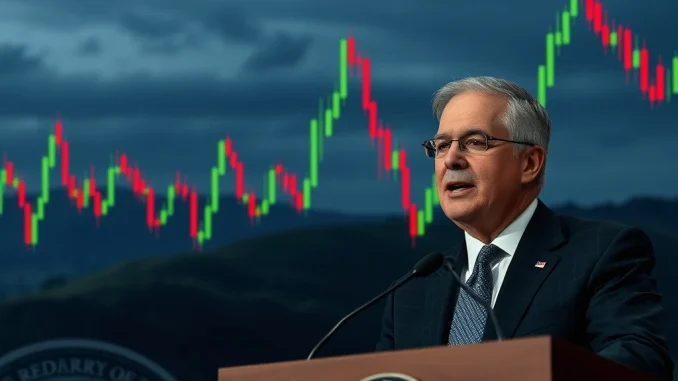
The broader **crypto market** showed little reaction following recent remarks from Federal Reserve Chair **Jerome Powell**. This lack of a strong rebound surprised some observers. LD Capital founder Jack Yi offered his insights. He noted a prevailing long-term optimism within the cryptocurrency space. However, he also highlighted coexisting short-term risks. Yi’s analysis suggests a period of strategic waiting for investors. This approach aims to clarify market direction before making significant moves.
Navigating the Crypto Market After Jerome Powell’s Remarks
Investors closely monitor statements from central bank officials. Such statements often influence market sentiment. Specifically, remarks from **Jerome Powell** can impact global financial markets. His recent speech did not, however, significantly move the cryptocurrency sector. Jack Yi observed this phenomenon. He pointed out that traditional markets often react to discussions about interest rates. Yet, crypto assets did not show a strong rebound. This indicates a unique dynamic within the digital asset space. Yi advises caution for traders. He believes the current environment is unsuitable for high-leverage positions. Both long and short strategies carry substantial risk now. Therefore, waiting for clearer signals becomes paramount for prudent trading.
Yi’s perspective emphasizes a dual outlook. He sees enduring optimism for crypto’s long-term prospects. Many believe in the transformative power of blockchain technology. This underlies the sustained interest in digital assets. Yet, short-term volatility remains a significant factor. Geopolitical events, regulatory changes, and macroeconomic data all contribute to this uncertainty. Investors must reconcile these two views. They need to balance long-term conviction with immediate market realities. This requires a nuanced understanding of market forces. Ultimately, patience and strategic planning are key.
Understanding Rate Cut Expectations and Market Dynamics
Central bank policies, especially regarding interest rates, profoundly affect financial markets. Discussions around **rate cut expectations** often signal potential shifts. Lower interest rates typically make borrowing cheaper. This can stimulate economic activity. It also tends to make riskier assets, like stocks and cryptocurrencies, more attractive. Investors seek higher returns when traditional savings offer less. Historically, a dovish stance from the Fed can fuel asset price appreciation. However, the crypto market’s reaction this time was muted. This suggests other factors are at play. Perhaps the market had already priced in certain expectations. Or, it may be waiting for more definitive action from the Fed. The complexity of these interactions makes predicting market movements challenging.
The cryptocurrency market often marches to its own drum. While influenced by macro trends, it also has unique drivers. Technological advancements, adoption rates, and specific project developments play a role. Furthermore, market liquidity and trading volumes can impact price movements. Yi’s advice against high leverage highlights this sensitivity. High leverage amplifies both gains and losses. In an uncertain market, this can lead to rapid capital depletion. Therefore, understanding the broader economic context is vital. But equally important is recognizing crypto’s distinct characteristics. This dual awareness helps investors navigate volatile periods more effectively.
The Impact of Recent Forced Liquidations
The cryptocurrency market recently experienced a record-breaking event. This involved significant **forced liquidations**. Such events occur when traders cannot meet margin calls. Their leveraged positions are then automatically closed by exchanges. This prevents further losses. Large-scale liquidations can create cascading effects. They often lead to sharp price drops. This can trigger more liquidations. The recent event was substantial. It caused considerable market turbulence. Naturally, such occurrences can spark speculation. Conspiracy theories often emerge during periods of high volatility. People look for explanations for sudden market movements. However, Jack Yi quickly dismissed these theories. He stated they were likely untrue. Instead, he pointed to fundamental market mechanics. These mechanics involve risk management and leverage. This perspective helps demystify complex market events.
Forced liquidations serve as a stark reminder of leverage risks. Using borrowed capital can magnify returns. Yet, it also magnifies potential losses. A small price movement against a highly leveraged position can wipe out an entire account. This risk is particularly pronounced in volatile markets like crypto. Yi’s dismissal of conspiracy theories is important. It refocuses attention on verifiable market dynamics. It also underscores the need for sound trading practices. Traders must understand the mechanisms behind such events. This knowledge empowers them to make better-informed decisions. It also helps them avoid falling prey to misinformation. Ultimately, transparency and education are key to a healthier market environment.
Prioritizing Risk Management Crypto Strategies
The recent market events underscore a critical lesson for all participants. Effective **risk management crypto** strategies are not optional; they are essential. For individual investors, this means several things. First, never invest more than you can afford to lose. This fundamental principle protects capital. Second, diversify your portfolio. Spreading investments across different assets reduces exposure to single-asset volatility. Third, use stop-loss orders. These automatically close a position at a predetermined price. This limits potential losses. Fourth, avoid excessive leverage. While tempting, high leverage significantly increases risk. Yi specifically highlighted the need for robust risk management. He emphasized its importance for long-term financial health in the crypto space.
Exchanges also bear a significant responsibility. They must strengthen measures to protect users. This includes implementing clear margin call procedures. It also means providing educational resources on leverage. Transparent communication about market risks is vital. Furthermore, robust technical infrastructure is necessary. This ensures fair and efficient trading. Exchanges play a crucial role in maintaining market integrity. Their actions directly impact user safety and trust. The recent liquidation event serves as a wake-up call. It highlights areas where both individual traders and platforms can improve. A collective commitment to better risk practices will benefit the entire ecosystem. This collaborative effort ensures a more secure trading environment for everyone.
Future Outlook for the Crypto Market
Despite the current caution, the long-term outlook for the **crypto market** remains largely optimistic. Many analysts foresee continued innovation. They also anticipate increasing institutional adoption. However, the path forward will likely involve periods of volatility. Investors should therefore prepare for these fluctuations. Jack Yi’s advice to wait for clearer market direction is prudent. This approach minimizes exposure during uncertain times. Key indicators to watch include macroeconomic data. Central bank policy decisions are also critical. Furthermore, regulatory developments will shape the industry’s future. Monitoring these factors helps investors make informed choices. It allows them to position themselves effectively for future growth.
The cryptocurrency space is still evolving. It is maturing rapidly. This growth brings both opportunities and challenges. Education and continuous learning are vital for participants. Understanding market cycles and economic influences is key. Moreover, adapting investment strategies to changing conditions is crucial. The resilience shown by the crypto market in various conditions is notable. This suggests a strong underlying belief in its potential. By prioritizing careful analysis and robust risk management, investors can navigate this dynamic landscape successfully. The journey ahead promises continued innovation and significant potential, but also demands informed decision-making.
Frequently Asked Questions (FAQs)
Q1: Why did the crypto market not strongly rebound after Jerome Powell’s speech?
A1: The crypto market’s muted reaction suggests that other factors are influencing investor sentiment. While traditional markets often react to discussions about interest rate cuts, crypto may have already priced in certain expectations or is awaiting more definitive policy actions from the Federal Reserve. Jack Yi noted that short-term risks are currently coexisting with long-term optimism, leading to a cautious stance.
Q2: What are ‘rate cut expectations’ and how do they typically affect markets?
A2: ‘Rate cut expectations’ refer to the anticipation that a central bank, like the Federal Reserve, will lower its benchmark interest rates. Typically, lower rates make borrowing cheaper, stimulating economic activity and making riskier assets, such as stocks and cryptocurrencies, more attractive to investors seeking higher returns. This can lead to increased asset prices.
Q3: What are forced liquidations in the crypto market?
A3: Forced liquidations occur when a trader’s leveraged position falls below a certain margin requirement. The exchange automatically closes these positions to prevent further losses. Large-scale liquidations can create significant downward pressure on prices, causing market turbulence and potentially triggering more liquidations.
Q4: Why is risk management so important for crypto investors?
A4: **Risk management crypto** strategies are crucial due to the inherent volatility of the cryptocurrency market. They help protect capital, limit potential losses, and enable investors to navigate unpredictable price swings. Key practices include not investing more than one can afford to lose, diversifying portfolios, using stop-loss orders, and avoiding excessive leverage.
Q5: What role do exchanges play in protecting users during market volatility?
A5: Exchanges have a significant responsibility to protect users. This includes implementing clear margin call procedures, providing educational resources on leverage and market risks, and ensuring robust technical infrastructure for fair trading. Strengthening these measures helps maintain market integrity and user trust, especially during periods of high volatility and events like forced liquidations.
Q6: What is the long-term outlook for the crypto market, according to analysts like Jack Yi?
A6: Despite short-term risks and current caution, analysts like Jack Yi maintain a long-term optimistic outlook for the crypto market. This optimism is driven by ongoing innovation, increasing institutional adoption, and the transformative potential of blockchain technology. However, investors are advised to remain patient and strategic, waiting for clearer market signals.