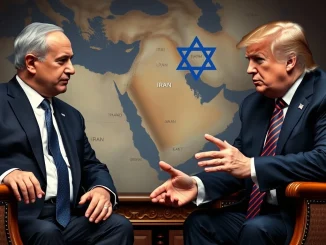
While the world of digital assets often feels distinct, global geopolitical shifts profoundly impact all markets, including cryptocurrencies. Therefore, a recent **Donald Trump statement** regarding the potential disarmament of Hamas merits close attention, as it signals a significant shift in potential **US policy Middle East** engagement. Such declarations can ripple through international relations, affecting stability and investor sentiment worldwide.
Trump Hamas: A Pivotal Declaration
U.S. President Donald Trump recently declared that Hamas, the Palestinian Sunni-Islamist fundamentalist organization, will be disarmed. This assertive declaration underscores a strong position on a deeply complex geopolitical issue. Furthermore, President Trump added a critical caveat: if the group does not disarm voluntarily, the United States will undertake the task of disarming it. This marks a potentially significant escalation in rhetoric and policy regarding the long-standing **Gaza conflict** and regional stability.
The statement comes amidst ongoing tensions in the Middle East. Consequently, it signals a firm approach to security concerns. Historically, U.S. administrations have navigated the Israeli-Palestinian conflict with varying degrees of direct intervention. This particular **Donald Trump statement**, however, suggests a more forceful and unilateral stance. Many observers are now analyzing the practical implications of such a commitment.
Understanding the Context of Disarmament
To fully grasp the weight of President Trump’s words, it is essential to understand what ‘disarming Hamas’ truly entails. Hamas operates both a political wing and an armed wing, known as the Izz ad-Din al-Qassam Brigades. Its arsenal includes various weaponry, from small arms to rockets. Disarmament could imply several scenarios:
- Voluntary Cessation: Hamas independently dismantling its military capabilities.
- Negotiated Agreement: A diplomatic process leading to the surrender of weapons.
- Forced Intervention: External military action to dismantle the group’s armed infrastructure.
Each of these pathways presents unique challenges and potential consequences. The feasibility of achieving such a goal, especially through non-voluntary means, remains a subject of intense debate among foreign policy experts. Moreover, the long history of the **Gaza conflict** illustrates the deep-rooted nature of the challenges involved.
Implications of US Policy in the Middle East
The potential for the U.S. to actively disarm Hamas represents a substantial shift in **US policy Middle East**. Traditionally, U.S. engagement has often focused on facilitating peace talks and providing security assistance. A direct intervention to disarm a non-state actor like Hamas would be a significant undertaking. It could reshape regional alliances and further complicate an already volatile landscape. Therefore, nations across the globe are closely watching these developments.
Such a policy could have several profound implications:
- Increased Regional Tensions: Direct U.S. intervention could provoke strong reactions from various state and non-state actors.
- Humanitarian Concerns: Any military operation carries the risk of civilian casualties and displacement, exacerbating humanitarian crises.
- Diplomatic Repercussions: International partners may react differently, potentially leading to divisions within the global community.
The declaration by President Trump signals a potential departure from previous diplomatic frameworks. Furthermore, it suggests a willingness to use military force to achieve specific security objectives in the region. This assertive posture will undoubtedly influence future discussions regarding the **Gaza conflict** and beyond.
Challenges in Disarming Hamas
Disarming Hamas presents formidable challenges. The group is deeply embedded within the social and political fabric of Gaza. It maintains an extensive network of tunnels and hidden weapon caches. Therefore, identifying and neutralizing all military assets would be a complex and dangerous operation. Additionally, the group’s ideology and popular support in certain segments of the Palestinian population add layers of difficulty.
Key challenges include:
- Operational Complexity: Locating and destroying hidden infrastructure and weapons in a densely populated urban environment.
- Political Resistance: Overcoming local and regional opposition to external intervention.
- Sustained Effort: Ensuring that any disarmament is permanent and does not lead to rearmament or the emergence of new militant groups.
Moreover, the international community has long grappled with how to address the militant aspects of Hamas while acknowledging its political role in Palestinian society. President Trump’s declaration to disarm Hamas directly confronts these long-standing dilemmas. It implies a readiness to bypass these complexities through direct action.
Global Reactions and Future Outlook
A **Donald Trump statement** of this magnitude will inevitably elicit varied reactions from around the world. Allies and adversaries alike will assess the implications for their own foreign policies. Regional powers, particularly Israel, Egypt, and Jordan, will be keenly interested in how such a policy might unfold. Their responses could significantly shape the operational environment. Consequently, the declaration sets the stage for intensive diplomatic activity and strategic repositioning.
The future outlook for the **Gaza conflict** under such a policy remains uncertain. While the goal of a disarmed Hamas could contribute to long-term security, the path to achieving it is fraught with risks. International law and humanitarian considerations will play a crucial role in any potential intervention. Therefore, careful planning and multilateral engagement would be paramount. The potential for the U.S. to actively disarm Hamas could fundamentally alter the dynamics of the Middle East.
In conclusion, President Trump’s assertion that **Hamas will be disarmed**, with the U.S. prepared to act if necessary, marks a powerful declaration. It highlights a potentially assertive shift in **US policy Middle East**. The implications for the **Gaza conflict**, regional stability, and international relations are profound. As the world watches, the practical execution and consequences of this stance will undoubtedly shape the future of a volatile region. This declaration emphasizes a proactive approach to security challenges, signaling a readiness for direct action to achieve stated objectives.
Frequently Asked Questions (FAQs)
Q1: What exactly did Donald Trump say about Hamas?
Donald Trump stated that Hamas will be disarmed. He added that if the group does not disarm on its own, the United States will take action to disarm it.
Q2: Why is the disarmament of Hamas a significant issue?
Hamas operates an armed wing and has been involved in the **Gaza conflict** for decades. Disarming the group would significantly alter the balance of power in the region and potentially reduce conflict, but it presents immense practical and political challenges.
Q3: How might this **Donald Trump statement** impact **US policy Middle East**?
This statement suggests a more direct and potentially interventionist **US policy Middle East** regarding the Israeli-Palestinian conflict. It could lead to increased U.S. military involvement or diplomatic pressure to achieve disarmament.
Q4: What are the main challenges in getting **Hamas disarmed**?
Challenges include Hamas’s deep integration within Gaza, its extensive tunnel networks, the difficulty of distinguishing between political and military wings, and potential local and international resistance to external intervention. The group’s ideological foundation also complicates disarmament efforts.
Q5: How could this affect the broader **Gaza conflict**?
A successful disarmament could lead to a significant de-escalation of the **Gaza conflict** and potentially pave the way for new peace initiatives. However, a forced disarmament could also lead to increased violence, regional instability, and humanitarian crises.