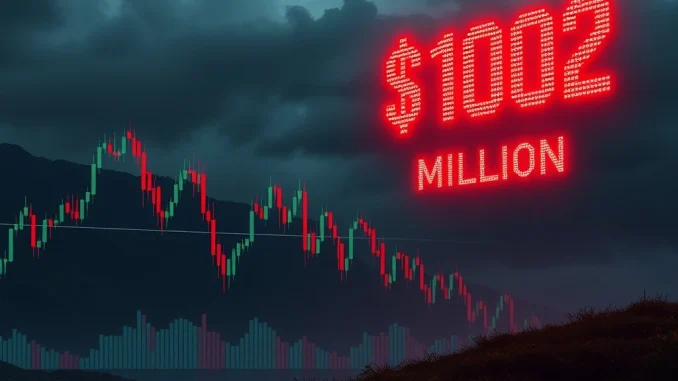
The cryptocurrency market just experienced a significant jolt. In a single hour, over $102 million in crypto futures were liquidated across major exchanges. This sudden event underscores the inherent volatility and rapid movements within the digital asset space. Furthermore, this immediate impact follows a broader trend. The past 24 hours witnessed a staggering $16.86 billion in crypto futures liquidations. Such figures demand attention. They signal heightened market activity and significant shifts in investor sentiment. Understanding these events is crucial for anyone participating in the volatile crypto ecosystem.
Understanding Urgent Crypto Liquidations
What exactly are crypto liquidations? Simply put, a liquidation occurs when an exchange forcibly closes a trader’s leveraged position. This happens because the trader’s margin, or collateral, falls below the minimum required level. The market moves against their prediction. Traders often use leverage to amplify potential gains. However, this also magnifies potential losses. When prices swing dramatically, these leveraged positions become vulnerable. Consequently, exchanges step in to prevent further losses for both the trader and the platform. This process can be swift and unforgiving.
The recent $102 million figure represents a substantial amount of capital wiped out in a very short period. This rapid closure of positions can create a cascading effect. It can push prices further in the direction of the initial movement. Such events are common in highly leveraged markets. They serve as a stark reminder of the risks involved. Furthermore, these liquidations clean out excessive leverage from the system. This sometimes leads to a healthier, albeit temporarily shaken, market structure.
The Mechanics of Crypto Futures Trading
To grasp liquidations fully, one must understand crypto futures trading. Futures contracts are agreements to buy or sell a specific cryptocurrency at a predetermined price on a future date. Traders use these contracts to speculate on future price movements. They can also use them to hedge existing spot positions. These derivatives allow participants to gain exposure to an asset without owning the underlying cryptocurrency itself.
Leveraged trading is a key component of the futures market. It allows traders to control a large position with a relatively small amount of capital. For instance, a 10x leverage means a trader can open a $10,000 position with just $1,000 of their own money. While this amplifies profits if the trade goes well, it equally amplifies losses. A small price movement against the trader’s position can quickly deplete their initial margin. This triggers a margin call. If the trader fails to add more funds, their position is liquidated. This prevents their balance from going negative.
Key aspects of futures trading include:
- Margin: The collateral required to open and maintain a leveraged position.
- Leverage: The ratio of borrowed funds to a trader’s own capital.
- Maintenance Margin: The minimum equity required to keep a position open.
- Liquidation Price: The price at which an exchange will automatically close a leveraged position.
These elements combine to create a dynamic, yet perilous, trading environment. Traders must manage their risk carefully. Otherwise, they face the harsh reality of liquidation.
Bitcoin Liquidations: A Key Market Indicator
While the $102 million figure refers to general crypto futures, a significant portion often comes from Bitcoin liquidations. Bitcoin, as the largest cryptocurrency by market capitalization, largely dictates the overall market sentiment and price movements. Therefore, substantial price swings in Bitcoin frequently trigger widespread liquidations across the broader crypto derivatives market. These liquidations often cascade, impacting altcoins as well.
Recent price action in Bitcoin likely played a central role in these massive liquidations. When Bitcoin experiences a sharp downturn, long positions (bets on price increases) are liquidated. Conversely, a sudden pump can liquidate short positions (bets on price decreases). The rapid movement in either direction can catch over-leveraged traders off guard. This leads to the forced closure of their positions. This cycle contributes to heightened volatility. It also provides insights into market sentiment. High liquidations often suggest that a significant number of traders were positioned incorrectly. This indicates a potential shift in market direction or a consolidation phase.
Analyzing the direction of liquidations offers further clues:
- Long Liquidations: Occur when prices drop rapidly, hitting positions betting on price increases.
- Short Liquidations: Occur when prices surge rapidly, hitting positions betting on price decreases.
The predominance of one type of liquidation can suggest whether the market was predominantly bullish or bearish leading up to the event. This helps traders understand the prevailing sentiment.
The Volatile Futures Market Landscape
The futures market for cryptocurrencies is notoriously volatile. It operates 24/7, reacting to global news, macroeconomic data, and technical analysis patterns. Unlike traditional markets, crypto markets lack circuit breakers. They do not have defined trading hours. This means price swings can be more extreme and sudden. These characteristics make the futures market an attractive, yet high-risk, arena for traders seeking amplified returns.
Several factors contribute to this extreme volatility:
- Decentralized Nature: The lack of a central authority means market reactions are often organic and swift.
- Retail Participation: A significant portion of crypto traders are retail investors. They often react emotionally to market movements.
- Whale Activity: Large holders, or ‘whales,’ can move markets with significant orders. This can trigger liquidations.
- Global Macro Factors: Interest rate changes, inflation data, and geopolitical events can impact crypto prices.
This dynamic environment requires traders to be exceptionally vigilant. They must adapt quickly to changing conditions. Otherwise, they risk substantial losses. The $102 million liquidation serves as a potent example of this market’s inherent unpredictability.
Implications of Massive Leveraged Trading Losses
The immediate consequence of these liquidations is financial loss for many individual and institutional traders. For those caught on the wrong side of the market, their capital is significantly reduced or entirely wiped out. Beyond individual losses, such large-scale liquidations have broader market implications. They can lead to a ‘ deleveraging’ event. This reduces the overall amount of borrowed capital in the system. This process, while painful, can be healthy in the long run. It removes excess speculation. It also sets the stage for more sustainable growth.
However, the short-term impact can be unsettling. High liquidation volumes often fuel fear and uncertainty. This leads to further selling pressure. It can also cause a ripple effect. Traders might close other positions to cover losses or reduce exposure. This contributes to a downward spiral. Nevertheless, these events also present opportunities for savvy investors. They can enter positions at lower prices. They can also capitalize on the market’s recovery.
The role of leveraged trading in these events cannot be overstated. While it offers the allure of quick riches, it is a double-edged sword. Its amplified nature means that even minor market fluctuations can have catastrophic outcomes for over-leveraged positions. The $102 million liquidation is a clear testament to this inherent risk. It highlights the importance of prudent risk management practices.
Navigating Market Turbulence: A Trader’s Perspective
In a market characterized by such dramatic swings, effective risk management becomes paramount. Traders must adopt strategies to protect their capital. Setting stop-loss orders is a fundamental practice. A stop-loss automatically closes a position when it reaches a predefined loss level. This prevents catastrophic drawdowns. It helps manage risk exposure.
Diversification is another key strategy. Spreading investments across different assets reduces reliance on a single cryptocurrency. Understanding market indicators and technical analysis can also provide an edge. These tools help traders identify potential support and resistance levels. They also signal trend reversals. Furthermore, avoiding over-leveraging is crucial. While high leverage can be tempting, it dramatically increases the risk of liquidation. Traders should only use leverage they fully understand. They must also be prepared for its consequences.
Key strategies for traders:
- Set Stop-Loss Orders: Limit potential losses automatically.
- Manage Position Size: Do not risk more than a small percentage of your total capital on any single trade.
- Avoid Over-Leveraging: Use conservative leverage ratios, especially during volatile periods.
- Stay Informed: Monitor market news, technical indicators, and macroeconomic developments.
- Develop a Trading Plan: Define entry and exit points, risk tolerance, and profit targets before trading.
Ultimately, discipline and a well-thought-out strategy are essential. They help navigate the turbulent waters of the futures market. Learning from past liquidations can inform future trading decisions. This fosters resilience in a dynamic environment.
The recent crypto liquidations, particularly the $102 million wipeout in an hour, serve as a potent reminder of the cryptocurrency market’s inherent risks and opportunities. While such events can be unsettling, they are a natural part of a maturing futures market. They highlight the significant impact of leveraged trading and the importance of prudent risk management. As the market continues to evolve, understanding these dynamics will remain crucial for all participants. Vigilance, informed decision-making, and a robust risk strategy are the cornerstones of successful engagement in this exciting, yet challenging, financial frontier.
Frequently Asked Questions (FAQs)
1. What are crypto futures liquidations?
Crypto futures liquidations occur when an exchange automatically closes a trader’s leveraged position. This happens because their margin, or collateral, falls below the required maintenance level. The market has moved unfavorably against their trade, and they lack sufficient funds to cover potential losses.
2. Why did $102 million in futures get liquidated so quickly?
A $102 million liquidation in an hour suggests a rapid and significant price movement in the underlying cryptocurrencies. Over-leveraged positions, betting on the opposite direction, were quickly hit. This caused exchanges to forcibly close them to prevent further losses. Such events often stem from sudden market news or large institutional trades.
3. How does leveraged trading contribute to liquidations?
Leveraged trading allows traders to control large positions with a small amount of capital. While this amplifies potential profits, it also magnifies losses. A small price swing can quickly deplete a trader’s margin, leading to a margin call. If the trader cannot add more funds, their position is liquidated. This makes leveraged trading a high-risk activity.
4. What is the significance of Bitcoin liquidations in the broader market?
Bitcoin liquidations are often a key indicator for the entire crypto market. As the largest cryptocurrency, Bitcoin’s price movements significantly influence other digital assets. Large Bitcoin liquidations can trigger a domino effect across the market. This creates broader volatility and often leads to liquidations in altcoin futures as well. They signal a cleansing of excess leverage.
5. How can traders protect themselves from crypto liquidations?
Traders can protect themselves by employing robust risk management strategies. These include setting stop-loss orders to limit potential losses, using conservative leverage ratios, and managing position sizes carefully. Diversifying portfolios and staying informed about market conditions also help mitigate risks associated with sudden price movements.
6. Is the crypto futures market always this volatile?
The crypto futures market is known for its high volatility compared to traditional financial markets. It operates 24/7 and is influenced by a multitude of factors, including global news, macroeconomic trends, and large trader activities. While not every hour sees $102 million in liquidations, significant price swings and subsequent liquidations are common occurrences in this dynamic market.