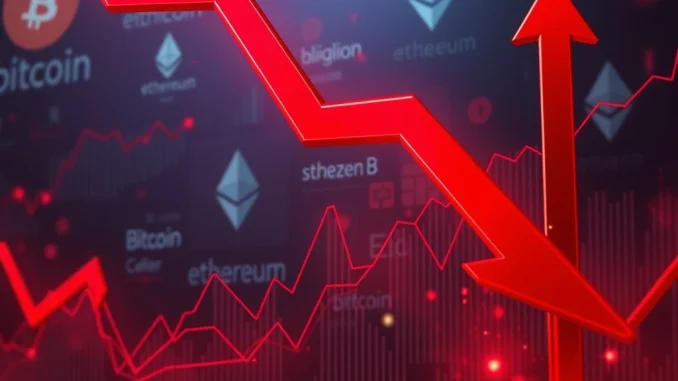
A staggering **crypto futures liquidation** event recently sent shockwaves through the digital asset landscape. In a single hour, major exchanges witnessed the forced closure of positions totaling an astonishing $7,136 million. This sudden market movement underscores the inherent risks and rapid shifts within cryptocurrency trading. Over the past 24 hours, the total liquidations reached $8,514 million. This article delves into the mechanics of this significant event and its broader implications for the **crypto market volatility** and participants.
Unpacking the Massive Crypto Futures Liquidation Event
The recent **crypto futures liquidation** was monumental. Over $7.1 billion in futures contracts vanished within just 60 minutes. This rapid unwinding of positions primarily affected traders using high leverage. When prices move sharply against their bets, these positions are automatically closed. Consequently, traders lose their collateral. This mechanism protects exchanges from incurring losses.
Such large-scale liquidations are not uncommon in volatile markets. However, the sheer speed and volume of this particular event stand out. It highlights the delicate balance of supply and demand in the crypto space. Moreover, it demonstrates how quickly sentiment can shift. The immediate impact was a further acceleration of price movements. This often leads to a cascading effect across the market.
The Mechanics of Leveraged Trading and Liquidations
Understanding **leveraged trading** is crucial for grasping liquidation events. Traders borrow funds to amplify their potential returns. For instance, a 10x leverage means a $1,000 investment controls $10,000 worth of assets. While this can magnify profits, it also significantly increases risk. A small price drop can wipe out a trader’s entire collateral.
Exchanges employ a ‘margin call’ system. If a trader’s position moves unfavorably, their margin (collateral) falls below a certain threshold. At this point, the exchange automatically liquidates the position. This prevents the trader from owing more than their initial margin. Furthermore, it protects the exchange from bad debt. These forced sales can add selling pressure to the market. Therefore, they often exacerbate price declines. This creates a feedback loop of more liquidations.
Bitcoin Futures and the Broader Derivatives Market Impact
While the liquidation figures encompass various cryptocurrencies, **Bitcoin futures** typically account for a significant portion. As the largest cryptocurrency by market capitalization, Bitcoin’s price movements heavily influence the entire **derivatives market**. A sharp drop in Bitcoin’s price often triggers liquidations across altcoin futures as well. This happens because many altcoin pairs are traded against Bitcoin. Furthermore, market sentiment around Bitcoin impacts the broader crypto ecosystem.
The **derivatives market** in crypto includes futures, options, and perpetual swaps. These instruments allow traders to speculate on future price movements without owning the underlying asset. They are popular for hedging and speculation. However, they introduce additional layers of complexity and risk. The massive liquidations demonstrate the interconnectedness of these markets. A shock in one area can quickly ripple through others.
Navigating Extreme Crypto Market Volatility
Events like this highlight the extreme **crypto market volatility**. Several factors contribute to these sharp price swings. Macroeconomic news, such as inflation data or interest rate changes, can significantly impact investor risk appetite. Regulatory developments, positive or negative, also play a major role. Moreover, large institutional trades, often called ‘whale’ movements, can trigger substantial price shifts. These factors combine to create an environment where prices can change dramatically in minutes.
For traders, managing volatility is key. Implementing robust risk management strategies becomes paramount. Without them, even experienced traders can face substantial losses. Understanding market sentiment and technical indicators helps. However, no strategy completely eliminates risk in such dynamic conditions.
Strategies for Mitigating Leveraged Trading Risks
Responsible **leveraged trading** demands discipline and careful planning. Traders must recognize the amplified risks involved. Here are some key strategies to mitigate potential losses:
- Start Small: Begin with lower leverage multiples. This allows traders to gain experience without excessive exposure.
- Implement Stop-Loss Orders: These orders automatically close a position if the price reaches a predetermined level. This limits potential losses.
- Manage Position Sizing: Never allocate too much capital to a single trade. Diversification can also help spread risk.
- Monitor Margin Levels: Continuously track your margin balance. Add collateral if necessary to avoid forced liquidation.
- Stay Informed: Keep abreast of market news and economic indicators. These can provide early warnings of potential volatility.
Exchanges also play a role in risk mitigation. They often implement circuit breakers during extreme volatility. These temporarily halt trading. This allows the market to stabilize. Furthermore, robust risk engines ensure timely liquidation. This prevents cascading defaults across the platform.
The Future of the Crypto Derivatives Market
The frequent occurrence of large-scale liquidations will likely shape the future of the **derivatives market**. Regulators globally are increasing their scrutiny of crypto exchanges. They aim to protect retail investors from excessive risk. We might see stricter rules on available leverage. Additionally, enhanced transparency requirements for trading platforms could emerge. This could lead to a more mature yet potentially less accessible market.
Innovation in risk management tools will also continue. Decentralized finance (DeFi) derivatives platforms are exploring new ways to manage collateral and liquidations. These could offer alternative models. Ultimately, the market seeks a balance. It wants to provide opportunities for sophisticated traders while safeguarding against systemic risks. The recent liquidation serves as a powerful reminder of this ongoing challenge.
Conclusion
The $7.1 billion **crypto futures liquidation** event was a stark demonstration of the power and peril within the cryptocurrency markets. It highlighted the amplified risks associated with **leveraged trading** and the significant impact of **crypto market volatility**. While **Bitcoin futures** and the broader **derivatives market** offer substantial opportunities, they demand a high degree of caution and expertise. As the crypto ecosystem evolves, both traders and platforms must prioritize robust risk management to navigate these unpredictable waters successfully.
Frequently Asked Questions (FAQs)
What is crypto futures liquidation?
Crypto futures liquidation is the forced closure of a trader’s leveraged position by an exchange. This occurs when the market moves against the trader’s bet, and their collateral (margin) falls below a required level. It prevents further losses for the trader and the exchange.
Why do large crypto futures liquidations happen?
Large liquidations typically happen during periods of high **crypto market volatility**. Sharp price movements, often triggered by significant news, macroeconomic events, or large trades, can rapidly deplete traders’ margins. This forces exchanges to close numerous leveraged positions simultaneously, creating a cascading effect.
How does leveraged trading contribute to liquidations?
**Leveraged trading** allows traders to control large positions with a small amount of capital. While this amplifies potential profits, it also magnifies losses. A small percentage move against a highly leveraged position can quickly lead to a margin call and subsequent liquidation.
Which cryptocurrencies are most affected by futures liquidations?
**Bitcoin futures** often account for the largest share of liquidations due to Bitcoin’s market dominance and liquidity. However, futures contracts for other major cryptocurrencies like Ethereum (ETH) and various altcoins are also significantly affected, especially during broad market downturns.
How can traders protect themselves from liquidation?
Traders can protect themselves by using lower leverage, setting stop-loss orders, managing their position sizes, and consistently monitoring their margin levels. Staying informed about market news and adopting a disciplined approach to **leveraged trading** are also crucial.