The ever-volatile cryptocurrency market constantly presents new challenges and opportunities. Understanding its underlying mood is crucial for investors. The Crypto Fear & Greed Index offers a vital snapshot of this collective psychological state. Recently, the index experienced a notable dip, falling six points from its previous position. Despite this shift, it firmly remains within the ‘greed’ territory, indicating prevailing optimism among participants in the cryptocurrency market.
Understanding the Crypto Fear & Greed Index
The Crypto Fear & Greed Index serves as a critical barometer for measuring overall market sentiment. Developed by Alternative.me, it aggregates various data points into a single, easy-to-understand score. This score ranges from 0 to 100. A reading of 0 signifies ‘extreme fear,’ suggesting investors are overly cautious or panicking. Conversely, a score of 100 indicates ‘extreme greed,’ implying that the market is overheating with excessive optimism and potential overvaluations. The index helps traders and investors gauge whether the market is due for a correction or a further rally.
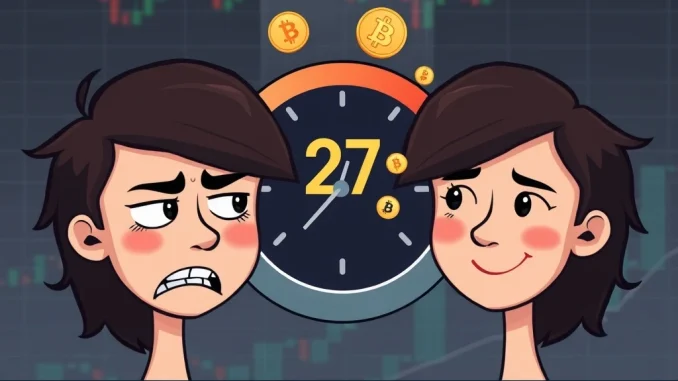
The index’s recent fall to 64, from an earlier 70, illustrates a slight cooling of this intense optimism. However, a score of 64 still places it squarely in the ‘greed’ zone. This suggests that while some exuberance might have subsided, a strong positive outlook persists. Savvy investors often use this index as a contrarian indicator. Extreme fear can signal a buying opportunity, whereas extreme greed might suggest it is time to exercise caution or even take profits.
Key Components Driving Market Sentiment
The Crypto Fear & Greed Index is not a simple measure. It compiles data from six distinct factors, each weighted differently, to provide a comprehensive view of investor sentiment. These components offer unique insights into market behavior and help paint a complete picture of the current mood.
- Volatility (25%): This component measures the current volatility and maximum drawdowns of Bitcoin compared to its average values over 30 and 90 days. High volatility often signals a fearful or uncertain market.
- Market Volume (25%): High trading volumes in a rising market usually indicate strong interest and bullish sentiment. Conversely, low volumes during price surges can suggest a lack of conviction.
- Social Media Mentions (15%): This factor analyzes the number and sentiment of cryptocurrency-related hashtags and mentions across various social media platforms. Increased discussion often correlates with heightened market activity.
- Surveys (15%): Though currently paused, surveys historically gathered opinions directly from crypto investors, providing a direct pulse of their expectations.
- Bitcoin’s Dominance (10%): An increasing Bitcoin dominance often indicates a shift from altcoins back into Bitcoin, a sign of fear or uncertainty in the broader altcoin market. A decreasing dominance can suggest higher risk appetite.
- Google Search Volume (10%): Tracking search queries related to Bitcoin and other cryptocurrencies reveals public interest. A surge in ‘Bitcoin price manipulation’ searches, for example, could indicate growing fear.
Each of these elements contributes to the overall score, providing a nuanced understanding of market dynamics. Therefore, changes in any one factor can influence the index’s direction, offering valuable clues to potential market shifts.
The Significance of Bitcoin Dominance in Market Sentiment
Bitcoin dominance plays a crucial role within the Crypto Fear & Greed Index, weighted at 10%. This metric represents Bitcoin’s market capitalization as a percentage of the total cryptocurrency market capitalization. Its movements often reflect broader market sentiment. When Bitcoin dominance rises, it frequently suggests that investors are moving their capital from riskier altcoins into Bitcoin, which is perceived as a safer asset in the crypto space. This flight to safety is typically a sign of fear or uncertainty regarding the stability of the broader altcoin market.
Conversely, a decrease in Bitcoin dominance often signals an increased appetite for risk. Investors might be rotating capital into altcoins, hoping for higher returns. This indicates a more optimistic and ‘greedy’ market environment. Therefore, monitoring Bitcoin dominance provides an indirect yet powerful insight into how comfortable investors are with risk, directly impacting the overall fear and greed assessment.
What Does ‘Greed Territory’ Mean for Investors?
The index currently sits at 64, placing it firmly in ‘greed territory.’ This implies that market participants are generally optimistic about future price movements. Investors are eager to buy, and a positive sentiment pervades the market. While this can be a sign of a healthy, upward-trending market, it also carries inherent risks. High levels of greed can lead to speculative bubbles and overvalued assets. Prices may become detached from fundamental value, driven instead by emotional buying.
For cautious investors, a sustained period in ‘greed’ can be a signal to review portfolios and consider taking some profits. It might also suggest a heightened risk of a market correction. However, for those with a higher risk tolerance, it could be an opportunity to ride the wave of optimism, albeit with increased vigilance. Understanding this psychological state helps in making informed decisions rather than being swept away by collective emotion.
Navigating Future Cryptocurrency Market Trends
The continuous fluctuation of the Crypto Fear & Greed Index provides a real-time reflection of the cryptocurrency market‘s pulse. While a single drop of six points may not drastically alter the long-term outlook, it serves as a reminder of the market’s dynamic nature. Investors should use the index as one tool among many, integrating it with fundamental and technical analysis. This holistic approach ensures more robust decision-making.
Looking ahead, continued monitoring of the index and its underlying components will be essential. Significant shifts towards ‘extreme fear’ or ‘extreme greed’ could signal pivotal moments for market entry or exit. As the market matures, tools like the Fear & Greed Index become increasingly valuable for discerning underlying trends and managing risk effectively.
FAQs About the Crypto Fear & Greed Index
Q1: What is the Crypto Fear & Greed Index?
A1: The Crypto Fear & Greed Index is a tool that measures the current sentiment of the cryptocurrency market. It ranges from 0 (extreme fear) to 100 (extreme greed), indicating whether investors are cautious or optimistic.
Q2: How is the Crypto Fear & Greed Index calculated?
A2: It is calculated using a weighted average of six factors: volatility (25%), trading volume (25%), social media mentions (15%), surveys (15%), Bitcoin’s dominance (10%), and Google search volume (10%).
Q3: What does it mean if the index is in ‘greed territory’?
A3: ‘Greed territory’ (typically above 50) means investors are generally optimistic and eager to buy. While this can signal a strong market, it also suggests potential overvaluation and a higher risk of correction.
Q4: How does Bitcoin’s dominance affect the index?
A4: Bitcoin’s dominance (its market cap percentage of the total crypto market) is a component of the index. Rising dominance can indicate a flight to safety (fear), while falling dominance often suggests increased risk appetite for altcoins (greed).
Q5: Should I base my investment decisions solely on the Crypto Fear & Greed Index?
A5: No. The index is a valuable sentiment indicator, but it should be used in conjunction with other analytical tools, such as fundamental analysis, technical analysis, and thorough research, to make informed investment decisions.