The financial world is buzzing with anticipation. Investors and economists alike are closely watching signals from the Federal Reserve. Recent statements by New York Fed President John Williams have ignited discussions. He has hinted at potential interest rate cuts later this year. This move would address growing concerns about the U.S. economy.
New York Fed President Signals Policy Shift
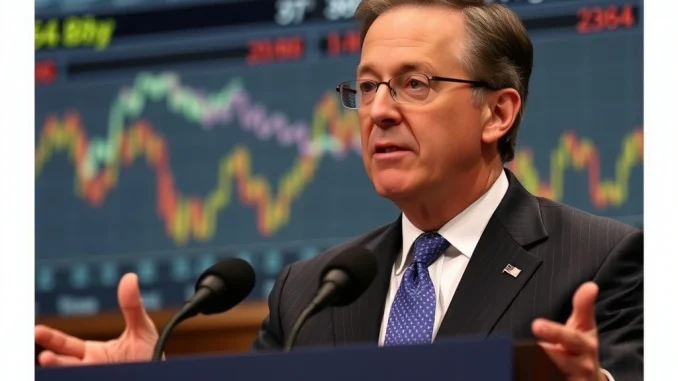
New York Fed President John Williams recently provided key insights into the central bank’s future plans. Walter Bloomberg reported Williams’ comments. He indicated a readiness to support additional rate reductions. This stance stems from observed shifts in economic data. Therefore, markets are now recalibrating expectations. Williams’ remarks carry significant weight. He is a prominent voice within the Federal Open Market Committee (FOMC).
Moreover, the Federal Reserve uses interest rates to manage economic growth. Lower rates typically stimulate borrowing and spending. Conversely, higher rates can cool an overheating economy. Williams’ comments suggest a proactive approach. The Fed aims to prevent a deeper downturn. This strategy prioritizes economic stability. Consequently, businesses and consumers may soon see changes.
Understanding the Rationale Behind Potential Interest Rate Cuts
Williams specifically cited concerns about a slowing labor market. This factor is crucial in the Fed’s decision-making process. A robust job market signifies economic health. However, recent indicators suggest a deceleration. For example, job growth might be weakening. Unemployment claims could be rising. These trends warrant careful consideration. Thus, the Fed aims to bolster employment. Lowering rates makes it cheaper for businesses to expand. This expansion can lead to more hiring. It helps maintain economic momentum. Therefore, these potential interest rate cuts are a direct response to evolving economic conditions.
- Economic Data: The Fed monitors various data points. These include inflation, GDP growth, and employment figures.
- Forward-Looking Stance: Central bankers often act pre-emptively. They try to mitigate future economic risks.
- Dual Mandate: The Federal Reserve has a dual mandate. It aims for maximum employment and stable prices.
John Williams’ Perspective on Economic Slowdown
John Williams, a respected figure in central banking, emphasized the need for vigilance. He articulated the risks associated with an economic slowdown. His view suggests that waiting too long could exacerbate issues. A weakening job market can quickly impact consumer confidence. This confidence drives spending. A decline in spending can ripple through the entire economy. Consequently, early intervention might prevent more severe problems. His comments underscore the Fed’s commitment. They are dedicated to supporting sustained growth. Ultimately, this approach seeks to ensure long-term prosperity.
Furthermore, global economic uncertainties also play a role. International trade tensions and geopolitical events can affect the U.S. economy. The Fed considers these external factors. They influence domestic economic conditions. Therefore, a flexible monetary policy is essential. It allows the central bank to adapt. This adaptability is key in navigating complex financial landscapes. Williams’ perspective highlights this need for agility.
The Impact on the Labor Market
The labor market remains a central focus for the Federal Reserve. A slowdown here could have broad implications. Businesses might reduce hiring. Some could even implement layoffs. Such actions directly affect household incomes. Reduced incomes then lead to lower consumer spending. This creates a negative feedback loop. Williams’ concern reflects this potential cycle. He believes proactive measures are necessary. These measures protect job growth. They also safeguard economic stability. Therefore, monitoring employment statistics is paramount for the Fed.
Recent data points suggest a cooling trend. For instance, the pace of job creation has moderated. Wage growth might also be slowing. These are early warning signs. They indicate a potential shift. The Fed aims to address these issues promptly. They want to ensure the labor market remains resilient. Ultimately, a strong job market benefits everyone. It underpins overall economic health. Hence, Williams’ advocacy for rate cuts is a strategic response.
Broader Implications of Potential Rate Cuts
The prospect of additional interest rate cuts has wide-ranging implications. For consumers, borrowing costs could decrease. This applies to mortgages, car loans, and credit cards. Businesses might find it cheaper to invest. This could spur expansion and innovation. Conversely, savers might see lower returns on deposits. Therefore, different segments of the economy will experience varied effects. These policy adjustments are designed to rebalance economic forces.
Moreover, an economic slowdown impacts global markets. Lower U.S. rates can affect currency valuations. They also influence international capital flows. Emerging markets often react to Fed policy changes. Consequently, global investors pay close attention. The Fed’s decisions resonate far beyond U.S. borders. This interconnectedness highlights the importance of transparent communication. Williams’ hints provide that transparency. They allow markets to prepare. This preparation can reduce volatility. Ultimately, the goal is a smoother economic transition.
What to Watch Next
Moving forward, market participants will closely watch upcoming economic reports. These include inflation data, GDP figures, and further labor market statistics. Statements from other Fed officials will also be scrutinized. These will offer additional clues about the Fed’s consensus. The next FOMC meeting will be particularly important. It will provide a clearer picture of the path ahead. The collective sentiment of the committee shapes policy. Therefore, every word from central bankers matters. Investors should remain informed and adaptable.
In conclusion, New York Fed President John Williams has signaled a potential shift. He sees the need for further interest rate cuts. This is a direct response to a slowing labor market and broader concerns about an economic slowdown. His comments underscore the Federal Reserve’s commitment. They are dedicated to maintaining economic stability. These potential policy adjustments could impact various sectors. Everyone should monitor future developments. The Fed’s actions will shape the economic landscape in the coming months.
Frequently Asked Questions (FAQs)
Q1: Who is John Williams and what is his role?
A1: John Williams is the President of the Federal Reserve Bank of New York. He is a key member of the Federal Open Market Committee (FOMC). This committee sets U.S. monetary policy. His views are influential in determining interest rate decisions.
Q2: Why is the Federal Reserve considering interest rate cuts?
A2: The Federal Reserve considers interest rate cuts primarily to stimulate economic growth. This is especially true when there are concerns about a slowing economy or a weakening labor market. Lower rates make borrowing cheaper, encouraging spending and investment.
Q3: How does a slowing labor market affect the economy?
A3: A slowing labor market means fewer jobs are being created, or unemployment is rising. This can lead to reduced consumer spending, lower wages, and a general decline in economic activity. The Fed aims to prevent this negative cycle through policy adjustments.
Q4: What are the potential impacts of interest rate cuts on consumers?
A4: For consumers, interest rate cuts can mean lower borrowing costs for loans like mortgages, auto loans, and credit cards. However, they may also lead to lower returns on savings accounts and certificates of deposit (CDs).
Q5: How do interest rate cuts affect cryptocurrency markets?
A5: While not directly tied, lower interest rates can make traditional investments like bonds less attractive. This might encourage investors to seek higher returns in alternative assets, including cryptocurrencies. However, crypto markets are also influenced by their own unique dynamics and broader economic sentiment.
Q6: What is an economic slowdown?
A6: An economic slowdown refers to a period where the rate of economic growth decreases. It’s not necessarily a recession, but it indicates a deceleration in key economic indicators like GDP, employment, and industrial production. Central banks often respond to prevent it from worsening.