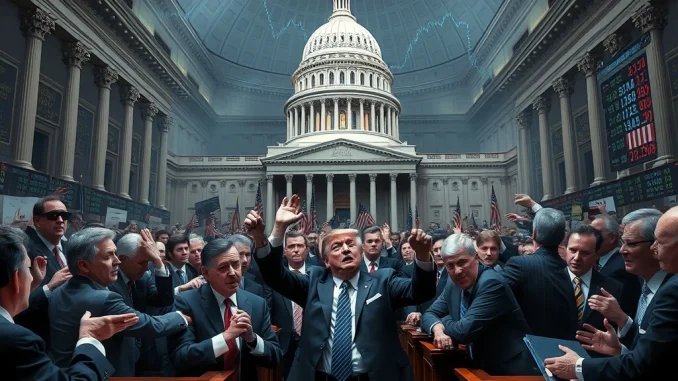
The political landscape in Washington D.C. remains fraught. Recently, the U.S. Senate rejected critical budget proposals from both major parties. This action ensures the **US government shutdown** will continue indefinitely. For investors, particularly those in the volatile **cryptocurrency market**, this prolonged impasse introduces a significant layer of **economic uncertainty**. Understanding the implications of this **fiscal policy failure** is vital for navigating the current financial climate.
Understanding the Continued US Government Shutdown
The U.S. Senate, led by Republicans, recently failed to pass two competing budget proposals. This crucial development means federal operations face further disruption. A Democratic-backed appropriations bill did not secure enough votes, failing 45-50. Similarly, a separate temporary spending bill proposed by Republicans also fell short of the required support. Consequently, essential government services will remain unfunded, impacting various sectors across the nation.
A government shutdown occurs when Congress fails to pass appropriation bills or continuing resolutions before the start of a new fiscal year. This scenario leads to a lapse in funding for non-essential government agencies and services. Many federal employees are furloughed, and numerous government functions cease. Historically, such events create ripples throughout the economy, affecting everything from public services to market sentiment. This current **US government shutdown** highlights deep divisions in Washington.
The Senate Budget Impasse and Its Immediate Consequences
The failure of both budget bills underscores a profound **Senate budget impasse**. Lawmakers on both sides of the aisle could not find common ground. This political gridlock directly causes the ongoing shutdown. Without a spending agreement, agencies cannot operate normally. Therefore, federal parks close, passport applications face delays, and some regulatory bodies halt their functions. This situation creates immediate inconvenience for citizens and businesses alike.
The votes reveal the entrenched positions of each party. Democrats sought a comprehensive spending package, while Republicans aimed for a short-term solution. Neither approach gained sufficient bipartisan backing. As a result, the stalemate persists. This lack of consensus raises questions about future legislative cooperation and the government’s ability to address pressing national issues. The extended **Senate budget impasse** signals deeper challenges.
Economic Uncertainty and Market Reactions
A prolonged **US government shutdown** invariably fuels **economic uncertainty**. Businesses and consumers become hesitant. This caution can slow down economic activity. Furthermore, federal contractors face payment delays, which can impact their operations and workforce. Analysts often track consumer confidence indicators closely during these periods. A decline in confidence can translate into reduced spending, further stifling economic growth.
Financial markets typically react to such instability. Stock markets may experience increased volatility as investors weigh the risks. The U.S. dollar’s value can fluctuate, reflecting global perceptions of America’s economic stability. Bond yields might also see movements, as investors seek safe havens or react to potential shifts in monetary policy. This environment of **economic uncertainty** prompts many to reconsider their investment strategies.
Key economic impacts often include:
- Reduced GDP growth due to halted federal spending.
- Delayed economic data releases, obscuring the true state of the economy.
- Impact on small businesses reliant on federal contracts.
- Decreased consumer and business confidence.
The Cryptocurrency Market and Fiscal Policy Failure
The **cryptocurrency market** often reacts uniquely to traditional financial instability. Some investors view digital assets, particularly Bitcoin, as a hedge against conventional economic turmoil. When governments face a **fiscal policy failure**, such as a budget impasse leading to a shutdown, the appeal of decentralized assets can grow. Bitcoin’s fixed supply and independence from central bank control may seem attractive during periods of fiat currency uncertainty.
However, the relationship is complex. A broader risk-off sentiment in global markets could also drag down cryptocurrencies. If investors become extremely risk-averse, they might sell off all volatile assets, including digital currencies. Therefore, while some see crypto as a safe haven, others view it as another high-risk asset. Monitoring market sentiment becomes crucial during these times. The **cryptocurrency market** shows diverse reactions.
Potential impacts on the crypto space:
- Increased interest in Bitcoin as a store of value.
- Heightened volatility across altcoins.
- Potential delays in crypto-related regulatory clarity from government agencies.
- A narrative shift towards decentralized finance as an alternative.
Navigating the Ongoing Political Deadlock
The current **political deadlock** in the Senate means there is no immediate end in sight for the **US government shutdown**. Both parties must eventually negotiate a compromise. This process can involve intense discussions and concessions. Public pressure often plays a significant role in breaking such stalemates. Citizens directly affected by service disruptions may demand swift action from their representatives. Consequently, lawmakers face increasing pressure to resolve the situation.
Future negotiations will likely involve:
- Discussions on spending levels for various federal programs.
- Debates over specific policy riders attached to appropriations bills.
- Potential short-term continuing resolutions to buy more time for a long-term deal.
The duration of the shutdown directly correlates with the severity of its economic and social impact. Investors and citizens alike will closely watch developments from Capitol Hill. A quick resolution could limit damage, but a prolonged impasse carries greater risks for the economy and the **cryptocurrency market**.
The rejection of budget bills in the U.S. Senate ensures the **US government shutdown** will continue, casting a long shadow of **economic uncertainty**. This **fiscal policy failure** creates ripple effects across traditional financial markets and presents unique considerations for the **cryptocurrency market**. While some view digital assets as a hedge against such instability, others anticipate broader market downturns. The ongoing **Senate budget impasse** demands close attention from all stakeholders. Its resolution will undoubtedly shape the economic narrative for the foreseeable future.
Frequently Asked Questions (FAQs)
1. What is a US government shutdown?
A US government shutdown occurs when Congress fails to pass legislation funding government operations. This means non-essential federal agencies close, and many federal employees are furloughed. Essential services typically continue, but with reduced staff.
2. How long can a government shutdown last?
The duration of a government shutdown varies greatly. It can last from a few days to several weeks, depending on how quickly lawmakers can reach a budget agreement. The longest shutdown in US history lasted 35 days.
3. What services are typically affected during a shutdown?
Services deemed non-essential are usually affected. This includes national parks, certain administrative offices, processing of permits and loans, and some regulatory functions. Essential services like national security, emergency services, and air traffic control generally continue.
4. How might a government shutdown impact my investments?
A shutdown can introduce **economic uncertainty**, potentially leading to increased volatility in stock markets and fluctuations in the dollar’s value. Investors might become more risk-averse. The **cryptocurrency market** could also react, either seeing increased interest as a hedge or experiencing declines due to broad risk-off sentiment.
5. Is the cryptocurrency market truly a hedge against a government shutdown?
The idea of the **cryptocurrency market** as a hedge is debated. Some argue Bitcoin’s decentralized nature makes it attractive during traditional financial instability. However, others contend that crypto assets are still highly correlated with broader market sentiment and can suffer during widespread economic downturns. Its role as a hedge is not universally accepted.
6. What are the potential resolutions for the current Senate budget impasse?
Resolutions typically involve further negotiations between the Democratic and Republican parties. They might agree on a short-term continuing resolution to temporarily fund the government, allowing more time for a long-term budget deal. A comprehensive spending bill that satisfies both sides is the ultimate goal, but it requires significant compromise.