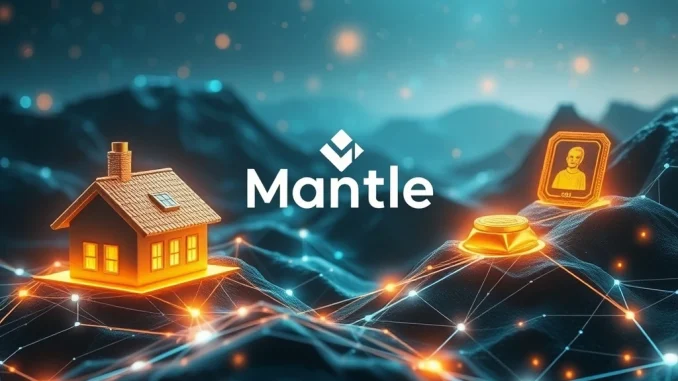
The blockchain world recently witnessed a significant advancement. Mantle Network officially launched its groundbreaking service. This new platform specifically targets the tokenization of real-world assets (RWAs). The move marks a crucial step forward for the integration of traditional finance with decentralized technology. Mantle RWA tokenization promises to unlock new opportunities for investors and asset holders globally.
Mantle RWA Tokenization: A New Era for Real-World Assets
Mantle has introduced a comprehensive Tokenization-as-a-Service platform. This innovative service facilitates the issuance of real-world assets on its network. CoinDesk confirmed this important development. This platform allows various tangible and intangible assets to convert into digital tokens. Examples include real estate, fine art, commodities, and even intellectual property. Essentially, tokenization transforms ownership rights into programmable digital tokens on a blockchain. This process offers numerous advantages, making assets more liquid and accessible.
Furthermore, the platform provides a streamlined approach for businesses. They can now easily tokenize their assets. This reduces the complexities typically associated with traditional asset management. Mantle aims to democratize access to these valuable assets. Historically, many of these assets remained exclusive to institutional investors. Now, a broader audience can participate.
Understanding Mantle Network’s Vision for Digital Assets
Mantle Network operates as a high-performance Layer 2 scaling solution for Ethereum. It utilizes optimistic rollups to enhance transaction speed and reduce costs. The network’s architecture supports robust decentralized applications (dApps) and various blockchain services. Its core vision involves fostering a more interconnected and efficient digital economy. The launch of the RWA tokenization service aligns perfectly with this objective. It demonstrates Mantle’s commitment to bridging the gap between traditional finance and the crypto space. The network’s infrastructure provides a secure and scalable environment for these new digital assets.
The strategic focus on real-world assets highlights a growing trend in the blockchain industry. Projects are increasingly exploring ways to bring tangible value onto the blockchain. This enhances utility beyond purely digital assets. Mantle positions itself at the forefront of this evolution. It offers essential tools for mass adoption.
The Power of Tokenization as a Service
Tokenization as a Service (TaaS) represents a significant innovation. It simplifies the entire process of creating and managing digital representations of assets. Mantle’s TaaS platform offers a suite of tools. These tools cover everything from legal compliance to technical execution. Consequently, businesses can focus on their core operations. They do not need to build complex blockchain infrastructure from scratch. This approach lowers the barrier to entry for many traditional enterprises.
- Streamlined Process: Mantle provides pre-built templates and smart contracts. These accelerate asset tokenization.
- Enhanced Liquidity: Tokenized assets can be traded 24/7 on global markets. This improves liquidity compared to traditional markets.
- Fractional Ownership: Assets can be divided into smaller, affordable units. This makes high-value assets accessible to more investors.
- Increased Transparency: Blockchain records all transactions. This offers an immutable and transparent ownership history.
This service also ensures regulatory compliance. Mantle works with legal experts to navigate the complex landscape of asset regulations. Therefore, users can trust the legitimacy and security of the tokenized assets. The platform prioritizes both innovation and regulatory adherence.
The Arrival of USD1 Stablecoin on Mantle Network
In related news, the World Liberty Financial stablecoin, USD1, is also preparing for its launch. It will debut on the Mantle Network. The introduction of USD1 stablecoin holds significant implications. Stablecoins are crucial for facilitating transactions within the RWA ecosystem. They provide price stability, which is essential for trading and settlement. USD1 will offer a reliable medium of exchange. This reduces volatility often associated with other cryptocurrencies. It creates a more predictable environment for RWA transactions.
The presence of a robust stablecoin directly enhances the utility of Mantle’s RWA tokenization service. Users can seamlessly convert between tokenized assets and a stable digital currency. This fosters greater confidence and usability within the network. USD1 aims to become a cornerstone of Mantle’s growing financial ecosystem. Its stability supports a wide range of decentralized financial activities.
Driving Innovation with Real-World Assets on Blockchain
The convergence of real-world assets and blockchain technology is reshaping global finance. Mantle’s initiatives contribute significantly to this paradigm shift. By making RWA tokenization more accessible, Mantle helps unlock trillions of dollars in illiquid assets. This creates new avenues for capital formation and investment. The long-term impact could be transformative. It promises a more inclusive and efficient financial system for everyone. Furthermore, Mantle’s focus on enterprise-grade solutions suggests a strong commitment to institutional adoption. This could pave the way for major financial players to enter the blockchain space.
Ultimately, Mantle Network is not just launching a service; it is building a future. This future envisions a world where assets are fluid, transparent, and globally accessible. The combination of its robust Layer 2 solution, TaaS platform, and a dedicated stablecoin positions Mantle as a key player. It drives the next wave of blockchain innovation. Mantle continues to push boundaries, demonstrating the immense potential of decentralized technologies to revolutionize traditional markets.
Mantle Network’s launch of its RWA tokenization service marks a pivotal moment. It signifies a concrete step towards integrating real-world assets with blockchain technology. This new platform, coupled with the upcoming USD1 stablecoin, establishes Mantle as a frontrunner. It aims to create a more liquid, transparent, and accessible financial future. The journey of tokenizing the world has just gained significant momentum on the Mantle Network.
Frequently Asked Questions (FAQs)
Q1: What is Mantle’s RWA tokenization service?
A1: Mantle’s RWA tokenization service is a Tokenization-as-a-Service platform. It allows businesses and individuals to convert real-world assets (like real estate, art, or commodities) into digital tokens on the Mantle Network. This process makes assets more liquid, divisible, and tradable on the blockchain.
Q2: What are Real-World Assets (RWAs)?
A2: Real-World Assets (RWAs) are tangible or intangible assets that exist outside the blockchain. Examples include physical property, commodities, intellectual property, and even financial instruments like bonds. Tokenization brings these assets onto a blockchain, representing their ownership digitally.
Q3: How does Tokenization as a Service benefit users?
A3: Tokenization as a Service (TaaS) simplifies the complex process of asset tokenization. It provides ready-made tools, smart contracts, and often legal frameworks. This allows businesses to tokenize assets efficiently without needing extensive blockchain expertise, lowering costs and accelerating adoption.
Q4: What is the significance of the USD1 stablecoin launching on Mantle Network?
A4: The launch of the USD1 stablecoin on Mantle Network is crucial. Stablecoins provide price stability, which is essential for conducting transactions involving tokenized real-world assets. USD1 will serve as a reliable medium of exchange, facilitating smoother trading and settlement within Mantle’s RWA ecosystem.
Q5: What makes Mantle Network suitable for RWA tokenization?
A5: Mantle Network is a high-performance Layer 2 solution for Ethereum. It offers faster transaction speeds and lower fees. This makes it an efficient and scalable environment for handling the large volume of transactions and data associated with real-world assets. Its robust infrastructure supports secure and transparent asset management.