The landscape of cryptocurrency investments continually evolves. Recently, **US spot ETH ETFs** captured significant attention. These investment vehicles provide regulated access to Ethereum’s price movements. September witnessed notable activity within this sector.
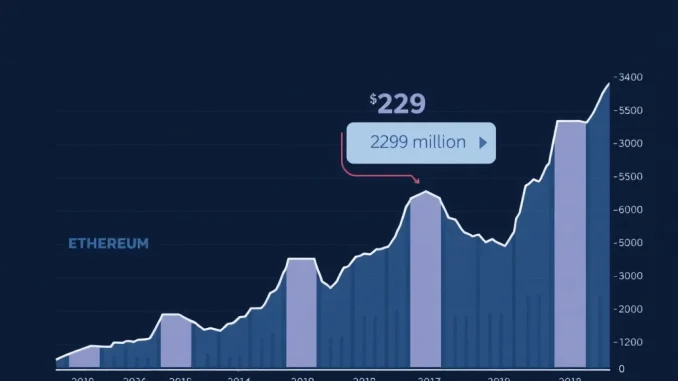
According to data from TraderT, **US spot ETH ETFs** recorded net inflows totaling $289 million last month. This figure translates to approximately 407 billion South Korean Won. However, this represents a substantial decrease compared to the previous month. August had seen a robust $3.8 billion in net inflows. This shift indicates a change in investor sentiment or market conditions.
Analyzing September’s ETH Inflows Across Key Funds
A closer look at individual fund performances reveals varying investor preferences. BlackRock’s ETHA, for instance, attracted considerable capital. It saw $318 million in inflows during September. This highlights continued strong interest in BlackRock’s offerings. Grayscale’s ETH also experienced positive movement. It recorded $50 million in net inflows. These figures underscore sustained institutional interest in **Ethereum ETFs** from these providers.
Conversely, Fidelity’s FETH faced a different trend. The fund experienced $52 million in net outflows. This suggests some investors opted to reduce their exposure through Fidelity’s product. Such fluctuations are common in dynamic markets. They reflect diverse strategies among market participants. These individual fund performances collectively shaped the overall September figures for **ETH inflows**.
Understanding the Broader Context of Crypto Investment Trends
The notable reduction in **ETH inflows** from August to September prompts a deeper analysis. August’s $3.8 billion inflows indicated strong bullish sentiment. This momentum did not carry through into September. Several factors could contribute to such shifts. These include broader macroeconomic conditions. Regulatory developments also play a crucial role. Furthermore, general **crypto investment trends** often influence specific asset performance. Investors frequently re-evaluate their portfolios based on these wider market signals.
The cryptocurrency market remains highly sensitive. News regarding inflation, interest rates, and global economic stability directly impacts investor confidence. Consequently, periods of uncertainty can lead to reduced inflows. They might even trigger outflows. Therefore, September’s performance could reflect a more cautious approach. Investors might be waiting for clearer market direction. This careful stance is typical in volatile asset classes.
The Significance of US Spot ETH ETFs for Market Maturity
**US spot ETH ETFs** represent a pivotal development for the cryptocurrency ecosystem. These products allow investors to gain exposure to Ethereum without directly holding the underlying asset. This simplifies the investment process significantly. It also offers regulatory oversight. Spot ETFs are particularly appealing to institutional investors. They provide a familiar and regulated investment vehicle. This accessibility can attract substantial capital into the Ethereum market. Consequently, it enhances market liquidity and stability.
The introduction of spot ETFs often signals growing maturity for an asset class. It integrates the asset more deeply into traditional financial systems. For Ethereum, this means greater legitimacy. It also opens doors to a wider pool of investors. The long-term impact of these vehicles could be profound. They foster greater adoption and mainstream acceptance of digital assets. This integration is crucial for the continued growth of the **cryptocurrency market**.
Key Players and Their Influence on Ethereum ETFs
Major financial institutions are increasingly active in the crypto space. Firms like BlackRock and Grayscale lead the charge. Their involvement lends significant credibility to **Ethereum ETFs**. BlackRock, a global asset management giant, brings immense institutional trust. Its ETHA fund’s substantial inflows highlight this influence. Grayscale, an early pioneer in crypto trusts, also maintains a strong presence. Its ETH product continues to attract investment. These large players provide the infrastructure and expertise necessary for regulated crypto investment products.
Fidelity, another prominent financial services company, also participates. Its FETH fund’s outflows in September demonstrate market fluidity. Investors continuously assess and adjust their positions. The performance of these individual funds collectively shapes the narrative. It provides insights into the evolving institutional appetite for Ethereum. Their participation ultimately validates the asset class. It encourages further innovation in the **cryptocurrency market**.
Navigating the Future of the Cryptocurrency Market and ETH Investments
The future trajectory of **US spot ETH ETFs** will depend on several factors. Regulatory clarity is paramount. Ongoing discussions with regulatory bodies, such as the SEC, will shape product offerings. Market demand will also play a critical role. Continued interest from both retail and institutional investors is essential. Furthermore, the overall health of the **cryptocurrency market** influences sentiment. Bitcoin’s performance often sets the tone for altcoins like Ethereum.
Investors should monitor global economic indicators. Geopolitical events can also impact digital asset prices. The long-term outlook for Ethereum remains strong. Its foundational role in decentralized finance (DeFi) and NFTs underpins its value. While September showed a moderation in **ETH inflows**, the overall trend towards institutional adoption persists. These investment vehicles are likely to become increasingly integral to diversified portfolios.
In conclusion, September’s $289 million in net inflows for **US spot ETH ETFs** represents a moderation after a very strong August. While a significant decrease, it still indicates continued, albeit tempered, interest in Ethereum as an investment. Funds like BlackRock’s ETHA continue to attract capital, while others see outflows. This dynamic market activity reflects ongoing adjustments in investor strategies and broader **crypto investment trends**. The presence of these regulated products is crucial for the maturation and institutional integration of the **cryptocurrency market**, paving the way for future growth and wider adoption.
Frequently Asked Questions (FAQs)
Q1: What are US spot ETH ETFs?
A: **US spot ETH ETFs** are exchange-traded funds that hold actual Ethereum (ETH) as their underlying asset. They allow investors to gain exposure to Ethereum’s price movements through a regulated financial product without needing to directly buy and store ETH.
Q2: How much did US spot ETH ETFs see in net inflows for September?
A: According to TraderT, **US spot ETH ETFs** recorded $289 million in net inflows during September. This figure was a notable decrease from the $3.8 billion seen in the previous month.
Q3: Which individual funds showed the most significant activity in September?
A: BlackRock’s ETHA attracted the largest inflows, totaling $318 million. Grayscale’s ETH also saw positive inflows of $50 million. Conversely, Fidelity’s FETH experienced $52 million in net outflows.
Q4: Why did the net inflows decrease significantly from August to September?
A: The decrease in **ETH inflows** can be attributed to various factors. These include broader market sentiment shifts, macroeconomic conditions, regulatory uncertainties, or general adjustments in **crypto investment trends**. Investors may have adopted a more cautious approach during September.
Q5: What is the significance of institutional interest in Ethereum ETFs?
A: Institutional interest, particularly from major players like BlackRock and Grayscale, lends credibility and legitimacy to Ethereum as an asset class. It facilitates greater capital flow into the **cryptocurrency market** through regulated channels, enhancing liquidity and potentially accelerating mainstream adoption.