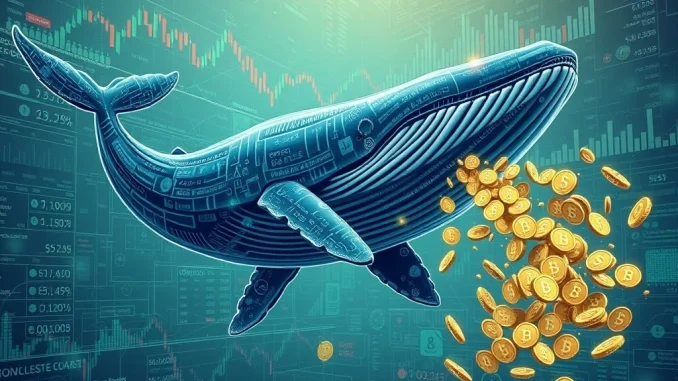
A significant event has captured the attention of the cryptocurrency market. Recently, two prominent SOL whale addresses executed a massive transfer. They deposited a substantial 277,000 SOL tokens, valued at approximately $54.23 million, to various crypto exchange platforms. This move occurred within a short three-hour window, as reported by blockchain analytics firm Lookonchain.
Such large-scale deposits often signal a potential intention to sell these assets. Therefore, this action has immediately raised questions about its potential impact on the Solana price and broader market sentiment. Investors and analysts are closely monitoring the situation to gauge the ripple effects of this significant whale activity.
Unpacking the Massive SOL Deposit and Its Implications
The recent transfer of 277,000 SOL tokens represents a considerable sum in the cryptocurrency world. Two distinct SOL whale addresses were responsible for these transactions. These addresses moved their substantial holdings to centralized exchanges. Lookonchain, a reputable on-chain data provider, promptly flagged these movements.
Historically, large deposits by major holders to exchanges frequently precede selling activity. This is because exchanges serve as primary venues for converting cryptocurrencies into fiat or other digital assets. Consequently, the crypto community is now contemplating the potential for increased selling pressure on Solana. This could certainly influence the immediate Solana price trajectory.
Understanding Crypto Whales and Their Market Power
Crypto whales are individuals or entities holding vast amounts of a particular cryptocurrency. Their actions significantly influence market dynamics. These large holders can move markets due to the sheer volume of their holdings. For instance, a single whale’s decision to buy or sell can create notable price swings.
Their movements are therefore closely watched by traders and analysts alike. Monitoring whale activity offers insights into potential market shifts. This recent SOL deposit exemplifies such a scenario. It highlights the concentrated power some holders possess within the Solana ecosystem.
Analyzing the Potential Impact on Solana Price
The $54 million worth of SOL deposited by these whales could introduce substantial liquidity into the market. If these tokens are indeed sold, the increased supply on exchanges might lead to a downward pressure on the Solana price. However, the actual impact depends on several factors:
- Market Depth: The ability of exchanges to absorb such a large sell order without significant price depreciation.
- Demand: Current buying interest in SOL from other market participants.
- Timing: Whether the sales occur gradually or as a single, large transaction.
Nevertheless, the mere expectation of a potential sell-off can affect investor sentiment. This often leads to precautionary selling by smaller holders. This reaction can further amplify price movements.
Decoding Whale Behavior and Market Signals from the SOL Deposit
Interpreting whale movements requires careful consideration. A large SOL deposit to a crypto exchange does not always guarantee an immediate sell-off. Whales might move funds for various reasons, including:
- Profit-taking: Cashing out gains after a price rally.
- Rebalancing portfolios: Shifting assets to diversify or consolidate holdings.
- Preparing for arbitrage: Exploiting price differences across different exchanges.
- Lending or Staking: While less common for such large amounts on spot exchanges, it’s a possibility.
Despite these possibilities, the prevailing interpretation for a deposit of this magnitude remains a strong indication of impending sales. This is especially true given the current market conditions. Vigilant monitoring of on-chain data and exchange order books becomes crucial during such times.
The Broader Market Context for SOL Whales and Solana’s Future
Solana has emerged as a significant player in the blockchain space. It boasts high transaction speeds and low fees. Its ecosystem continues to attract developers and users. Therefore, the actions of crypto whales within this network carry substantial weight. This particular SOL deposit serves as a reminder of the inherent volatility in cryptocurrency markets. It underscores how individual actions can trigger widespread reactions.
The long-term outlook for Solana remains robust, supported by ongoing development and adoption. However, short-term price movements can be heavily influenced by such large-scale transactions. Market participants should always consider various data points when making investment decisions. They must look beyond isolated whale movements.
In conclusion, the deposit of 277,000 SOL by two whale addresses to exchanges is a noteworthy event. It has certainly generated buzz and concern within the crypto community. While the ultimate outcome on the Solana price remains to be seen, the market is poised for potential volatility. Investors should stay informed and monitor further developments closely. This situation highlights the critical role of on-chain analytics in understanding market sentiment and potential future trends.
Frequently Asked Questions (FAQs)
Q1: What does it mean when a ‘SOL whale’ deposits a large amount of SOL to an exchange?
A1: When a ‘SOL whale’ deposits a large amount of SOL to a ‘crypto exchange’, it typically suggests an intention to sell those tokens. Exchanges are the primary platforms for converting cryptocurrencies into fiat or other digital assets, so such a move often precedes a sell-off.
Q2: How could this large ‘SOL deposit’ affect the ‘Solana price’?
A2: A large ‘SOL deposit’ could increase the supply of SOL available for sale on exchanges. If these tokens are sold, it might lead to increased selling pressure, potentially causing the ‘Solana price’ to decline. Market sentiment can also shift negatively, prompting other investors to sell.
Q3: Who reported this significant ‘SOL whale’ activity?
A3: The significant ‘SOL whale’ activity, specifically the deposit of 277,000 SOL to exchanges, was reported by Lookonchain. Lookonchain is a well-known blockchain analytics platform that tracks and reports on large cryptocurrency movements.
Q4: Are there other reasons for ‘crypto whales’ to move funds to an exchange besides selling?
A4: While selling is the most common interpretation for large deposits, ‘crypto whales’ might also move funds to an exchange for reasons like rebalancing their portfolio, preparing for arbitrage opportunities, or even for specific lending or staking programs that require exchange interaction. However, for such a massive amount, selling remains the primary concern.
Q5: How can regular investors track ‘SOL whale’ movements?
A5: Regular investors can track ‘SOL whale’ movements by following blockchain analytics platforms like Lookonchain, Whale Alert, or Etherscan (for Ethereum-based tokens, though similar tools exist for Solana). These platforms provide real-time data on large transactions and wallet activities, helping investors stay informed about potential market shifts.