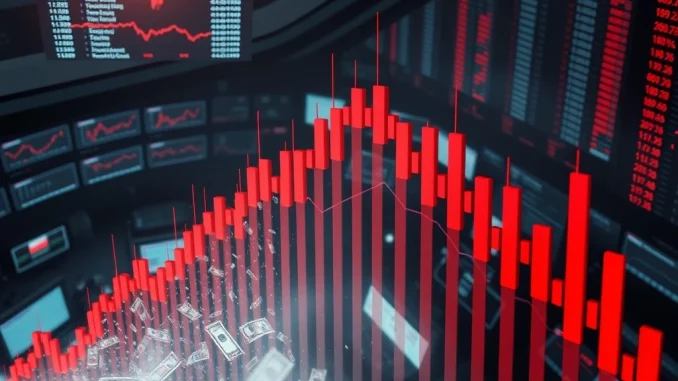
The cryptocurrency market recently experienced a sharp and sudden downturn. This event triggered a **massive crypto futures liquidation** wave. Major exchanges reported staggering figures. In a single hour, $137 million worth of crypto futures contracts were liquidated. This swift capital removal sent ripples across the digital asset landscape. It highlights the inherent **cryptocurrency market volatility** that defines this sector.
Understanding Crypto Futures Liquidation
To grasp the significance of these events, one must understand crypto futures. Futures contracts are agreements. They obligate parties to buy or sell an asset at a predetermined price on a specific future date. Traders use these contracts to speculate on price movements. They also use them to hedge existing positions. Critically, these contracts often involve **leverage trading risks**. Leverage allows traders to control large positions with a relatively small amount of capital. For instance, a 10x leverage means a $1,000 investment controls $10,000 worth of crypto.
Liquidation occurs when a trader’s leveraged position loses too much value. The exchange automatically closes the position. This happens to prevent further losses. The trader’s initial margin can no longer cover potential losses. This forced closure happens quickly. It aims to protect the exchange from counterparty risk. The recent **crypto futures liquidation** event demonstrates this mechanism in action. Over the past 24 hours, the total liquidations reached an alarming $717 million. Such rapid liquidations often cascade. One liquidation can trigger others. This creates a downward spiral in prices.
The Impact of Cryptocurrency Market Volatility
The cryptocurrency market is known for its extreme price swings. Therefore, significant liquidations are not entirely unprecedented. However, the speed and scale of this event were notable. It underscored the fragile nature of market sentiment. A sudden price drop can quickly wipe out leveraged positions. This, in turn, amplifies the downward pressure. Consequently, market participants often experience heightened fear. This fear can lead to further selling. The **cryptocurrency market volatility** makes these events impactful. It affects both institutional and retail traders.
Several factors contribute to such market movements. These include macroeconomic news, regulatory announcements, or large institutional trades. Sometimes, a single large sell order can start a chain reaction. This is especially true in a highly leveraged environment. When positions are closed, the underlying asset is often sold. This further drives down its price. Therefore, these liquidations act as a feedback loop. They intensify existing market trends.
Navigating Leverage Trading Risks
Leverage offers magnified profits. However, it also brings magnified losses. This is a fundamental aspect of **leverage trading risks**. Traders can lose their entire margin quickly. This happens if the market moves against their position. Many traders are drawn to leverage for its potential returns. Yet, without proper risk management, it becomes a dangerous tool. For instance, a 10% price drop can liquidate a 10x leveraged long position. This highlights the importance of caution.
Sound risk management strategies are crucial. These include using stop-loss orders. Stop-loss orders automatically close a position at a predetermined price. This limits potential losses. Furthermore, traders should avoid over-leveraging. They must only risk capital they can afford to lose. Understanding margin requirements is also vital. Exchanges provide tools for managing these risks. However, the ultimate responsibility rests with the individual trader. The recent liquidations serve as a stark reminder of these inherent dangers.
Analyzing Bitcoin Price Action and Broader Market Trends
While specific coins were liquidated, **Bitcoin price action** often dictates the overall market direction. Bitcoin remains the largest cryptocurrency by market capitalization. Its movements influence altcoins. A significant drop in Bitcoin’s price often leads to broader market corrections. This affects other digital assets. The recent liquidations likely coincided with a notable shift in Bitcoin’s short-term trajectory. Traders holding leveraged long positions on Bitcoin or altcoins would have been particularly vulnerable.
This event reflects a broader trend in the derivatives market. As the crypto ecosystem matures, derivatives trading grows. It attracts more sophisticated traders. However, it also introduces more complex risks. The interplay between spot markets and futures markets is constant. Price movements in one can quickly impact the other. Consequently, market participants must monitor both. This helps them anticipate potential shifts. These liquidations underscore the interconnectedness of the crypto financial system.
The Wider Derivatives Market Impact
The **derivatives market impact** extends beyond individual traders. Such large-scale liquidations can affect market liquidity. They can also influence investor confidence. When significant capital is wiped out, it can deter new investment. It might also cause existing investors to pull back. Exchanges also face scrutiny during these times. They must ensure their systems handle extreme volatility. Robust infrastructure is essential to maintain market integrity. Regulators also pay close attention to these events. They seek to understand systemic risks.
Ultimately, these liquidations are a natural, albeit painful, part of a volatile market cycle. They serve to cleanse excess leverage from the system. While disruptive in the short term, they can sometimes precede a period of more stable growth. However, they also remind everyone of the speculative nature of crypto futures. The market continuously adapts to these challenges. It seeks to balance innovation with stability. This ongoing evolution shapes the future of digital finance.
In conclusion, the recent $137 million **crypto futures liquidation** within an hour underscores the dynamic and often unforgiving nature of the cryptocurrency market. It highlights the critical importance of understanding **leverage trading risks** and implementing robust risk management strategies. As the market continues to evolve, traders and investors must remain vigilant. They need to adapt to its inherent **cryptocurrency market volatility**. The **derivatives market impact** of such events is profound. It influences both individual portfolios and the broader financial ecosystem. This event serves as a powerful lesson in market dynamics and the cautious approach required for success.
Frequently Asked Questions (FAQs)
What is crypto futures liquidation?
Crypto futures liquidation occurs when a trader’s leveraged position in a futures contract falls below a certain margin level. The exchange automatically closes the position to prevent further losses, effectively wiping out the trader’s collateral.
Why did $137 million worth of futures liquidate so quickly?
This rapid liquidation typically happens due to a sudden and significant price movement against a large number of leveraged positions. A sharp price drop, often triggered by a major market event or large sell orders, can quickly deplete traders’ margins, leading to cascading liquidations.
What are the main risks of leverage trading in crypto?
The primary risk of leverage trading is amplified losses. While it can magnify profits, even small adverse price movements can lead to losing your entire margin quickly. It also increases the speed at which positions can be liquidated.
How does this event impact the broader cryptocurrency market?
Large-scale liquidations can increase **cryptocurrency market volatility**, reduce overall market liquidity, and erode investor confidence. They can also trigger further price declines as forced selling adds downward pressure, impacting **Bitcoin price action** and other altcoins.
How can traders protect themselves from future liquidations?
Traders can protect themselves by using stop-loss orders, avoiding excessive leverage, diversifying their portfolios, and only trading with capital they can afford to lose. Understanding margin requirements and market conditions is also crucial.