Understanding the pulse of the cryptocurrency market is vital for informed decisions. Specifically, analyzing the BTC perpetual futures long/short ratio offers deep insights into prevailing market sentiment. This metric reveals whether traders are predominantly betting on price increases (long positions) or decreases (short positions). Therefore, monitoring these ratios on major platforms becomes a crucial part of any robust Bitcoin trading strategy. Let’s delve into the latest data from the world’s top three crypto futures exchanges by open interest, providing a snapshot of current market expectations.
Decoding the BTC Perpetual Futures Long/Short Ratio
The BTC perpetual futures market allows traders to speculate on Bitcoin’s price movements without an expiry date. This flexibility makes it a popular instrument. The long/short ratio aggregates all open long and short positions, presenting a clear picture of trader bias. A ratio above 1 suggests more traders are long, expecting prices to rise. Conversely, a ratio below 1 indicates a prevalence of short positions, anticipating price declines. This data acts as a powerful indicator of collective market sentiment. It often helps traders gauge potential reversals or continuations in price trends. Consequently, savvy investors frequently consult these figures.
The 24-hour long/short position ratio for BTC perpetual futures on leading exchanges offers a fascinating look. This data reflects immediate trader positioning. Here is the recent breakdown:
- Overall Market Bias: 49.89% long / 50.11% short
- Binance: 50.98% long / 49.02% short
- Bybit: 49.25% long / 50.75% short
- Gate.io: 51.83% long / 48.17% short
These figures provide a detailed view of current market dynamics. They show slight variations across different platforms. Each exchange has its unique user base and trading patterns.
Analyzing Market Sentiment Across Top Crypto Futures Exchanges
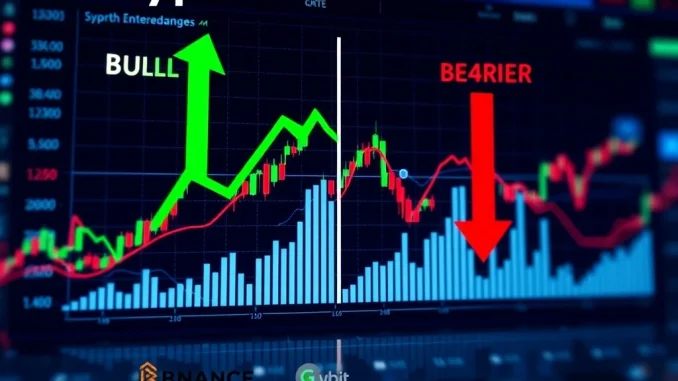
Observing the overall ratio, we see a near-even split between long and short positions. Specifically, shorts slightly outweigh longs at 50.11% versus 49.89%. This suggests a balanced, yet slightly cautious, market sentiment among traders on crypto futures exchanges. Such a tight distribution can indicate indecision or a period of consolidation. Traders might be awaiting clearer directional signals. Furthermore, this balance prevents any single side from dominating the market. This often leads to increased volatility.
Binance: A Slight Bullish Lean
Binance, a dominant player, shows a marginally bullish bias. Their long/short ratio stands at 50.98% long against 49.02% short. This indicates that a slightly larger portion of traders on Binance anticipate a price increase for Bitcoin. Binance’s extensive user base means this slight lean can significantly influence broader market perception. Traders often look to Binance data as a bellwether. Therefore, this modest bullishness could signal underlying confidence within a key segment of the market.
Bybit: Predominantly Bearish Positioning
In contrast, Bybit presents a more bearish outlook. Their ratio shows 49.25% long and 50.75% short. This suggests that Bybit users are leaning towards a downward price movement for BTC. Bybit is known for its strong derivatives offerings. Thus, this bearish tilt among its users is noteworthy. It could reflect a different demographic of traders or specific strategies being employed. Consequently, this contrast highlights the diverse perspectives present across various platforms within the BTC perpetual futures market.
Gate.io: Stronger Bullish Conviction
Gate.io exhibits the strongest bullish sentiment among the three. Their ratio is 51.83% long against 48.17% short. This indicates a more pronounced belief in Bitcoin’s upward trajectory among its trading community. Such a higher long percentage suggests a segment of traders feels confident about BTC’s near-term prospects. This conviction stands out. It might stem from specific technical analysis or fundamental beliefs held by Gate.io users. Hence, these varied ratios underscore the decentralized nature of market sentiment.
Implications for Bitcoin Trading Strategies
These long/short ratios provide valuable context for Bitcoin trading strategies. A balanced ratio, like the overall market, often precedes periods of range-bound trading. Extreme ratios, however, can signal potential reversals. For example, an excessively high long ratio might suggest an overbought market. This could lead to a ‘long squeeze’ if prices drop. Conversely, a very high short ratio might indicate an oversold market, potentially leading to a ‘short squeeze.’ Consequently, monitoring these metrics helps traders anticipate market shifts. It allows them to adjust their positions proactively.
Traders must also consider other factors. These include funding rates, open interest, and overall market news. The long/short ratio is one piece of a larger puzzle. Combining this data with technical analysis and fundamental understanding yields a more comprehensive view. This holistic approach enhances decision-making. It helps in managing risks more effectively. Ultimately, successful trading involves synthesizing multiple data points. This ratio is a critical component.
The Role of Crypto Futures Exchanges in Price Discovery
Crypto futures exchanges play a pivotal role in the broader cryptocurrency ecosystem. They offer platforms for price discovery and risk management. The sheer volume of trading on these exchanges helps establish market prices for assets like Bitcoin. They also provide liquidity. This ensures efficient execution of trades. Moreover, the data they generate, such as the BTC perpetual futures long/short ratio, contributes significantly to market transparency. This transparency empowers traders with more information. It helps them make more informed decisions.
These exchanges continuously innovate. They introduce new products and features. This constant evolution attracts more participants. It also deepens market liquidity. The competition among these platforms benefits traders. It often leads to better trading conditions and more robust data analytics. Consequently, their influence on market dynamics cannot be overstated. They are central to the maturation of the digital asset space.
The latest long/short ratio data for BTC perpetual futures reveals a finely balanced, yet diverse, market sentiment across top crypto futures exchanges. While the overall market hovers near equilibrium, individual platforms show distinct biases. Binance leans slightly bullish, Bybit shows a bearish tendency, and Gate.io exhibits stronger bullish conviction. These insights are indispensable for anyone engaged in Bitcoin trading. They help in understanding current market psychology and anticipating future price movements. Always remember to combine this data with other analytical tools for a comprehensive trading strategy.
Frequently Asked Questions (FAQs)
What is a BTC perpetual future?
A BTC perpetual future is a type of derivative contract. It allows traders to speculate on the future price of Bitcoin. Unlike traditional futures, it has no expiry date. This means positions can be held indefinitely. Funding rates ensure its price stays close to the spot price.
How is the long/short ratio calculated for BTC perpetual futures?
The long/short ratio is calculated by dividing the total number or volume of open long positions by the total number or volume of open short positions. Exchanges often provide this data. It reflects the proportion of bullish versus bearish bets.
Why is the long/short ratio important for Bitcoin trading?
The long/short ratio is crucial because it indicates collective market sentiment. A high ratio suggests bullishness, while a low ratio points to bearishness. It can help traders identify potential market tops or bottoms. It also helps in anticipating significant price movements.
What does a 50/50 long/short ratio imply?
A 50/50 long/short ratio suggests a neutral or indecisive market. Neither bulls nor bears are dominating. This can precede periods of consolidation or increased volatility. Traders might be waiting for a clear catalyst to push the market in one direction.
How do different crypto futures exchanges’ ratios compare?
Ratios can vary across different crypto futures exchanges due to diverse user bases and trading strategies. For instance, one exchange might show a bullish bias while another is bearish. Analyzing these differences offers a more nuanced understanding of overall market sentiment.
Can the long/short ratio predict market movements accurately?
While the long/short ratio is a valuable indicator, it is not a standalone predictor. It provides insight into market sentiment. However, it should be used in conjunction with other technical and fundamental analysis tools. No single indicator guarantees accurate predictions.