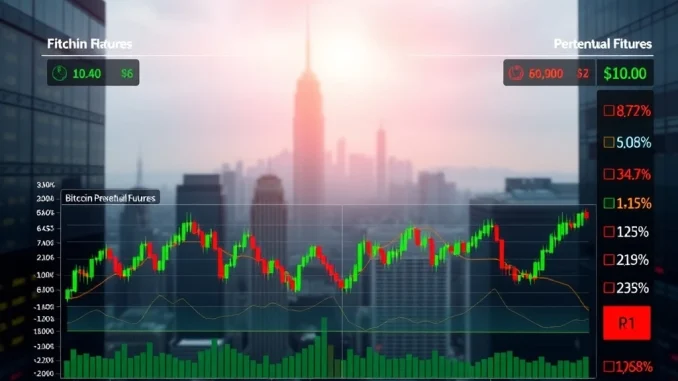
In the volatile world of cryptocurrency, understanding market sentiment is paramount for any trader. One of the most insightful indicators available to gauge this sentiment is the **long/short ratio** for **BTC perpetual futures**. This metric provides a snapshot of how traders are positioning themselves on major **crypto exchanges**, revealing whether the collective belief leans towards price increases (long) or decreases (short).
Understanding BTC Perpetual Futures and Long/Short Ratios
BTC perpetual futures contracts are a cornerstone of modern cryptocurrency trading. Unlike traditional futures, they lack an expiry date, allowing traders to hold positions indefinitely, provided they meet margin requirements. This flexibility makes them incredibly popular for speculation and hedging alike. The market for these derivatives is highly liquid, attracting a vast array of participants, from retail traders to institutional players.
The **long/short ratio** itself is a simple yet powerful tool. It measures the proportion of open long positions against open short positions. A ratio above 1 typically indicates a bullish sentiment, with more traders betting on a price increase. Conversely, a ratio below 1 suggests a bearish outlook, as more traders anticipate a price decline. Monitoring this ratio can offer valuable insights into potential market shifts and prevailing investor psychology.
Furthermore, these ratios are often analyzed across different **crypto exchanges**. Discrepancies between exchanges can highlight localized sentiment or unique trading dynamics. For instance, one exchange might show a stronger bullish bias than another, potentially due to its user base or specific trading products. Therefore, a comprehensive view across leading platforms is essential for a holistic understanding of the market.
Recent BTC Perpetual Futures Long/Short Data Across Top Exchanges
Over the past 24 hours, the **BTC perpetual futures** market has shown a notable lean towards short positions across the world’s three largest crypto futures exchanges by open interest. This data offers a crucial glimpse into current **market sentiment**. Investors closely watch these figures to inform their **Bitcoin trading** strategies.
Here is a breakdown of the long/short position ratios:
- Overall Market Sentiment: The aggregated data reveals 47.42% long / 52.58% short. This indicates a slight bearish bias across the combined platforms. More traders are positioning for a potential downside move in Bitcoin’s price.
- Binance: On Binance, the ratio stands at 46.84% long / 53.16% short. This exchange, known for its massive trading volume, shows an even stronger bearish inclination compared to the overall average. Many traders are expressing caution.
- Bybit: Bybit reports 46.21% long / 53.79% short. This represents the most pronounced bearish sentiment among the top three exchanges. Traders on Bybit are predominantly expecting a price decrease.
- Gate.io: In contrast, Gate.io presents a different picture: 51.37% long / 48.63% short. This exchange is the only one among the top three to show a slight bullish bias. More traders here anticipate an upward price movement for Bitcoin.
This divergence highlights varied perspectives among different trading communities. While the general trend suggests caution, Gate.io’s data provides a counter-narrative of modest optimism. Such variations underscore the complexity of market dynamics.
Interpreting the Data: Implications for Bitcoin Trading
The observed **long/short ratios** carry significant implications for **Bitcoin trading**. A prevailing short bias, as seen on Binance and Bybit, suggests that a substantial portion of the market expects a price correction or continued downward pressure. This sentiment could influence short-term price movements, potentially leading to increased selling pressure if these short positions gain momentum. Conversely, if Bitcoin’s price unexpectedly rises, a ‘short squeeze’ could occur, where short sellers are forced to buy back their positions, further fueling the rally.
The bullish tilt on Gate.io, while modest, offers a point of contrast. It indicates that a segment of the market remains optimistic, potentially viewing current price levels as an accumulation opportunity. Traders often use these contrasting signals to refine their strategies. For example, some might consider taking contrarian positions, while others may choose to align with the dominant sentiment on their preferred **crypto exchanges**.
Furthermore, these ratios are not static. They constantly evolve, reflecting real-time changes in **market sentiment**. Astute traders continuously monitor these shifts, as sudden changes can precede significant price action. A rapid increase in long positions, for instance, could signal growing confidence, while a sharp rise in short positions might foreshadow a downturn. Therefore, the presented data serves as a snapshot, and continuous observation is crucial for effective decision-making.
The Role of Crypto Exchanges in Shaping Market Sentiment
The choice of **crypto exchanges** significantly impacts how traders perceive and react to market data. Binance, Bybit, and Gate.io are titans in the futures trading arena, each boasting vast user bases and substantial open interest. Their collective data provides a robust indicator of broader **market sentiment**. However, individual exchange dynamics can also play a role.
Different exchanges may cater to distinct user demographics or offer varying trading tools and incentives. This can lead to slight divergences in their respective **long/short ratios**. For instance, an exchange known for its high-leverage options might attract more aggressive traders, potentially amplifying bullish or bearish biases. Understanding these nuances helps in interpreting the data more accurately. Traders must consider the specific characteristics of each platform when analyzing the aggregated figures for **BTC perpetual futures**.
Navigating Market Sentiment with BTC Perpetual Futures Data
In conclusion, the **long/short ratios** for **BTC perpetual futures** offer invaluable insights into current **market sentiment**. The recent data, showing a predominantly bearish bias across major **crypto exchanges** like Binance and Bybit, suggests caution among many traders. However, the slight bullish lean on Gate.io reminds us that sentiment is not monolithic. Strategic **Bitcoin trading** involves not just reacting to these ratios but also understanding their underlying drivers and potential implications.
Traders should integrate this data with other technical and fundamental analysis tools to form a comprehensive market outlook. While these ratios provide a powerful indication of collective positioning, they are just one piece of the puzzle. Continuous monitoring and a nuanced interpretation are key to navigating the complex and often unpredictable landscape of the cryptocurrency market. Stay informed and adapt your strategies based on evolving market signals.
Frequently Asked Questions (FAQs)
What are BTC perpetual futures?
BTC perpetual futures are cryptocurrency derivative contracts that allow traders to speculate on the future price of Bitcoin without needing to own the underlying asset. Unlike traditional futures, they do not have an expiry date, enabling traders to hold positions indefinitely, provided they maintain sufficient margin.
How do long/short ratios indicate market sentiment?
The long/short ratio compares the number of open long positions (bets on price increase) to open short positions (bets on price decrease). A ratio above 1 suggests bullish sentiment, as more traders expect prices to rise. A ratio below 1 indicates bearish sentiment, with more traders anticipating a price fall.
Why is it important to check long/short ratios across multiple crypto exchanges?
Checking ratios across several crypto exchanges provides a more comprehensive view of overall market sentiment. Different exchanges may have varied user bases or trading dynamics, leading to slight differences in their ratios. This helps identify broader trends versus localized sentiment.
What does a high short ratio imply for Bitcoin trading?
A high short ratio, like the one observed on Binance and Bybit, implies that a significant portion of traders expects Bitcoin’s price to decline. This can indicate potential selling pressure or a lack of confidence in immediate upward price movements. However, it can also set the stage for a ‘short squeeze’ if prices unexpectedly rise.
Can long/short ratios predict future Bitcoin prices accurately?
Long/short ratios are powerful indicators of current market sentiment and positioning, but they are not perfect predictors of future prices. They should be used in conjunction with other technical analysis tools, fundamental analysis, and market news to form a well-rounded trading strategy. They reflect collective expectations, which can change rapidly.
Which exchanges are considered top for BTC perpetual futures trading?
Exchanges like Binance, Bybit, and Gate.io are consistently ranked among the top platforms for BTC perpetual futures trading, primarily due to their high open interest, liquidity, and large user bases. These platforms offer robust trading environments for derivatives.