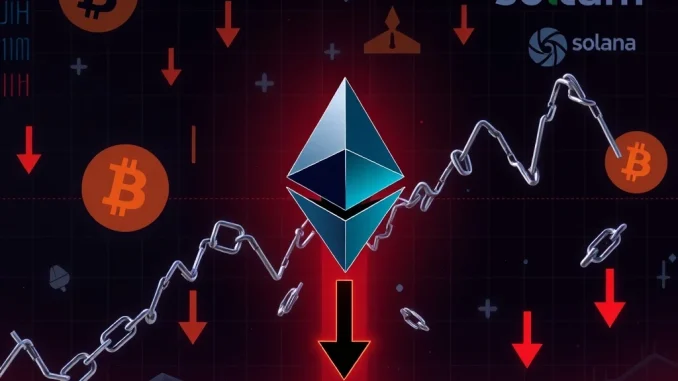
The cryptocurrency market often experiences rapid shifts. Therefore, understanding these movements becomes crucial for traders. A recent 24-hour period highlighted significant volatility, particularly with a massive surge in ETH liquidations. This event sent ripples across the entire digital asset landscape. Market participants observed substantial forced closures of leveraged positions, indicating intense price action.
Unpacking the Scale of ETH Liquidations
Ethereum (ETH) led the recent wave of market instability. Furthermore, it registered a staggering $116 million liquidated within just 24 hours. This figure underscores the high leverage present in the Ethereum futures market. A closer look reveals that long positions bore the brunt of these liquidations, accounting for 61.29% of the total. This means that a majority of traders betting on an ETH price increase saw their positions forcefully closed. Consequently, this contributed to further downward pressure on the asset. Such large-scale liquidations often occur during sharp price declines. They can also accelerate market corrections, impacting investor confidence significantly.
The Dynamics of Bitcoin Liquidations
Bitcoin (BTC), the largest cryptocurrency by market capitalization, also faced considerable pressure. The past 24 hours saw approximately $55.27 million liquidated in BTC perpetual futures. Similar to Ethereum, long positions were predominantly affected. They represented 63.54% of the total Bitcoin liquidations. This trend indicates that bullish sentiment was challenged across major cryptocurrencies. While substantial, Bitcoin’s liquidation volume was notably less than Ethereum’s. This difference might suggest varying levels of leverage or market conviction between the two leading assets. Traders closely monitor these figures for insights into market health.
Solana’s Unique Liquidation Profile
Solana (SOL) presented a distinct pattern during this volatile period. It recorded $25.19 million liquidated. However, unlike ETH and BTC, short positions comprised the majority of these liquidations. Specifically, short positions accounted for 61.62%. This means that traders betting on a price *decline* for SOL were primarily affected. This reversal suggests a sudden upward price movement or a short squeeze for Solana. Consequently, this created a different kind of market dynamic for SOL. Understanding these nuances is vital for anyone participating in the perpetual futures market.
Decoding the Perpetual Futures Market
The perpetual futures market is a cornerstone of modern cryptocurrency trading. It allows traders to speculate on asset prices without owning the underlying asset. Unlike traditional futures, these contracts have no expiry date. This perpetual nature makes them popular. However, they also come with inherent risks. Traders often use leverage, borrowing funds to amplify their potential returns. While leverage can boost profits, it equally magnifies losses. A forced liquidation occurs when a trader’s margin balance falls below a certain threshold. The exchange then automatically closes the position to prevent further losses. These events are a natural, albeit sometimes painful, part of a highly leveraged market. They can cause cascading effects, leading to further price volatility.
Implications for Ethereum Futures and Beyond
The recent spike in ETH liquidations has significant implications. It highlights the inherent risks associated with leveraged trading. Furthermore, it serves as a stark reminder of market volatility. Such large-scale liquidations can clear out excessive leverage from the market. This might pave the way for a more stable price discovery in the long run. Nevertheless, the immediate impact is often negative sentiment. Traders in Ethereum futures must carefully manage their risk. They should use stop-loss orders and appropriate position sizing. Monitoring overall crypto liquidations provides a broader market perspective. This data helps in assessing the health and sentiment of the entire digital asset ecosystem. Market participants must remain vigilant.
In conclusion, the past 24 hours offered a vivid snapshot of the cryptocurrency market’s dynamic nature. ETH liquidations dominated, showcasing Ethereum’s heightened sensitivity to price swings. Bitcoin also experienced significant long liquidations. Solana, however, saw short positions primarily impacted. These events underscore the critical importance of risk management in the highly leveraged perpetual futures market. Traders must stay informed and adapt to rapidly changing conditions.
Frequently Asked Questions (FAQs)
What are crypto liquidations?
Crypto liquidations are the forced closure of a trader’s leveraged position by an exchange. This happens when the value of their collateral (margin) falls below a certain threshold. It occurs to prevent further losses for the trader and the exchange.
Why did ETH see the highest liquidations?
Ethereum (ETH) often experiences high liquidation volumes due to its significant market capitalization and popularity among leveraged traders. Its price movements can be highly volatile, leading to rapid margin calls and subsequent liquidations, especially during sharp price declines.
What is the difference between long and short liquidations?
Long liquidations occur when traders betting on a price increase (long positions) have their positions closed due to a price drop. Short liquidations happen when traders betting on a price decrease (short positions) have their positions closed due to a price increase.
How does the perpetual futures market work?
The perpetual futures market allows traders to speculate on the future price of an asset without an expiry date. Traders use leverage to amplify potential gains. However, this also magnifies potential losses, making liquidations a common occurrence when prices move unfavorably.
What are the risks of trading Ethereum futures?
Trading Ethereum futures carries several risks, primarily due to leverage. These include rapid liquidations during volatile price swings, significant capital loss, and the complexity of managing margin requirements. Market manipulation and regulatory changes also pose risks.
How can traders mitigate liquidation risks?
Traders can mitigate liquidation risks by using less leverage, setting appropriate stop-loss orders, diversifying their portfolio, and maintaining sufficient margin in their accounts. Furthermore, understanding market trends and having a robust risk management strategy are crucial.