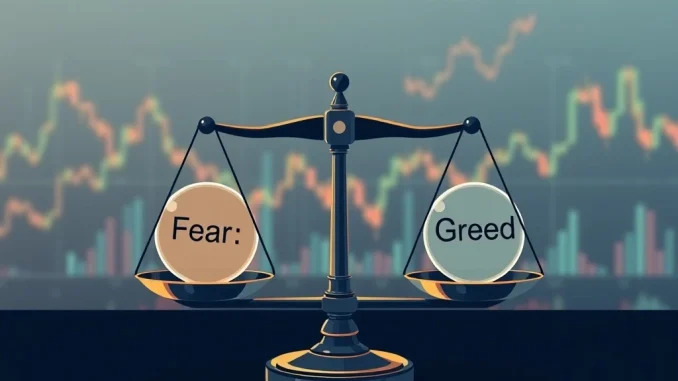
The Crypto Fear & Greed Index recently settled at a neutral 53, a reading that often prompts questions among market observers. This pivotal metric offers a snapshot of the prevailing market sentiment across the volatile digital asset landscape. Understanding its components and implications is essential for anyone navigating the crypto market.
Decoding the Crypto Fear & Greed Index
The Crypto Fear & Greed Index, provided by Alternative.me, serves as a prominent gauge for investor psychology. It consolidates various data points into a single, easy-to-understand number. This index operates on a scale from 0 to 100. A score of 0 signifies “extreme fear,” suggesting potential undervaluation and buying opportunities. Conversely, a score of 100 indicates “extreme greed.” This often hints at an overheated market ripe for correction. The current reading of 53 firmly places the index in “neutral” territory. This specific level suggests a balanced state. Neither excessive optimism nor pervasive pessimism dominates the trading environment. Consequently, investors observe a period of relative equilibrium.
The Pillars of Investor Sentiment: How the Index is Calculated
The accuracy of the Crypto Fear & Greed Index stems from its multi-faceted approach. It combines six distinct factors, each weighted to reflect its impact on overall investor sentiment:
- Volatility (25%): High volatility, especially when prices are falling, often indicates fear. Conversely, significant price increases with high volatility can signal greed. The index monitors Bitcoin’s current volatility and compares it to average levels.
- Market Volume (25%): Strong buying volume in a rising market often accompanies greed. Conversely, high selling volume can reflect fear. This component analyzes current trading volume and market momentum.
- Social Media Mentions (15%): A surge in positive or negative cryptocurrency-related hashtags and mentions on platforms like Twitter can reveal shifts in public mood. The index scans various platforms for relevant keywords.
- Surveys (15%): Although currently paused, these surveys previously gathered direct input from investors. They provided a qualitative layer to the quantitative data. When active, they directly captured participant sentiment.
- Bitcoin Dominance (10%): A rising Bitcoin dominance often indicates that investors are moving funds from altcoins back into Bitcoin, a perceived safer asset. This can signal fear in the broader altcoin market. Conversely, decreasing Bitcoin dominance can suggest growing confidence in altcoins. This factor provides insight into Bitcoin sentiment.
- Google Search Volume (10%): Trends in Google searches for terms like “Bitcoin price manipulation” (fear) or “buy Bitcoin” (greed) offer clues about retail interest and underlying concerns. The index tracks search data to identify sentiment shifts.
Neutral Territory: What Does a 53 Mean for the Crypto Market?
A neutral reading of 53 on the Crypto Fear & Greed Index suggests a period of equilibrium. This is neither a strong buy signal nor a clear warning of an impending crash. Instead, it indicates that participants in the crypto market are behaving cautiously. They are not rushing into trades based on emotion. Such neutrality can precede significant price movements, but it does not guarantee them. Historically, prolonged neutral periods can lead to consolidation. They can also represent a lull before a breakout or breakdown. For many, a neutral index allows for more rational decision-making. It removes the urgency often associated with extreme readings.
Navigating Bitcoin Sentiment in a Neutral Market
Bitcoin sentiment often sets the tone for the wider crypto market. When the index sits in neutral territory, it suggests that Bitcoin holders are not panicking nor are they exuberantly buying. This can be a healthy sign. It implies a market digesting recent price action. It may also indicate a phase of accumulation by long-term holders. For Bitcoin, a neutral index often means a period of range-bound trading. Prices might fluctuate within established support and resistance levels. This provides opportunities for technical traders. It also allows fundamental developments to gain more prominence. The absence of extreme fear can prevent rapid sell-offs. Similarly, the lack of extreme greed can curb unsustainable pumps.
The Broader Implications for Investor Sentiment
The current investor sentiment, as reflected by the index, indicates a wait-and-see approach. Investors are likely assessing macroeconomic factors, regulatory news, and project-specific developments. This cautious stance can lead to lower volatility in the short term. It can also create a more predictable trading environment. However, it is crucial to remember that the index is a lagging indicator. It reflects past and current sentiment. It does not predict future price action with certainty. Savvy investors use it as one tool among many. They combine it with technical analysis, fundamental analysis, and risk management strategies. A neutral index encourages a balanced portfolio review. It also promotes strategic planning.
Historical Context and Future Outlook for the Crypto Market
Reviewing historical data reveals patterns in the Crypto Fear & Greed Index. Periods of extreme fear often mark market bottoms, presenting buying opportunities for those brave enough. Conversely, extreme greed typically precedes market tops. The current neutral position suggests neither of these extremes. It implies a period of potential consolidation. The crypto market could be preparing for its next major move. This move could be upward or downward. However, the current sentiment provides little directional bias. Investors should monitor key support and resistance levels. They should also watch for shifts in global economic conditions. A sustained move into either fear or greed territory would signal a change. Until then, neutrality prevails.
Conclusion:
The Crypto Fear & Greed Index at 53 signals a period of balanced market sentiment. This neutral reading offers a moment for reflection rather than reaction. It suggests that both Bitcoin sentiment and overall investor sentiment are in a state of equilibrium. While not a definitive predictor, this index remains a vital tool. It helps observers understand the prevailing emotional landscape of the crypto market. As always, thorough research and a disciplined approach remain paramount for navigating digital asset investments.
Frequently Asked Questions (FAQs)
Q1: What does a “neutral” reading on the Crypto Fear & Greed Index signify?
A neutral reading, typically between 40 and 60, indicates a balanced market sentiment. Neither extreme fear nor extreme greed dominates investor behavior. It suggests a period of relative calm and equilibrium in the crypto market.
Q2: How often is the Crypto Fear & Greed Index updated?
The Crypto Fear & Greed Index is updated daily. This provides a fresh snapshot of market sentiment and allows investors to track changes in fear and greed levels consistently.
Q3: Is the Crypto Fear & Greed Index a reliable buy or sell signal?
No, the index is not a direct buy or sell signal. Instead, it serves as an indicator of market sentiment. Extreme fear (low scores) can suggest buying opportunities, while extreme greed (high scores) might signal an overheated market. However, it should be used in conjunction with other analytical tools.
Q4: Which factors contribute most to the index’s calculation?
Volatility and trading volume each contribute 25% to the index. Social media mentions and surveys each contribute 15%. Bitcoin’s market cap dominance and Google search volume each contribute 10%. These factors collectively paint a comprehensive picture of market sentiment.
Q5: How does Bitcoin’s dominance affect the Crypto Fear & Greed Index?
Bitcoin’s market cap dominance contributes 10% to the index. A rising dominance often suggests investors are moving into Bitcoin, a perceived safe haven, indicating fear in the broader altcoin market. Conversely, falling dominance can signal growing confidence in altcoins, reflecting less fear.
Q6: Can a neutral index reading lead to significant price movements?
Yes, a neutral index reading can precede significant price movements. It often represents a period of consolidation or accumulation. This lull can occur before a major breakout or breakdown. However, the neutral reading itself does not provide a directional bias.