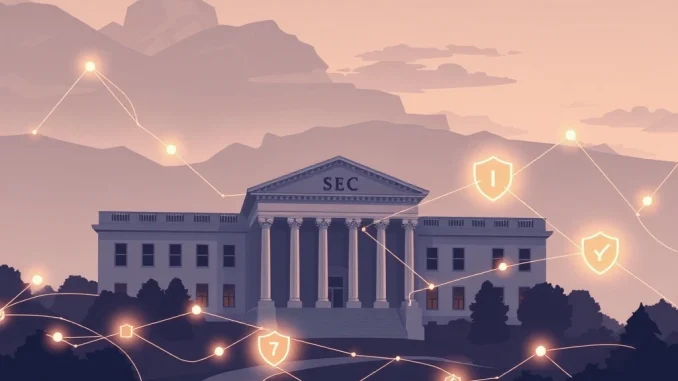
The landscape of digital assets is constantly evolving. Furthermore, the need for robust regulatory frameworks grows alongside it. A significant development recently emerged from a crucial meeting. Lagrange met with the U.S. Securities and Exchange Commission’s (SEC) crypto task force. This discussion centered on a vital balance: effective **digital asset regulation** and individual privacy. This engagement marks a proactive step toward shaping the future of decentralized finance.
Lagrange SEC: Bridging Regulation and Innovation
Lagrange, a prominent player in the blockchain space, recently engaged in pivotal discussions with the **Lagrange SEC** crypto task force. This meeting aimed to address the complex challenges posed by digital assets. Specifically, it focused on how to supervise this burgeoning sector without compromising user privacy. The conversation underscored the industry’s commitment to working with regulators. It also highlighted the importance of fostering innovation within a compliant environment. For many, this dialogue represents a crucial step forward.
The core of the discussion revolved around finding common ground. Regulators seek to ensure market integrity and investor protection. Meanwhile, blockchain innovators prioritize decentralization and privacy. This balance is not easily achieved. However, proactive engagement, like that demonstrated by Lagrange, is essential. It helps to forge paths for future growth. Consequently, both parties can move towards a more secure and efficient digital economy.
Advancing Crypto Privacy with Cutting-Edge Technology
During the meeting, Lagrange introduced an innovative solution. The company proposed a financial surveillance and privacy sandbox. This sandbox aims to evaluate DeepProve, its advanced ZK-proof system. DeepProve is specifically designed to offer verifiable, privacy-preserving evidence of regulatory compliance. This technology holds immense potential for the digital asset space. It allows entities to prove adherence to rules without revealing sensitive underlying data. This is a game-changer for **crypto privacy**.
The concept of privacy-preserving compliance is fundamental. It ensures that user data remains confidential. Simultaneously, it allows for necessary oversight. DeepProve leverages the power of zero-knowledge proofs. These cryptographic protocols enable one party to prove a statement’s truth to another. Crucially, no additional information beyond the statement’s validity is disclosed. Therefore, it provides a powerful tool for balancing two often conflicting demands.
The Financial Surveillance Sandbox: A New Regulatory Frontier
The proposed **financial surveillance sandbox** represents a forward-thinking approach to regulation. It offers a controlled environment for testing new technologies. Specifically, it allows for the evaluation of systems like DeepProve. Such sandboxes enable regulators to understand novel solutions in practice. They can assess their effectiveness and potential risks. This hands-on approach is far more beneficial than theoretical discussions alone. It fosters collaboration between innovators and overseers.
Key benefits of a regulatory sandbox include:
- Controlled Experimentation: New technologies can be tested safely.
- Informed Policy-Making: Regulators gain practical insights.
- Reduced Compliance Costs: Efficient solutions can be identified.
- Innovation Promotion: Companies can develop and deploy novel tools.
This initiative could set a precedent for how regulators engage with emerging technologies. It paves the way for a more adaptive and technology-friendly regulatory landscape. Consequently, the entire digital asset ecosystem stands to benefit from such collaborative efforts.
Unlocking Potential with Zero-Knowledge Proofs
At the heart of Lagrange’s proposal lies the transformative power of **zero-knowledge proofs**. These cryptographic primitives are becoming increasingly vital in blockchain technology. They offer a unique way to ensure both security and privacy. For instance, a financial institution could prove it meets capital requirements without disclosing its entire balance sheet. This capability is critical for regulated industries.
Zero-knowledge proofs are not just theoretical constructs. They are being actively developed and implemented. They provide a robust foundation for building trustless systems. Furthermore, they allow for verifiable computation without revealing input data. This makes them ideal for sensitive operations in finance, healthcare, and identity management. Their application in regulatory compliance could revolutionize how oversight is conducted globally.
Navigating the Future of Digital Asset Regulation
The ongoing dialogue between industry leaders like Lagrange and regulatory bodies such as the SEC is paramount. It ensures that **digital asset regulation** evolves intelligently. The goal is to create frameworks that protect consumers. Simultaneously, these frameworks must not stifle innovation. The discussions cover complex areas, including market manipulation, investor protection, and systemic risk. Therefore, finding solutions that address these concerns while respecting privacy is a significant challenge.
Lagrange’s proactive engagement with the SEC signals a maturing industry. It indicates a willingness to collaborate and develop responsible solutions. This cooperative spirit is essential for the long-term health and legitimacy of the digital asset market. As a result, the industry can move towards broader adoption and acceptance.
In conclusion, the meeting between Lagrange and the SEC represents a pivotal moment. It highlights the industry’s dedication to finding innovative solutions for complex regulatory challenges. By proposing a financial surveillance and privacy sandbox to evaluate DeepProve’s **zero-knowledge proofs**, Lagrange is paving the way. This approach could redefine the balance between supervision and **crypto privacy** in the digital asset space. Ultimately, such collaborations are vital for building a secure, transparent, and privacy-respecting future for all digital assets.
Frequently Asked Questions (FAQs)
1. What was the main topic of discussion between Lagrange and the SEC?
Lagrange met with the U.S. Securities and Exchange Commission’s (SEC) crypto task force to discuss the critical balance between effective digital asset supervision and user privacy.
2. What is DeepProve, and how does it relate to regulatory compliance?
DeepProve is Lagrange’s ZK-proof system. It is designed to provide verifiable, privacy-preserving evidence of regulatory compliance. This means it can prove adherence to rules without revealing sensitive underlying data, enhancing crypto privacy.
3. What is a financial surveillance and privacy sandbox?
A financial surveillance and privacy sandbox is a controlled environment proposed by Lagrange. It allows for the evaluation of new technologies, like DeepProve, in a practical setting. This helps regulators understand and assess innovative solutions for digital asset regulation.
4. How do zero-knowledge proofs contribute to digital asset regulation?
Zero-knowledge proofs enable one party to prove a statement’s truth to another without revealing any additional information. In regulation, this allows entities to demonstrate compliance (e.g., meeting financial requirements) while maintaining the privacy of their sensitive data.
5. Why is the balance between supervision and privacy important in digital assets?
Achieving a balance between supervision and privacy is crucial for fostering trust and adoption in the digital asset space. Effective supervision protects investors and market integrity, while privacy safeguards user data and supports the decentralized ethos of blockchain technology.