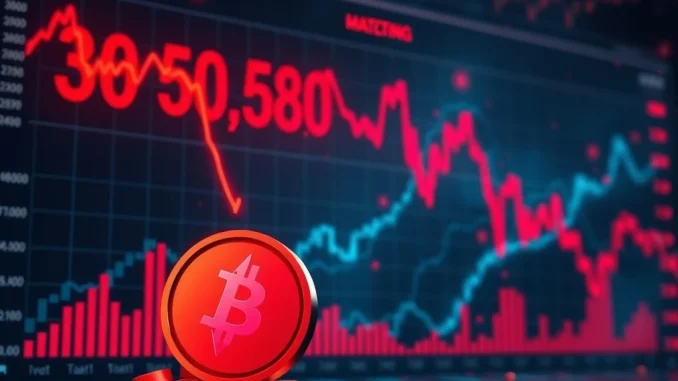
The cryptocurrency market experienced a swift and substantial downturn recently. Major exchanges witnessed a staggering **$118 million worth of futures liquidated** in just one hour. This rapid event highlights the inherent risks of digital asset trading. Furthermore, the broader impact extended over a 24-hour period. During this time, a total of **$370 million worth of futures** faced liquidation across various platforms. Such significant liquidations often signal increased **crypto market volatility** and can influence investor sentiment.
Understanding Crypto Liquidations and Their Mechanics
Crypto liquidations occur when an exchange forcibly closes a trader’s leveraged position. This happens due to a partial or total loss of the trader’s initial margin. Traders typically open leveraged positions to amplify potential gains. However, leverage also magnifies potential losses. If the market moves against a leveraged position, the trader’s margin might fall below the maintenance level. Consequently, the exchange steps in to prevent further losses for both the trader and the exchange itself. This process ensures market stability, even during rapid price movements. Therefore, understanding these mechanics is crucial for all participants.
The Mechanics of Futures Liquidation Explained
A **futures liquidation** event specifically relates to futures contracts. These contracts are agreements to buy or sell an asset at a predetermined price on a future date. Many traders use futures with leverage. For instance, a 10x leverage means a trader can control $10,000 worth of crypto with just $1,000 of their own capital. If the price moves favorably, profits are significantly boosted. Conversely, a small price drop can quickly erode the initial margin. When the margin account cannot cover potential losses, the position is liquidated. This forced closure often involves selling the underlying assets at current market prices. This action can further depress prices in a falling market. Thus, liquidations can create a cascade effect.
The Role of Leveraged Trading in Market Swings
**Leveraged trading** allows participants to trade with more capital than they actually possess. It is a powerful tool for experienced traders. However, it also carries substantial risks. The recent **$118 million futures liquidation** underscores this reality. While leverage can amplify returns, it also increases exposure to market fluctuations. A small percentage drop in the asset’s price can lead to a complete loss of the initial margin. This is why liquidations are a common occurrence in volatile markets. Traders must therefore manage their risk effectively. Without proper risk management, significant capital losses are highly probable. Consequently, many traders opt for lower leverage or avoid it altogether.
Impact on Crypto Market Volatility
Massive **crypto liquidations** often contribute directly to **crypto market volatility**. When large numbers of positions are liquidated, exchanges execute market orders to close them. These forced sales add selling pressure to the market. This increased selling pressure can drive prices down even further. As prices fall, more leveraged positions approach their liquidation threshold. This creates a feedback loop, often referred to as a ‘liquidation cascade.’ Such cascades can lead to sharp, sudden price drops. For example, the recent $370 million in 24-hour liquidations illustrates this phenomenon. Therefore, monitoring liquidation data provides insights into potential market shifts. This information helps traders anticipate price movements.
Navigating Derivatives Trading Risks
**Derivatives trading**, including futures, offers diverse strategies for market participants. However, it is not without significant risks. The recent liquidation events serve as a stark reminder. Traders must understand margin requirements and liquidation thresholds thoroughly. They should also implement robust risk management strategies. This includes setting stop-loss orders. Stop-loss orders automatically close a position if the price drops to a certain level. Diversifying portfolios can also mitigate risk. Furthermore, avoiding excessive leverage is a prudent approach. Market participants should only invest what they can afford to lose. Educating oneself about market dynamics is also paramount. This proactive approach helps navigate the complex world of crypto derivatives. Ultimately, informed decisions are key to success.
The recent **$118 million futures liquidation** event serves as a critical reminder for all cryptocurrency traders. High leverage, while enticing, can lead to swift and significant losses during periods of market volatility. Understanding the mechanisms of **crypto liquidations** and the inherent risks of **leveraged trading** and **derivatives trading** is essential. As the market continues to evolve, prudent risk management and continuous education remain the most valuable tools for navigating its unpredictable nature. Always prioritize capital preservation.
Frequently Asked Questions (FAQs)
Q1: What exactly are crypto liquidations?
A1: Crypto liquidations occur when an exchange closes a trader’s leveraged position. This happens automatically if the trader’s margin falls below a required level. It prevents further losses for both the trader and the exchange.
Q2: Why did $118 million worth of futures liquidate so quickly?
A2: A rapid price movement against highly leveraged positions triggered the liquidations. When market prices drop suddenly, many leveraged traders no longer meet their margin requirements. This forces exchanges to close their positions.
Q3: How does leveraged trading contribute to such large liquidation events?
A3: Leveraged trading amplifies both gains and losses. While it can increase profits, it also means a smaller price movement can wipe out a trader’s initial margin. This increased exposure makes traders more vulnerable to sudden market shifts.
Q4: Is derivatives trading inherently risky?
A4: Yes, derivatives trading, including futures, carries significant risks. It often involves leverage, which can lead to substantial losses if the market moves unfavorably. Proper risk management and a thorough understanding of market mechanics are crucial.
Q5: What can traders do to avoid being liquidated?
A5: Traders can implement several strategies. These include using lower leverage, setting stop-loss orders, maintaining sufficient margin, and diversifying their portfolios. Continuous education about market conditions also helps mitigate risks.