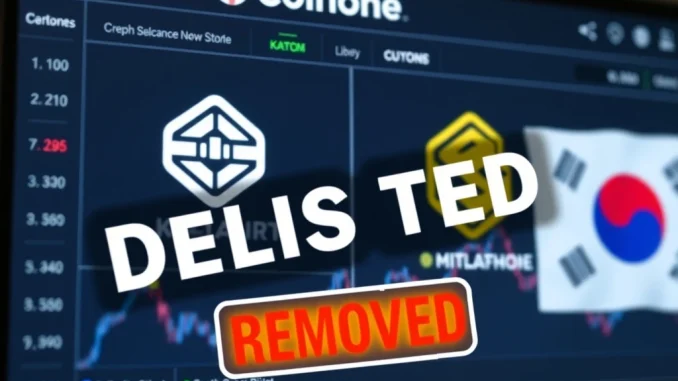
The South Korean cryptocurrency market frequently experiences dynamic shifts. Consequently, investors must stay informed about critical developments. Recently, Coinone, a prominent South Korean crypto exchange, announced a significant decision. The exchange confirmed the **Coinone delisting** of two digital assets: KAI and FRONT. This move will occur at 6:00 a.m. UTC on October 13. Such announcements often trigger immediate reactions across the crypto community. Therefore, understanding the implications is crucial for affected users and the broader market.
Coinone Delisting KAI and FRONT: Essential Details
Coinone officially announced the cessation of trading support for KAI and FRONT. This decision affects users holding these specific tokens on the platform. Specifically, the delisting date is set for October 13, 2023, at 6:00 a.m. UTC. After this time, users will no longer be able to trade these assets on Coinone. Therefore, all affected holders must take prompt action. They need to manage their assets effectively before the deadline.
Furthermore, Coinone will typically provide a withdrawal period for delisted assets. This period allows users to transfer their KAI and FRONT tokens to external wallets or other exchanges. Users should check Coinone’s official announcement for precise details regarding withdrawal deadlines. Failure to withdraw assets within the specified timeframe can lead to permanent loss. Consequently, this makes timely action imperative for all investors.
Understanding the Rationale Behind Cryptocurrency Delisting Impact
Cryptocurrency exchanges delist assets for various reasons. These decisions are not arbitrary; instead, they stem from a comprehensive evaluation process. Firstly, low liquidity or trading volume often plays a significant role. Assets with minimal trading activity do not contribute substantially to the exchange’s ecosystem. Secondly, regulatory compliance issues can force an exchange’s hand. Exchanges operate under strict guidelines, especially in jurisdictions like South Korea. Non-compliant assets pose a risk. Thirdly, project inactivity or a failure to meet roadmap milestones can lead to delisting. Investors expect continuous development and innovation from crypto projects.
Moreover, security vulnerabilities represent another critical factor. Exchanges prioritize the safety of user funds. Any asset posing a security risk will likely face delisting. Furthermore, a lack of community engagement or transparency can also be detrimental. Projects need an active community and clear communication channels. Coinone, like other major exchanges, regularly reviews listed assets. This ensures they maintain a high standard of quality and compliance. While Coinone did not immediately disclose specific reasons for the KAI and FRONT delistings, these general criteria typically guide such decisions. Understanding these factors helps shed light on the broader **cryptocurrency delisting impact**.
The Immediate Impact on KAI Crypto and FRONT Crypto Holders
The news of the **Coinone delisting** directly impacts holders of **KAI crypto** and **FRONT crypto**. First and foremost, these investors face an urgent need to move their assets. They must transfer their tokens off the Coinone platform before the October 13 deadline. Options include withdrawing to a personal, self-custody wallet or sending them to another exchange that still lists these assets. Failure to do so could result in inaccessible funds.
Secondly, the delisting announcement often triggers price volatility for the affected tokens. Selling pressure may increase as holders rush to offload their assets. This can lead to a significant drop in value. Conversely, some may hold, hoping for a rebound on other platforms. However, liquidity might be severely reduced across the market. Therefore, investors must carefully consider their options and act quickly. Evaluating alternative trading venues becomes a priority for those wishing to continue holding or trading KAI and FRONT.
Navigating South Korean Crypto Exchange Regulations
South Korea maintains one of the world’s most stringent regulatory frameworks for cryptocurrencies. The financial authorities aim to protect investors and prevent illicit activities. Consequently, this environment heavily influences the operations of every **South Korean crypto exchange**, including Coinone. Regulations mandate strict anti-money laundering (AML) and know-your-customer (KYC) procedures. Exchanges must also report suspicious transactions and adhere to data protection laws. This rigorous oversight means exchanges must be highly selective about the assets they list.
Furthermore, South Korean regulations often require exchanges to evaluate projects for their financial stability and technological viability. Projects that do not meet these high standards risk being delisted. The Financial Services Commission (FSC) and the Financial Intelligence Unit (FIU) are key regulatory bodies. They work to ensure compliance across the industry. Therefore, a delisting by Coinone could signal that KAI and FRONT no longer meet the exacting standards set by either the exchange itself or the national regulators. This regulatory pressure contributes significantly to the overall **cryptocurrency delisting impact** within the country.
A Closer Look at KAI and FRONT Projects
To fully grasp the situation, it helps to understand the projects involved. KAI, or Klaytn, is a blockchain platform developed by Kakao, a major South Korean tech conglomerate. Klaytn aims to provide an enterprise-grade blockchain service. It focuses on facilitating the widespread adoption of blockchain technology. KAI crypto is the native token of the Klaytn network, used for transaction fees and staking. Despite its origins, the project may have faced challenges in maintaining its market position or meeting Coinone’s listing criteria.
FRONT, or Frontier, is a decentralized finance (DeFi) aggregation layer. It aims to connect various DeFi protocols and services. Frontier allows users to track and manage their DeFi portfolios across different platforms. The **FRONT crypto** token serves as a utility token within its ecosystem, enabling staking, governance, and gas fees. Like many smaller-cap projects, Frontier likely contended with intense competition and evolving market demands. These factors can influence an exchange’s decision regarding continued support, especially for a prominent **South Korean crypto exchange** like Coinone.
Broader Implications for the Crypto Market
Delistings, such as the recent **Coinone delisting** of KAI and FRONT, serve as a market hygiene factor. They help to clear out underperforming or non-compliant assets. This process contributes to a healthier overall market. It forces projects to maintain high standards of development, transparency, and regulatory adherence. For investors, these events underscore the inherent risks in the cryptocurrency space. Not all projects succeed, and not all listed assets retain their exchange support indefinitely. Consequently, investor confidence can be affected, particularly if delistings become frequent or involve high-profile assets.
Moreover, these actions highlight the importance of due diligence for investors. Before investing, individuals should thoroughly research a project’s fundamentals, team, technology, and community. They must also monitor exchange announcements and regulatory changes. The trend of delistings suggests a maturation of the crypto market. Exchanges are becoming more selective, prioritizing quality and regulatory compliance. This is a positive sign for the long-term sustainability of the industry. However, it presents immediate challenges for holders of affected tokens. The overall **cryptocurrency delisting impact** shapes market perceptions and investment strategies.
What Investors Can Learn from This Coinone Delisting
This event offers several crucial lessons for cryptocurrency investors. Firstly, diversification remains a key strategy. Spreading investments across various assets and platforms can mitigate the risk associated with a single project’s failure or delisting. Secondly, staying informed about project developments is paramount. Active projects with clear roadmaps and transparent communication are generally more stable. Investors should regularly check project updates, community forums, and official announcements.
Thirdly, monitoring exchange announcements is essential. Exchanges provide critical information regarding listing status, withdrawal deadlines, and policy changes. Subscribing to official exchange notifications can help investors react promptly. Finally, understanding regulatory environments is increasingly important. Regions with strict regulations, like South Korea, often see more rigorous asset reviews. Therefore, investors should consider the regulatory landscape of the exchanges they use. This proactive approach helps in navigating the volatile crypto market more effectively. It also prepares investors for potential **cryptocurrency delisting impact**.
The **Coinone delisting** of KAI and FRONT serves as a stark reminder of the dynamic nature of the cryptocurrency market. While such events can cause immediate concern for affected holders, they also reflect a maturing industry striving for greater compliance and quality. Holders of **KAI crypto** and **FRONT crypto** must act quickly to secure their assets before the October 13 deadline. This situation underscores the critical need for vigilance, due diligence, and proactive asset management in the fast-paced world of digital currencies. The actions of a prominent **South Korean crypto exchange** like Coinone often set precedents, influencing both local and international market trends.
Frequently Asked Questions (FAQs)
Q1: What does Coinone delisting KAI and FRONT mean for me if I hold these tokens?
If you hold KAI or FRONT tokens on Coinone, it means you will no longer be able to trade them on the exchange after October 13, 2023, 6:00 a.m. UTC. You must withdraw your assets to a personal wallet or another exchange that supports these tokens before the specified deadline. Failure to do so may result in the permanent loss of your funds.
Q2: Why did Coinone decide to delist KAI and FRONT?
While Coinone did not provide specific reasons for this particular delisting, exchanges typically delist assets due to factors such as low trading volume, failure to meet regulatory compliance standards, project inactivity, security concerns, or lack of community engagement. These decisions aim to maintain a healthy and compliant trading environment.
Q3: What should I do with my KAI crypto and FRONT crypto before the deadline?
You have two primary options: 1) Withdraw your tokens to a personal, non-custodial wallet (e.g., a hardware wallet or a software wallet you control). 2) Transfer your tokens to another cryptocurrency exchange that continues to list and support KAI and FRONT. Always double-check the receiving address and ensure it is correct to prevent loss.
Q4: How does this delisting affect the value of KAI and FRONT?
Delisting announcements often lead to increased selling pressure and reduced liquidity for the affected tokens. This can cause a significant drop in their market value, especially in the short term. Investors may rush to sell before the delisting, further impacting prices. The long-term impact depends on the projects’ ability to find new liquidity and maintain development.
Q5: Is this a common occurrence in the cryptocurrency market?
Yes, cryptocurrency delistings are a relatively common occurrence. As the market matures and regulatory scrutiny increases, exchanges regularly review their listed assets. They remove those that no longer meet their listing criteria, performance standards, or regulatory requirements. This process helps maintain market quality and investor protection.
Q6: What can investors learn from this Coinone delisting to protect their investments?
Investors should prioritize diversification across different assets and exchanges. Always conduct thorough due diligence on projects before investing, focusing on their fundamentals, team, and roadmap. Stay informed about exchange announcements and regulatory changes. Regularly monitor your portfolio and be prepared to act quickly in response to significant market news like delistings.