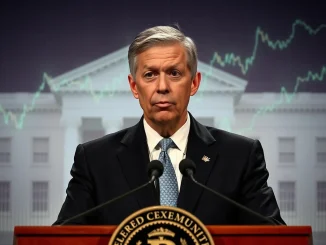
A significant call from one of the world’s largest asset managers has sent ripples through financial circles. Specifically, BlackRock’s Chief Investment Officer (CIO) recently stated that the Federal Reserve should implement substantial interest rate cuts, proposing a 50 basis point reduction as early as next week. This bold recommendation, reported by Watcher.Guru, immediately sparked discussions about its potential crypto market impact and broader economic implications. Investors across all sectors, particularly those in the volatile cryptocurrency space, are closely watching these developments. Understanding the reasoning behind such a move and its likely consequences becomes paramount for informed decision-making.
BlackRock CIO’s Urgent Call for Rate Cuts
Rick Rieder, BlackRock’s Chief Investment Officer of Global Fixed Income, articulated a strong stance on the future direction of U.S. monetary policy. He argues for an immediate and significant shift from the current approach. According to reports, Rieder believes the Federal Reserve needs to act decisively to support economic stability. His proposal suggests a 50 basis point reduction in interest rates, which represents a substantial adjustment in the Fed’s target range. Such a move would aim to ease financial conditions and stimulate economic activity. Historically, large rate cuts often signal concerns about economic slowdowns or a desire to preemptively boost growth. Consequently, this statement from a prominent BlackRock CIO carries considerable weight within global financial markets.
A basis point, for clarity, is one-hundredth of a percentage point. Therefore, a 50 basis point cut translates to a 0.50% reduction in the federal funds rate. This level of reduction is typically reserved for periods requiring strong intervention. Rieder’s comments highlight a divergence in opinion between some market participants and the Fed’s publicly stated intentions. Many analysts had anticipated a more gradual approach to rate adjustments, or even a pause, rather than such an aggressive cut. Therefore, BlackRock’s public declaration adds a new dimension to the ongoing debate about the future of interest rates.
Understanding the Federal Reserve’s Monetary Policy
The Federal Reserve, often simply called the Fed, serves as the central bank of the United States. Its primary mandates include maximizing employment, stabilizing prices (controlling inflation), and moderating long-term interest rates. The Federal Open Market Committee (FOMC) is responsible for setting the nation’s monetary policy. They typically achieve this by adjusting the federal funds rate, which influences other interest rates throughout the economy. When the Fed raises rates, borrowing becomes more expensive, which can cool down an overheating economy and curb inflation. Conversely, when the Fed cuts rates, borrowing costs decrease, encouraging spending and investment.
Currently, the U.S. economy faces a complex landscape. Inflation has shown signs of cooling, but it remains above the Fed’s long-term target of 2%. Furthermore, the labor market, while robust, shows some signs of softening. These factors contribute to the ongoing debate about the appropriate course for interest rates. BlackRock’s CIO, Rick Rieder, likely views the current economic indicators as justification for a more aggressive easing policy. He may believe that a proactive cut is necessary to prevent a deeper economic downturn or to provide sufficient stimulus for sustained growth. Therefore, his call directly challenges the Fed’s cautious ‘higher for longer’ narrative.
Implications of Aggressive Interest Rate Cuts
Aggressive interest rate cuts can have profound effects across various financial sectors. Here are some key implications:
- Lower Borrowing Costs: Consumers and businesses benefit from cheaper loans for mortgages, car loans, and business expansion. This typically stimulates demand.
- Boost to Stock Markets: Lower interest rates often make equities more attractive compared to fixed-income investments. Companies also see reduced borrowing costs, potentially boosting profits.
- Weaker U.S. Dollar: Reduced interest rates can make the dollar less attractive to foreign investors, leading to its depreciation. This can make U.S. exports more competitive.
- Increased Liquidity: More money flows into the financial system, seeking higher returns. This increased liquidity can find its way into various asset classes, including riskier ones.
Such a substantial shift in policy would signal a significant change in the Fed’s outlook. It suggests a move away from inflation containment as the primary focus towards stimulating growth. Investors must carefully consider these potential shifts. The impact on traditional assets like bonds and equities could be immediate. Bond yields would likely fall, while stock markets could see an upward trajectory. Understanding these dynamics is crucial for portfolio management.
Potential Crypto Market Impact
The cryptocurrency market, known for its volatility, is highly sensitive to macroeconomic shifts and monetary policy decisions. A 50 basis point cut in the federal funds rate could have a notable crypto market impact for several reasons:
- Increased Risk Appetite: Lower interest rates often encourage investors to seek higher returns in riskier assets. Cryptocurrencies, generally considered risk-on assets, could benefit from this increased appetite.
- Dollar Weakness: A weaker U.S. dollar, a common outcome of rate cuts, can make dollar-denominated assets like Bitcoin more attractive to international investors.
- Search for Yield: With traditional savings and bond yields decreasing, investors might allocate more capital to alternative investments like crypto in search of better returns.
- Inflation Hedge Narrative: Some investors view Bitcoin as a hedge against inflation or currency debasement. While rate cuts might aim to stimulate, they can also raise long-term inflation concerns, potentially reinforcing this narrative for crypto.
Historically, periods of quantitative easing and lower interest rates have often coincided with bull runs in the crypto market. The influx of liquidity into the financial system frequently finds its way into digital assets. Therefore, a move by the Federal Reserve towards aggressive easing, as advocated by BlackRock’s CIO, could create a more favorable environment for cryptocurrencies. However, it is essential to remember that the crypto market also responds to its unique internal dynamics and regulatory developments.
Broader Market Reactions to Monetary Policy Shifts
The broader financial landscape would undoubtedly react strongly to a significant shift in the Federal Reserve‘s approach. Bond markets would likely see immediate price increases and yield decreases. Stock markets, particularly growth-oriented sectors, could experience a rally as borrowing costs fall and future earnings look more attractive. The U.S. dollar’s value against other major currencies would also be a key area to watch. A weaker dollar can boost commodities prices, as they become cheaper for holders of other currencies.
Moreover, the global implications of U.S. monetary policy are substantial. Many central banks around the world often take cues from the Fed. If the U.S. begins aggressive interest rate cuts, it could prompt other nations to consider similar easing measures to maintain competitive currency valuations and support their own economies. This synchronized global easing could further amplify the effects across all asset classes, including the crypto market impact. Therefore, BlackRock’s CIO’s recommendation extends far beyond domestic U.S. economic considerations, resonating with investors worldwide.
In conclusion, the call from BlackRock’s CIO for a 50 basis point cut by the Federal Reserve represents a significant voice in the ongoing debate over U.S. monetary policy. While the Fed’s ultimate decision remains uncertain, such a move would undoubtedly reshape the economic landscape. Investors, particularly those in the cryptocurrency space, should monitor these developments closely. The potential for lower interest rates to fuel risk appetite and increase liquidity could have a profound crypto market impact. Remaining informed about these macro trends is crucial for navigating the evolving financial markets.
Frequently Asked Questions (FAQs)
1. What is a basis point in the context of interest rates?
A basis point (bp) is a common unit of measure in finance, representing one-hundredth of a percentage point. So, a 50 basis point cut means the interest rate is reduced by 0.50%.
2. Why does BlackRock’s CIO advocate for such aggressive interest rate cuts?
BlackRock’s CIO, Rick Rieder, likely believes that a substantial reduction in rates is necessary to stimulate economic growth, ease financial conditions, and potentially preempt a deeper economic slowdown. This view contrasts with the Federal Reserve’s more cautious approach.
3. How do Federal Reserve decisions on interest rates affect the crypto market impact?
Federal Reserve decisions on interest rate cuts can significantly influence the crypto market impact. Lower rates typically increase investor appetite for riskier assets like cryptocurrencies, weaken the U.S. dollar, and boost overall market liquidity, which can be favorable for crypto prices.
4. What is monetary policy, and who sets it in the U.S.?
Monetary policy refers to actions undertaken by a central bank to influence the availability and cost of money and credit to help promote national economic goals. In the United States, the Federal Open Market Committee (FOMC) of the Federal Reserve sets monetary policy.
5. What is BlackRock’s significance in financial markets?
BlackRock is the world’s largest asset manager, overseeing trillions of dollars in assets. Its opinions and actions are closely watched by investors and policymakers globally due to its vast influence and insights into market trends and economic conditions.