The financial world recently witnessed a significant event: **gold futures** prices reached an unprecedented high, surging past the $3,600 per ounce mark. This monumental achievement immediately captures the attention of investors across all asset classes, including those deeply entrenched in cryptocurrencies. Indeed, gold’s performance often signals broader shifts in **investor sentiment** and economic outlook, making it crucial for every market participant to understand its implications.
Gold Futures Reach Unprecedented Heights
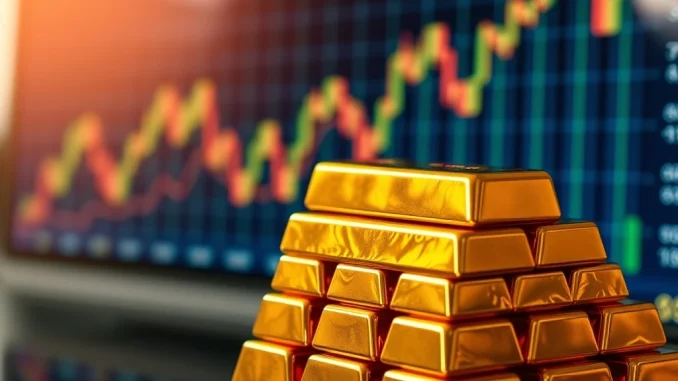
New York gold futures prices officially hit a new record high, touching $3,600 per ounce. This milestone represents a substantial increase, reflecting growing demand for the precious metal. Historically, gold has served as a reliable store of value, particularly during times of economic uncertainty. This recent surge underscores its enduring appeal. Therefore, many investors closely monitor gold’s movements to gauge market health. For instance, strong gold performance often correlates with inflationary concerns or geopolitical tensions.
Furthermore, this record-breaking ascent did not happen in isolation. It reflects a confluence of global economic factors. Analysts are now scrutinizing the underlying drivers behind this remarkable rally. Clearly, understanding these dynamics is essential for anticipating future market trends. This is especially true for those navigating the volatile cryptocurrency landscape, as traditional asset movements frequently influence digital assets.
What Drives the Gold Price Record?
Several key factors contribute to the impressive **gold price record**. Firstly, persistent inflation concerns globally continue to push investors towards tangible assets. Central banks worldwide have implemented expansionary monetary policies, increasing money supply. Consequently, this often devalues fiat currencies, making gold a more attractive hedge. Many perceive gold as a safeguard against purchasing power erosion.
Secondly, geopolitical instability plays a significant role. Conflicts and political uncertainties create a flight to safety, with gold being a primary beneficiary. Investors seek refuge in assets perceived as less risky. Moreover, the weakening of the U.S. dollar can also bolster gold prices, as gold becomes cheaper for holders of other currencies. Therefore, a depreciating dollar often correlates with rising gold values. Finally, increased central bank gold purchases also support the price. These institutions often diversify their reserves, further boosting demand for gold.
Precious Metals and Investor Sentiment
The performance of **precious metals**, particularly gold, offers a clear window into broader **investor sentiment**. When uncertainty pervades financial markets, investors typically gravitate towards safe-haven assets. Gold’s recent surge strongly suggests a prevailing cautious mood among global investors. They are actively seeking protection against potential economic downturns or market volatility. This flight to safety is a common pattern observed throughout history.
Furthermore, the demand for gold often reflects a lack of confidence in traditional equity markets or government bonds. When interest rates are low or real returns on bonds are negative, gold’s appeal grows. Investors want assets that preserve capital. Thus, the record high indicates a strong preference for stability. This sentiment can also indirectly affect cryptocurrency markets. For example, if traditional markets appear unstable, some investors might consider cryptocurrencies as an alternative, albeit riskier, hedge. However, others might pull back from all speculative assets, including crypto, in favor of gold.
Implications for Broader Market Stability
The sustained rally in gold futures has significant implications for overall **market stability**. Gold’s role as a counter-cyclical asset means its strength can signal underlying weaknesses in the broader economy. For instance, if investors are flocking to gold, it suggests they anticipate challenges ahead. This could include a slowdown in economic growth or an escalation of existing financial pressures. Therefore, gold’s performance acts as a barometer for market health.
Moreover, the increased demand for gold can draw capital away from other asset classes. This might include equities, bonds, and even cryptocurrencies. While gold and crypto often move independently, periods of extreme market stress can see correlations emerge. A strong gold market might indicate a more risk-averse environment, which could temper enthusiasm for riskier assets like Bitcoin and altcoins. Consequently, monitoring gold’s trajectory provides valuable insights into the prevailing risk appetite across global financial markets.
Gold vs. Bitcoin: A Safe Haven Debate
The debate between gold and Bitcoin as ultimate safe havens continues to intensify, especially with the recent **gold price record**. Gold, the traditional store of value, boasts millennia of history and universal acceptance. It is a tangible asset, resistant to cyberattacks, and its supply increases predictably. On the other hand, Bitcoin, often dubbed ‘digital gold,’ offers decentralization, censorship resistance, and a verifiable fixed supply cap. Both assets are seen as hedges against inflation and government overreach.
However, key differences remain. Bitcoin’s volatility far exceeds gold’s, making it a higher-risk, higher-reward asset. Gold’s liquidity and regulatory framework are well-established. Bitcoin’s market is still maturing and faces evolving regulatory landscapes. For cryptocurrency investors, gold’s performance provides a benchmark. It highlights the enduring demand for non-fiat assets. Ultimately, an investor’s choice often depends on their risk tolerance and investment horizon. Diversification, therefore, often includes both, recognizing their distinct roles in a portfolio.
Navigating Current Market Trends
Understanding the current **market trends**, particularly gold’s record surge, is paramount for informed decision-making. Investors should consider how this impacts their diversified portfolios. While gold provides a hedge against inflation and uncertainty, it may not offer the same growth potential as some other assets. Therefore, a balanced approach is often advisable. Monitoring macroeconomic indicators, such as inflation rates, interest rate decisions, and geopolitical developments, becomes crucial. These factors directly influence both gold and the broader financial markets.
For cryptocurrency enthusiasts, gold’s strength can serve as a reminder of the market’s interconnectedness. While digital assets offer unique advantages, they are not entirely insulated from traditional market forces. Savvy investors might consider a strategic allocation across various asset classes. This includes both traditional safe havens like gold and innovative digital assets like Bitcoin. Ultimately, staying informed and adapting investment strategies to evolving market conditions remains key to long-term success.
Conclusion
The historic rise of **gold futures** prices above $3,600 per ounce marks a significant moment in financial markets. This **gold price record** underscores deep-seated concerns about inflation and geopolitical stability, directly influencing **investor sentiment**. As a result, demand for **precious metals** continues to soar, signaling a cautious outlook on overall **market stability**. For cryptocurrency investors, this development offers valuable insights into the broader financial landscape, highlighting the ongoing debate between traditional and digital safe havens. Navigating these complex **market trends** requires careful analysis and a diversified approach to investment. Ultimately, understanding gold’s strength helps us better comprehend the forces shaping our interconnected global economy.
Frequently Asked Questions (FAQs)
Q1: What does the new gold futures record high signify?
A1: The new gold futures record high, surpassing $3,600 per ounce, primarily signifies increased investor demand for safe-haven assets. It suggests prevailing concerns about inflation, economic uncertainty, and geopolitical instability. Investors are seeking to protect their wealth by moving into assets traditionally seen as reliable stores of value.
Q2: How does gold’s performance impact cryptocurrency markets?
A2: Gold’s performance can indirectly impact cryptocurrency markets by reflecting broader investor sentiment and risk appetite. When gold surges due to economic uncertainty, some investors might pull back from riskier assets, including cryptocurrencies. Conversely, others might see cryptocurrencies like Bitcoin as an alternative ‘digital gold’ hedge. The interplay highlights the interconnectedness of global financial markets.
Q3: What factors are driving the current gold price record?
A3: Several factors are driving the current gold price record. These include high global inflation rates, which erode the purchasing power of fiat currencies; ongoing geopolitical tensions that increase market uncertainty; sustained purchases by central banks; and a potential weakening of the U.S. dollar, making gold cheaper for international buyers.
Q4: Is gold still considered a better safe-haven asset than Bitcoin?
A4: The debate between gold and Bitcoin as safe-haven assets continues. Gold has millennia of history and lower volatility, making it a traditional choice. Bitcoin offers decentralization and a fixed supply, appealing to a new generation of investors. While Bitcoin has shown potential as an inflation hedge, its higher volatility means it carries more risk. The ‘better’ option often depends on an individual investor’s risk tolerance and investment goals.
Q5: How should investors react to the gold futures record?
A5: Investors should view the gold futures record as a signal of current market conditions, particularly heightened uncertainty and inflation concerns. It’s an opportune time to review portfolio diversification, assess risk exposure, and consider how traditional assets like gold fit into their overall strategy alongside other investments, including cryptocurrencies. Staying informed about macroeconomic trends is crucial.