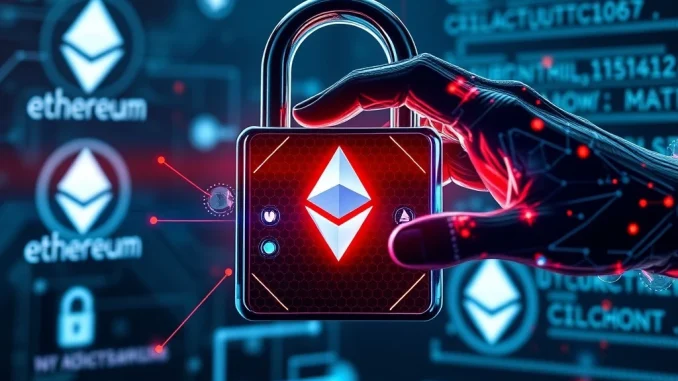
WLFI holders currently face a critical new threat. Recent **Ethereum phishing attacks** are exploiting a novel feature, EIP-7702, endangering digital assets. This sophisticated method targets users by leveraging a recent Ethereum upgrade. Therefore, understanding this vulnerability is crucial for asset protection.
Unpacking the EIP-7702 Exploit and Its Impact
Ethereum Improvement Proposal EIP-7702 is a significant development. It was included in the Pectra upgrade in May. This proposal allows an externally owned account (EOA) to temporarily function like a smart contract wallet. Consequently, it enables delegated execution permissions and batch transactions. This feature aims to enhance flexibility and user experience within the Ethereum ecosystem. However, it has also introduced new vulnerabilities.
Yu Xian, founder of the blockchain security firm SlowMist, posted on X about these emerging threats. He explained that hackers are exploiting EIP-7702. They plant addresses they control directly into victims’ wallets. This allows them to steal tokens. The exploit essentially tricks the EOA into delegating control to a malicious address. Therefore, users must remain highly vigilant.
The Broader Landscape of Ethereum Phishing Attacks
Phishing attacks are unfortunately common in the cryptocurrency space. Yet, this new vector represents a concerning evolution. Traditional phishing often involves fake websites or malicious links. These new **Ethereum phishing attacks** leverage a core protocol change. This makes them particularly insidious. Users might unknowingly approve a malicious delegation, believing it to be a legitimate transaction. Ultimately, this leads to unauthorized token transfers.
Furthermore, the temporary smart contract functionality of EOAs, enabled by EIP-7702, blurs lines. It creates a complex environment for users. Verifying transaction details becomes more challenging. Therefore, education on these new attack methods is paramount. Security experts continually warn about the evolving nature of cyber threats in crypto. This incident underscores that reality.
Fortifying WLFI Security Against Emerging Threats
Protecting your assets, especially for **WLFI security**, requires proactive measures. Firstly, always verify the legitimacy of any transaction request. Do not blindly approve unknown delegations or batch transactions. Secondly, regularly review your wallet permissions. Many tools exist to check and revoke token approvals. This helps minimize exposure to previously granted malicious access.
Consider using a hardware wallet for storing significant assets. Hardware wallets offer an additional layer of security. They require physical confirmation for transactions. This makes remote exploitation much harder. In addition, stay informed about the latest security advisories. Follow reputable security firms like SlowMist. Their alerts provide timely warnings about new threats. Ultimately, personal vigilance forms the strongest defense.
Mitigating Crypto Security Threats on Ethereum
The incident highlights the ongoing battle against **crypto security threats**. As blockchain technology advances, so do the methods of attackers. The Pectra upgrade, while bringing innovative features, also opens new potential attack vectors. The community must adapt quickly. Developers, security firms, and users all play a role. Implementing multi-factor authentication (MFA) on all crypto-related accounts is a baseline defense.
Moreover, platforms and wallets should enhance their user interfaces. They need to clearly communicate the implications of complex transactions. This includes those involving delegated execution. Simple, understandable warnings can prevent many exploits. Collaboration between security researchers and protocol developers is also vital. This helps identify and patch vulnerabilities before widespread exploitation occurs. Ultimately, a layered security approach is essential for the entire ecosystem.
Navigating Pectra Upgrade Risks and Beyond
The **Pectra upgrade risks** are not just theoretical; they are actively being exploited. This situation serves as a stark reminder. New features, even those designed for efficiency and flexibility, can introduce unforeseen vulnerabilities. Therefore, users must approach any new protocol upgrade with caution. They need to understand its implications for their security posture. Do not rush into using new functionalities without proper research.
Furthermore, the broader implication is clear. The crypto space requires continuous learning and adaptation. Both users and developers must prioritize security. Regular security audits of smart contracts and protocol changes are non-negotiable. Ultimately, the collective effort of the community will determine its resilience against these evolving threats. Stay updated, stay secure, and always question suspicious activity.
Conclusion
The exploitation of EIP-7702 by **Ethereum phishing attacks** poses a significant risk to WLFI holders and the broader Ethereum community. As reported by SlowMist’s Yu Xian, hackers are leveraging the Pectra upgrade’s new features to steal tokens. Consequently, understanding this mechanism is vital. Users must adopt enhanced security practices. These include verifying transactions, reviewing permissions, and utilizing hardware wallets. The ongoing evolution of **crypto security threats** demands constant vigilance and proactive measures from everyone involved in the digital asset space.
Frequently Asked Questions (FAQs)
What is EIP-7702?
EIP-7702 is an Ethereum Improvement Proposal. It allows an externally owned account (EOA) to temporarily behave like a smart contract wallet. This enables features such as delegated execution permissions and batch transactions. It was included in the Pectra upgrade.
How are hackers exploiting EIP-7702?
Hackers exploit EIP-7702 by tricking users into delegating execution permissions to malicious addresses they control. Once permission is granted, the hackers can then initiate transactions to steal the victim’s tokens from their wallet.
Are only WLFI holders affected by these phishing attacks?
While the initial report highlighted WLFI holders, the underlying vulnerability in EIP-7702 could potentially affect any user whose EOA interacts with this feature. All Ethereum users should exercise caution.
What steps can I take to protect my crypto assets from these attacks?
To protect your assets, always verify transaction details before approving. Regularly review and revoke token approvals for suspicious or unused dApps. Consider using a hardware wallet for storing your main assets. Stay informed about security alerts from reputable sources like SlowMist.
What is the Pectra upgrade?
The Pectra upgrade is a significant update to the Ethereum network. It bundles several Ethereum Improvement Proposals (EIPs), including EIP-7702. Its goal is to enhance the network’s functionality, security, and scalability.
Who is Yu Xian and SlowMist?
Yu Xian is the founder of SlowMist, a prominent blockchain security firm. SlowMist specializes in identifying and analyzing security vulnerabilities within the cryptocurrency ecosystem. They provide intelligence on emerging threats and help secure blockchain projects.