Understanding the pulse of the cryptocurrency market is vital for any trader or investor. Specifically, analyzing BTC perpetual futures provides crucial insights. These instruments offer a way to trade Bitcoin’s price movements without an expiry date. The long/short ratio is a key metric. It reveals the prevailing sentiment among traders on major exchanges. This article dives deep into the latest data. We will explore what these figures mean for the broader Bitcoin futures market.
Understanding the BTC Perpetual Futures Landscape
BTC perpetual futures are a cornerstone of modern crypto trading. They allow participants to speculate on Bitcoin’s price. Unlike traditional futures, they do not expire. This makes them highly popular for continuous exposure. The funding rate mechanism keeps their price tethered to the spot price. Consequently, these contracts offer immense liquidity. Many professional traders rely on them. They also use them for hedging strategies.
Furthermore, these derivatives significantly influence price discovery. They reflect a broad spectrum of market opinions. Traders globally utilize these instruments. They offer leverage, amplifying potential gains or losses. Understanding their dynamics is essential. It provides a clearer picture of market direction. Thus, observing trading activity on these contracts becomes paramount.
Decoding the Long/Short Ratio: A Glimpse into Crypto Market Sentiment
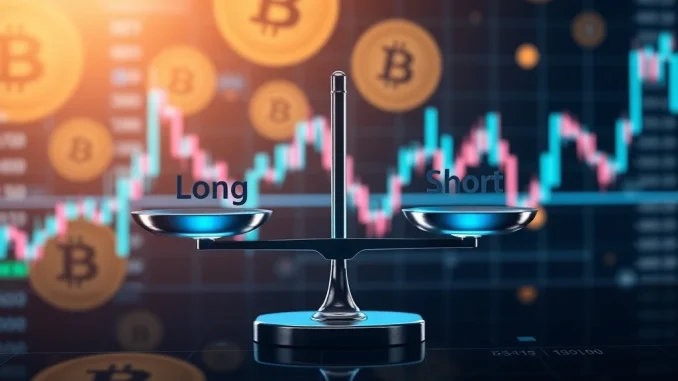
The long/short ratio serves as a powerful indicator. It measures the proportion of bullish versus bearish positions. Specifically, it compares the number of long positions to short positions. A ‘long’ position anticipates a price increase. Conversely, a ‘short’ position expects a price decrease. This ratio offers a snapshot of current crypto market sentiment.
When the ratio is above 1, more traders are long. This indicates a generally bullish outlook. Conversely, a ratio below 1 suggests more traders are short. This points towards a bearish sentiment. Therefore, monitoring this metric helps gauge collective trader psychology. It provides valuable context for price movements. However, it is just one piece of a larger puzzle. Traders combine this data with other analyses. This helps them form comprehensive trading strategies.
Current Snapshot: BTC Perpetual Futures Long/Short Ratio
The 24-hour long/short position ratio for BTC perpetual futures on the world’s top three crypto futures exchanges, ranked by open interest, provides a fascinating look. These exchanges command significant market share. Their data offers a robust representation of overall sentiment. Here is the latest breakdown:
- Overall: Long 49.88% / Short 50.12%
- Binance: Long 50.1% / Short 49.9%
- Bybit: Long 49.96% / Short 51.04%
- Gate.io: Long 50.13% / Short 49.87%
This data reveals a near-balanced market. Overall, short positions slightly outweigh long positions. However, individual exchange data presents subtle differences. These variations can be significant. They often reflect unique trading behaviors on each platform. Therefore, a closer look at each exchange is warranted. This helps uncover underlying trends. It also highlights specific market biases.
In-Depth Analysis of Top Exchanges’ Bitcoin Futures Data
Analyzing the Bitcoin futures data from leading platforms offers nuanced insights. Each exchange attracts a slightly different demographic of traders. This can lead to variations in their respective long/short ratios. Understanding these differences enriches our market perspective. It moves beyond a simple aggregated view.
Binance: A Slight Bullish Lean
Binance, the world’s largest cryptocurrency exchange, shows a long/short ratio of 50.1% long against 49.9% short. This indicates a marginal bullish preference among its traders. Despite the overall market leaning slightly short, Binance’s users appear marginally more optimistic. This slight bias could reflect the platform’s diverse user base. It includes many retail traders. They often exhibit a tendency to ‘buy the dip.’ Alternatively, larger institutional players on Binance might be accumulating long positions. This subtly shifts the balance. This data point is particularly important. Binance’s sheer volume means its sentiment often sets the tone. Its ratio can influence broader market perceptions. Furthermore, this slight positive sentiment suggests confidence in Bitcoin’s near-term price action.
Bybit: Predominantly Bearish Sentiment
Bybit’s data presents a contrasting picture. Its ratio stands at 49.96% long and 51.04% short. This clearly indicates a bearish dominance among its perpetual futures traders. More traders on Bybit are betting on a price decline. This stronger short interest might stem from several factors. Bybit is popular among professional derivatives traders. These traders often employ sophisticated shorting strategies. They might be hedging spot positions. Alternatively, they could be outright speculating on a downtrend. Consequently, Bybit’s ratio often provides an early warning. It can signal potential downward pressure. This makes it a crucial metric to watch. Its distinct bearish tilt is noteworthy. It suggests a lack of immediate bullish conviction on this platform.
Gate.io: Marginal Bullish Edge
Gate.io mirrors Binance’s sentiment to some extent. It reports 50.13% long and 49.87% short. This shows the highest percentage of long positions among the top three. Gate.io’s user base, while significant, might include a higher proportion of speculative long-term holders. These individuals often view price dips as buying opportunities. Their collective action pushes the long ratio slightly higher. This positive sentiment, albeit slight, contributes to the overall market balance. It suggests that despite some bearish pressures, a segment of the market remains confident. This confidence could be based on fundamental analysis. It might also reflect a belief in Bitcoin’s long-term value. Therefore, Gate.io’s data helps confirm diverse market opinions.
Interpreting Futures Trading Data for Market Direction
Understanding futures trading data goes beyond simply reading numbers. It involves interpreting what these ratios imply for future price movements. A perfectly balanced ratio, like the overall 49.88% long / 50.12% short, often suggests indecision. It can also indicate a period of consolidation. Neither bulls nor bears have a strong upper hand. This can lead to choppy price action. It may also precede a significant move in either direction.
However, consistent shifts in the ratio deserve attention. A sustained increase in long positions, for instance, could signal growing bullish momentum. Conversely, a surge in short positions might precede a price drop. Traders often look for divergences. For example, if the price is rising but the long/short ratio is decreasing, it could indicate a weakening rally. This suggests caution. Therefore, this metric acts as a crucial sentiment gauge. It helps validate or challenge price trends. It adds depth to technical analysis. Furthermore, combining this with open interest data provides even more context.
The Broader Impact of Crypto Market Sentiment on Strategies
The prevailing crypto market sentiment, as reflected by the long/short ratio, significantly impacts trading strategies. When sentiment is overwhelmingly bullish, many traders might consider taking profits. This is because extreme sentiment can often precede a reversal. Conversely, excessively bearish sentiment can sometimes indicate a bottom. This might present a buying opportunity for contrarian traders.
Experienced traders do not solely rely on this ratio. They integrate it with other technical indicators. These include moving averages, RSI, and volume analysis. For instance, a high long/short ratio combined with declining volume might signal a weakening trend. This prompts careful consideration. Therefore, this ratio serves as a powerful confirmation tool. It helps validate other signals. It allows traders to fine-tune their entry and exit points. Furthermore, understanding the collective mood helps manage risk effectively. It prevents emotional trading decisions. This strategic integration is key for sustained success.
Limitations and Nuances of Futures Trading Data
While invaluable, futures trading data, specifically the long/short ratio, has its limitations. Firstly, it only represents positions on specific exchanges. It does not capture all market activity. Over-the-counter (OTC) trades, for example, are not included. Secondly, not all long or short positions are speculative. Some traders use futures for hedging purposes. This means their positions do not necessarily reflect a directional bet. For instance, a miner might short Bitcoin futures to lock in future revenue. This distorts the pure sentiment reading.
Moreover, large institutional orders can heavily skew the ratio temporarily. A single large whale trade can dramatically shift the balance. This might not reflect broad market sentiment. Therefore, it is crucial to view this data with a critical eye. It should always be part of a comprehensive analysis. Relying solely on one metric can lead to misinterpretations. This emphasizes the need for a multi-faceted approach. Diversifying data sources provides a more accurate market picture. Consequently, traders should combine this ratio with other fundamental and technical analyses for robust decision-making.
Conclusion: Navigating the BTC Perpetual Futures Market
The latest BTC perpetual futures long/short ratio data offers a fascinating snapshot of current market sentiment. While the overall market appears nearly balanced, subtle differences emerge across top exchanges. Binance and Gate.io show a slight bullish bias. Bybit, however, leans bearish. This divergence highlights the varied perspectives within the market. These insights are crucial for traders. They help in making informed decisions. Monitoring these ratios, alongside other metrics, is essential. It allows participants to better anticipate potential price movements. The dynamic nature of the crypto market demands constant vigilance. Therefore, staying updated on these key indicators remains paramount for successful trading strategies.
Frequently Asked Questions (FAQs)
Q1: What exactly are BTC perpetual futures?
BTC perpetual futures are derivative contracts. They allow traders to speculate on Bitcoin’s future price. Unlike traditional futures, they do not have an expiration date. This makes them popular for continuous trading. They are cash-settled and often include leverage. A funding rate mechanism helps keep their price close to Bitcoin’s spot price.
Q2: How is the long/short ratio calculated?
The long/short ratio is calculated by dividing the total number or value of open long positions by the total number or value of open short positions. Alternatively, it can be presented as percentages of total open interest. It reflects the proportion of bullish versus bearish bets in the market.
Q3: Why is the long/short ratio important for Bitcoin futures traders?
The long/short ratio is a key indicator of crypto market sentiment. It helps traders gauge whether the majority of participants are bullish or bearish. This insight can help validate existing trends. It can also signal potential reversals. Consequently, it informs trading strategies and risk management.
Q4: Do different exchanges always show the same long/short ratio?
No, different exchanges often show slightly varied long/short ratio data. This is due to several factors. Each exchange has its own user base. These users may have different trading styles or geographical locations. For example, some exchanges might attract more retail traders. Others might see more institutional activity. These differences lead to variations in sentiment.
Q5: Can the long/short ratio predict future Bitcoin price movements accurately?
While the long/short ratio is a valuable sentiment indicator, it is not a standalone predictive tool. It reflects current market sentiment. Extreme ratios can sometimes precede reversals. However, it should always be used in conjunction with other technical and fundamental analyses. Relying solely on this ratio can lead to inaccurate predictions.
Q6: What other metrics should be considered alongside the long/short ratio?
For a comprehensive market view, consider several other metrics. These include open interest, funding rates, volume, and on-chain data. Technical analysis indicators like RSI, MACD, and moving averages are also crucial. Combining these elements provides a more robust understanding of market dynamics. This helps in making more informed trading decisions.