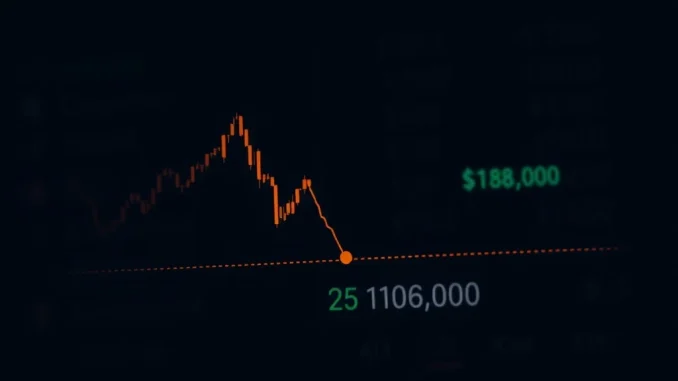
The cryptocurrency market often experiences swift and significant shifts. Today, a notable development has captured the attention of investors worldwide. According to Coin Pulse market monitoring, the Bitcoin price crash has seen BTC fall below a critical threshold. This sudden downturn prompts immediate questions about market stability and future direction for digital assets.
Currently, Bitcoin is trading at $107,988.2 on the Binance USDT market. This figure represents a considerable dip from recent highs. Such movements can trigger both concern and strategic opportunities for those involved in the digital asset space. Investors are closely watching for further indications of market sentiment.
Understanding the Recent BTC Market Analysis
A comprehensive BTC market analysis reveals several contributing factors to the recent price depreciation. Market participants often react to a confluence of macroeconomic data, regulatory news, and technical indicators. For instance, increased inflation concerns or shifts in global interest rates can significantly influence investor appetite for risk assets like Bitcoin. Furthermore, large sell-offs by whales or institutional players can exert downward pressure.
Technical analysis often highlights key support levels. The $108,000 mark served as a psychological and technical support point for many traders. Breaking below this level suggests a potential shift in market structure. Therefore, many analysts are now re-evaluating their short-term outlooks. Moreover, the broader market tends to follow Bitcoin’s lead. Consequently, a downturn in BTC often precipitates similar movements across altcoins.
Key Drivers Behind the Bitcoin Price Crash
Several elements likely contributed to the recent Bitcoin price crash. First, global economic uncertainties frequently push investors towards less volatile assets. Rising interest rates, for example, can make traditional investments more attractive. Secondly, profit-taking by long-term holders may also play a role. After periods of sustained growth, some investors choose to secure their gains. This can lead to increased selling pressure on exchanges.
Thirdly, unexpected regulatory announcements in major economies can introduce uncertainty. Such news often creates a cautious environment among institutional investors. Finally, specific on-chain metrics might signal a weakening sentiment. For example, a rise in exchange inflows indicates that more Bitcoin is being moved to trading platforms, potentially for sale. These combined factors paint a clearer picture of the current market dynamics.
What This Means for Cryptocurrency News Today
The latest cryptocurrency news today highlights the volatile nature of digital assets. Such price movements are not uncommon in the crypto space. However, a drop below a significant level like $108,000 often garners widespread attention. This event serves as a crucial indicator for the overall health of the market. It also prompts a renewed focus on risk management strategies for all participants.
Media outlets and analysts are now dissecting the implications of this decline. Many are exploring whether this is a temporary correction or the start of a more prolonged bearish trend. Investors, therefore, need to stay informed and adapt their strategies accordingly. The rapid dissemination of information in the crypto market means that developments can unfold quickly. Thus, continuous monitoring remains essential for informed decision-making.
Navigating Bitcoin Trading Strategies Amid Volatility
For active traders, understanding effective Bitcoin trading strategies during periods of high volatility is paramount. Some traders might view this dip as a buying opportunity, often referred to as ‘buying the dip.’ They believe the price will eventually recover. Conversely, others might opt to sell off their holdings to prevent further losses. This is known as stop-loss execution. Moreover, short-selling strategies can become profitable in a declining market.
Risk management tools are indispensable. Setting clear entry and exit points helps mitigate potential losses. Diversification across different assets can also reduce exposure to single asset volatility. Furthermore, dollar-cost averaging, where investors buy a fixed amount regularly, can smooth out the impact of price fluctuations. Ultimately, each trader must align their strategy with their individual risk tolerance and investment goals.
Analyzing the Broader BTC Price Movement
The recent BTC price movement extends beyond a single day’s trading. It is part of a larger narrative of market cycles and investor sentiment. Bitcoin, as the flagship cryptocurrency, often dictates the rhythm of the entire digital asset ecosystem. Its performance influences altcoins, decentralized finance (DeFi) protocols, and NFT markets. Therefore, a significant move by BTC sends ripples throughout the industry.
Historically, Bitcoin has demonstrated remarkable resilience, recovering from numerous significant downturns. However, past performance does not guarantee future results. Understanding the underlying forces driving these movements is crucial. This includes tracking institutional adoption, technological advancements within the Bitcoin network, and evolving global financial policies. Continuous research and analysis empower investors to make informed decisions in a dynamic market.
Expert Outlook and Future Prospects
Many crypto analysts are now offering their perspectives on Bitcoin’s immediate future. Some predict a quick rebound, citing strong underlying fundamentals and growing institutional interest. They suggest that the $108,000 level might be retested as resistance before a potential recovery. Other experts, however, caution against premature optimism. They point to potential further downside if key technical support levels fail to hold.
The next few days will be critical in determining market sentiment. Volume accompanying the price drop provides additional clues. High selling volume indicates strong conviction among sellers. Conversely, a quick bounce back with significant buying volume would signal renewed confidence. Investors are advised to remain vigilant and consider multiple perspectives before making any investment decisions. The market remains unpredictable, demanding careful observation.
Conclusion: Navigating the Volatile Crypto Landscape
The fall of Bitcoin below $108,000 serves as a stark reminder of the inherent volatility in the cryptocurrency market. This Bitcoin price crash demands careful consideration from all participants. While such downturns can be unsettling, they also present opportunities for strategic re-evaluation. Staying informed with reliable cryptocurrency news today is essential for navigating these shifts effectively.
Understanding the factors influencing BTC market analysis and refining Bitcoin trading strategies are crucial steps. As the market continues to evolve, adapting to new information and managing risk remain paramount. The digital asset space continues to grow, yet vigilance is always required. Investors should always conduct thorough research and consider their financial goals carefully.
Frequently Asked Questions (FAQs)
Q1: What caused Bitcoin to fall below $108,000?
A1: Several factors likely contributed, including broader macroeconomic concerns, potential profit-taking by investors, and the breakdown of a key technical support level at $108,000. Regulatory news and on-chain metrics also play a role in shaping market sentiment.
Q2: Is this Bitcoin price crash a good time to buy BTC?
A2: Some investors view significant price dips as ‘buying opportunities,’ believing the price will recover. However, this depends on individual risk tolerance and market outlook. It is crucial to conduct your own research and consider professional financial advice before making investment decisions.
Q3: How does Bitcoin’s price movement affect other cryptocurrencies?
A3: As the largest cryptocurrency, Bitcoin’s price movements often influence the broader altcoin market. A significant drop in BTC can lead to similar declines across other digital assets, while a recovery can boost overall market sentiment.
Q4: What should investors do during periods of high BTC market volatility?
A4: During volatile periods, it is advisable for investors to prioritize risk management. This includes setting stop-loss orders, diversifying portfolios, and avoiding emotional trading. Staying informed through reliable cryptocurrency news today is also critical.
Q5: What are the key indicators for predicting future BTC price movement?
A5: Key indicators include macroeconomic trends (inflation, interest rates), on-chain data (exchange flows, whale movements), technical analysis (support/resistance levels, chart patterns), and global regulatory developments. No single indicator guarantees accurate predictions.