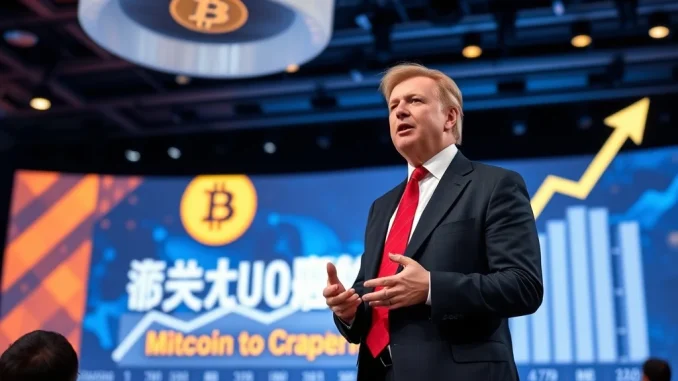
Eric Trump’s audacious prediction has sent a wave of excitement across the global digital asset landscape. Indeed, the second son of former U.S. President Donald Trump recently stated that Bitcoin will undoubtedly surpass the monumental $1 million mark. This remarkable declaration, made at the prestigious Bitcoin Asia 2025 conference in Hong Kong, immediately captured headlines. Such a bold forecast from a figure with a high public profile naturally draws considerable attention, particularly within the ever-evolving crypto market future.
Eric Trump Bitcoin: A Monumental Price Prediction Unveiled
At the bustling Bitcoin Asia 2025 conference, Eric Trump delivered a statement that resonated deeply with attendees and observers alike. According to reports from Bitcoin Magazine, he expressed absolute confidence in Bitcoin‘s trajectory, asserting it would “without a doubt surpass $1 million.” This is not a casual remark; rather, it reflects a strong conviction in the cryptocurrency’s long-term potential. His comments add significant fuel to ongoing discussions about the ultimate value proposition of digital assets.
Many industry participants closely monitor such high-profile endorsements. For instance, Eric Trump’s involvement in the real estate sector and his family’s brand lend a unique perspective to his views on emerging financial technologies. His presence at a major industry event like Bitcoin Asia 2025 further amplifies the message. Therefore, his prediction carries weight, sparking widespread debate and analysis across financial news outlets and social media platforms.
The Road to a Million Dollar Bitcoin: Underlying Factors
Achieving a million dollar Bitcoin valuation involves a complex interplay of various economic and technological factors. Several key drivers consistently emerge in discussions about Bitcoin’s future growth. Understanding these elements helps to contextualize such ambitious price predictions. Consequently, many analysts point to these fundamental aspects when projecting Bitcoin’s long-term potential.
Scarcity and Halving Events
Bitcoin’s fundamental design incorporates inherent scarcity. Its total supply is capped at 21 million coins. Furthermore, the network undergoes periodic “halving” events, which reduce the reward for mining new blocks. This mechanism effectively tightens the supply of new Bitcoin entering circulation. Historically, these halvings have preceded significant price appreciation, reinforcing the asset’s deflationary characteristics. Therefore, this controlled supply is a powerful bullish factor.
Growing Institutional Adoption
In recent years, institutional interest in Bitcoin has surged dramatically. Major financial institutions, corporations, and even sovereign wealth funds are exploring or actively investing in digital assets. The approval of spot Bitcoin ETFs in various jurisdictions marks a significant milestone. This institutional embrace provides legitimacy and introduces substantial capital into the market. Thus, it paves the way for greater market stability and broader acceptance.
Macroeconomic Environment and Inflation Hedge
The current global macroeconomic climate, characterized by inflation concerns and quantitative easing, positions Bitcoin as an attractive alternative asset. Many investors view Bitcoin as a potential hedge against inflation and a store of value, similar to gold. Its decentralized nature means it operates independently of government monetary policies. This independence appeals to those seeking protection from traditional financial system vulnerabilities.
Historical Context of Bitcoin Price Prediction and Volatility
Bitcoin’s journey has been marked by extraordinary volatility and dramatic price swings. Since its inception, the cryptocurrency has experienced multiple boom-and-bust cycles. Nevertheless, it has consistently recovered to achieve new all-time highs. This resilience underscores its underlying strength and growing adoption.
Previous bold forecasts, such as John McAfee’s infamous $1 million prediction by 2020, highlight the speculative nature of the asset. While McAfee’s timeline proved incorrect, the general sentiment of extreme bullishness has often surrounded Bitcoin. Examining these past predictions provides valuable perspective. It reminds us that while the future is uncertain, Bitcoin’s growth trajectory has often defied conventional expectations. Therefore, Eric Trump’s current Bitcoin price prediction, while ambitious, aligns with a history of significant upward revisions.
Diverse Perspectives on the Crypto Market Future
Eric Trump’s optimistic outlook is not isolated. Indeed, many prominent figures in finance and technology share a bullish vision for Bitcoin and the broader crypto market future. For example, Cathie Wood of Ark Invest has long maintained a highly optimistic view, projecting Bitcoin to reach substantial valuations due to its transformative potential. Similarly, Mike Novogratz, CEO of Galaxy Digital, frequently speaks about Bitcoin’s role in a digital economy. However, not all perspectives are uniformly positive.
Figures like Jamie Dimon, CEO of JPMorgan Chase, have expressed skepticism about Bitcoin, even while his institution explores blockchain technology. These varying viewpoints highlight the ongoing debate surrounding digital assets. Market analysts often employ different models, such as the Stock-to-Flow model, to forecast Bitcoin’s price. Yet, these models also face criticism and offer diverse outcomes. Therefore, while enthusiasm is high, a balanced view acknowledges the range of opinions and potential market dynamics.
Navigating Challenges for Million Dollar Bitcoin Aspirations
Despite the optimistic forecasts, several significant challenges could impact Bitcoin‘s path to a million dollar Bitcoin valuation. Addressing these hurdles is crucial for sustained growth and mainstream acceptance. Proponents must consider these factors carefully.
Evolving Regulatory Landscape
The regulatory environment for cryptocurrencies remains fragmented and uncertain across the globe. Governments are still grappling with how to classify and oversee digital assets. Stricter regulations, bans, or unfavorable tax policies could impede adoption and innovation. Harmonized global regulations could provide clarity, but this process is slow. Consequently, regulatory clarity is a key factor for future growth.
Technological Scalability and Infrastructure
While Bitcoin’s network has proven robust, concerns about its scalability persist. The speed and cost of transactions can become prohibitive during periods of high demand. Solutions like the Lightning Network aim to address these issues, but widespread adoption and further development are necessary. Enhancing the underlying technology is vital for Bitcoin to handle a massive influx of users and transactions.
Competition and Innovation
The digital asset space is highly competitive. Numerous altcoins offer different functionalities and technological improvements. Central Bank Digital Currencies (CBDCs) are also emerging as potential competitors, backed by governments. Bitcoin must continue to innovate and maintain its dominant position amidst this evolving landscape. Therefore, staying ahead of technological advancements is paramount.
Market Volatility and Security Risks
Bitcoin’s notorious price volatility remains a significant concern for many investors. Rapid price drops can lead to substantial losses, deterring cautious participants. Furthermore, security breaches, hacking incidents, and scams continue to pose risks within the broader crypto ecosystem. Protecting assets and ensuring secure transactions are ongoing challenges for the industry. Addressing these risks builds investor confidence.
Impact on the Crypto Market and Beyond
An achievement of a million dollar Bitcoin would undoubtedly reshape the entire financial world. Its impact would extend far beyond the immediate crypto market future. Such a valuation would signal a profound shift in how the world perceives and utilizes money and assets. This could trigger a new era of digital finance.
Firstly, investor psychology would undergo a significant transformation. The confidence in digital assets would skyrocket, potentially drawing in even more traditional investors. Secondly, mainstream financial integration would accelerate. Banks, payment processors, and investment firms would likely deepen their engagement with Bitcoin. This could lead to new financial products and services. Moreover, a million-dollar Bitcoin could redistribute wealth on an unprecedented scale. Early adopters would see their holdings appreciate enormously. This could create new economic dynamics globally. Finally, it would solidify Bitcoin’s role as a global reserve asset, challenging traditional fiat currencies. The implications are truly vast and transformative.
Eric Trump’s prediction of Bitcoin reaching $1 million serves as a powerful reminder of the ambitious outlook held by many within the cryptocurrency community. While highly speculative, such forecasts underscore the immense potential seen in digital assets. Bitcoin’s journey has been anything but conventional, characterized by both dramatic growth and significant challenges. As the crypto market future continues to unfold, factors like scarcity, institutional adoption, and macroeconomic shifts will play crucial roles. Investors should approach these predictions with a well-informed perspective, balancing optimism with a thorough understanding of market risks. The path to a million dollar Bitcoin is complex, yet the conversation itself highlights Bitcoin’s enduring significance in the global financial dialogue.
Frequently Asked Questions (FAQs)
Q1: What exactly did Eric Trump say about Bitcoin?
Eric Trump stated that he believes Bitcoin will “without a doubt surpass $1 million.” He made this significant remark at the Bitcoin Asia 2025 conference held in Hong Kong, indicating a strong conviction in Bitcoin’s long-term value.
Q2: What factors could drive Bitcoin’s price to $1 million?
Several key factors could contribute to a million dollar Bitcoin. These include Bitcoin’s inherent scarcity and halving events, increasing institutional adoption, its role as a hedge against inflation in the current macroeconomic environment, and growing global accessibility and utility.
Q3: Is Eric Trump’s Bitcoin price prediction realistic?
Eric Trump’s prediction is highly ambitious and speculative. While Bitcoin has shown remarkable growth and resilience, reaching $1 million would require significant market capitalization increases and sustained demand. Many analysts offer varying predictions, reflecting the inherent volatility and uncertainty of the crypto market future.
Q4: What are the main challenges Bitcoin faces in reaching such a high valuation?
Key challenges include an evolving and often uncertain regulatory landscape, concerns about technological scalability and network capacity, increasing competition from other cryptocurrencies and CBDCs, and Bitcoin’s inherent market volatility and security risks. Addressing these issues is crucial for sustained growth.
Q5: How would a $1 million Bitcoin impact the global financial system?
A million dollar Bitcoin would profoundly impact the global financial system. It would likely accelerate mainstream financial integration, redistribute wealth on an unprecedented scale, and solidify Bitcoin’s position as a significant global reserve asset. This would challenge traditional fiat currencies and conventional investment paradigms.
Q6: Where can I learn more about Bitcoin and its future?
To learn more about Bitcoin and the crypto market future, consider consulting reputable financial news sources, academic research on blockchain technology, official reports from financial institutions, and educational platforms dedicated to cryptocurrency. Always conduct thorough research before making investment decisions.