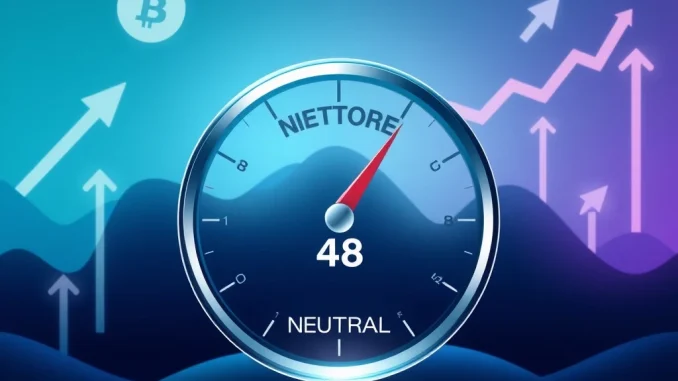
The **Crypto Fear & Greed Index** currently registers a score of 48, signaling a slight but notable shift in investor psychology. This figure, down three points from the previous day, firmly places the market in a ‘neutral’ zone. For anyone navigating the volatile cryptocurrency landscape, understanding this index offers crucial insights into the collective mood of participants. Consequently, this provides a valuable barometer for assessing potential market movements.
Understanding the Crypto Fear & Greed Index
The **Crypto Fear & Greed Index**, developed by data provider Alternative.me, serves as a vital tool for gauging the overall **market sentiment** within the cryptocurrency space. Its purpose is straightforward: to quantify the emotional state of crypto investors. The index operates on a scale from 0 to 100. A score of 0 indicates ‘Extreme Fear,’ suggesting investors are highly anxious and potentially overselling their assets. Conversely, a score of 100 signifies ‘Extreme Greed,’ implying that the market is overheated, and investors might be buying impulsively, potentially leading to a correction. The current reading of 48, therefore, positions the market squarely in a balanced, albeit slightly cautious, ‘neutral’ territory.
This index is not merely an arbitrary number. Instead, it aggregates data from several key market indicators, providing a holistic view of investor behavior. Investors often use it to counteract emotional decision-making. When the index shows extreme fear, it can present a buying opportunity for contrarian investors. Conversely, extreme greed might signal a good time to take profits. Therefore, its daily fluctuations warrant close observation.
The Recent Dip to 48: What It Means for Market Sentiment
A three-point drop in the **Crypto Fear & Greed Index** to 48, while keeping the market in the neutral stage, suggests a subtle increase in investor caution. This shift, although minor, reflects changing perceptions among market participants. It indicates that some of the previous day’s optimism has receded, giving way to a more measured approach. Such movements are common in the dynamic crypto market.
Remaining in the ‘neutral’ zone implies that neither extreme fear nor overwhelming greed dominates the market. Investors are not panic selling, nor are they rushing into speculative buys. This balanced state often precedes periods of consolidation or indecision. It could also signal a waiting game as market participants anticipate clearer directional signals. Furthermore, a neutral reading allows for more rational analysis of underlying fundamentals and technical indicators, rather than being swayed by widespread emotional swings. Ultimately, understanding this nuanced shift is key to interpreting broader market trends.
Key Factors Influencing the Crypto Fear & Greed Index
The **Crypto Fear & Greed Index** is a composite metric, meticulously calculated from six distinct factors. Each component contributes a specific weight to the final score, reflecting different facets of market behavior and psychology. Understanding these individual elements is essential for a comprehensive grasp of the index’s readings.
1. Volatility (25%) and Crypto Volatility
Volatility constitutes a significant 25% of the index’s calculation. This factor measures the current price fluctuations of Bitcoin and compares them to its average values over the last 30 and 90 days. High **crypto volatility** often signals an anxious or uncertain market. When prices swing wildly, investors tend to become more fearful, fearing potential losses. Conversely, stable prices might indicate a more confident market. Therefore, a sharp increase in volatility usually pushes the index towards ‘fear.’ This reflects a heightened sense of risk among participants, prompting them to exercise greater caution. It acts as a direct measure of market instability.
2. Trading Volume (25%) and Trading Volume Crypto
Equally weighted at 25%, **trading volume crypto** provides crucial insights into market activity. This component analyzes the current trading volume and market momentum, comparing them with average values. High trading volumes, especially during price increases, often indicate strong investor interest and conviction, contributing to ‘greed.’ Conversely, low trading volumes during price declines might suggest a lack of buyer interest, pushing the index towards ‘fear.’ Sustained high volume, regardless of direction, often signifies strong engagement. Thus, it reflects the collective action of buyers and sellers, confirming the strength of price movements. Significant shifts in trading volume can quickly alter market sentiment.
3. Social Media Mentions (15%)
Social media plays an increasingly vital role in shaping **market sentiment**, accounting for 15% of the index. This factor scans various social media platforms, primarily Twitter, for mentions and hashtags related to Bitcoin. It then analyzes the sentiment of these posts. A surge in positive mentions or a high frequency of specific bullish keywords can indicate rising optimism. Conversely, a proliferation of negative discussions or fear-inducing narratives will push the index towards ‘fear.’ This component effectively captures the collective emotional pulse of the crypto community, reflecting how quickly news and opinions spread and influence perceptions. It acts as a real-time gauge of public enthusiasm or apprehension.
4. Surveys (15%)
Surveys, though less frequently updated than other metrics, contribute 15% to the index. These polls gather opinions from thousands of crypto investors, asking direct questions about their market outlook. While individual surveys might be less frequent, their aggregated results offer a direct measure of investor confidence. For instance, if a significant majority of respondents anticipate a price increase, this contributes to ‘greed.’ If they foresee a downturn, it adds to ‘fear.’ This component directly taps into the psychological aspect of investing, providing a snapshot of prevailing expectations. It offers a qualitative layer to the quantitative data.
5. Bitcoin’s Market Cap Dominance (10%) and Bitcoin Dominance
**Bitcoin dominance**, accounting for 10% of the index, measures Bitcoin’s share of the total cryptocurrency market capitalization. An increasing Bitcoin dominance often suggests a flight to safety, where investors move funds from altcoins back into Bitcoin, perceived as a more stable asset during uncertain times. This can be interpreted as ‘fear’ for the broader altcoin market. Conversely, a decreasing Bitcoin dominance might indicate growing confidence in altcoins and higher risk appetite, leaning towards ‘greed’ for the overall market. Therefore, this metric reflects the relative strength and perceived safety of Bitcoin compared to other digital assets, offering a proxy for overall market confidence. It highlights the pivotal role Bitcoin plays in the ecosystem.
6. Google Search Volume (10%)
Finally, Google search volume contributes 10% to the index. This factor analyzes search queries related to Bitcoin, such as ‘Bitcoin price manipulation’ or ‘how to buy Bitcoin.’ A surge in search terms related to ‘how to buy Bitcoin’ or ‘Bitcoin pump’ can indicate growing public interest and potential ‘greed.’ Conversely, an increase in searches for ‘Bitcoin crash’ or ‘is Bitcoin dead’ might signal widespread concern and ‘fear.’ This component effectively captures general public interest and curiosity, which often correlates with market movements. It serves as a good indicator of retail investor engagement and underlying emotional drivers.
Interpreting the Index: Fear, Greed, and Neutrality
Understanding the different zones of the **Crypto Fear & Greed Index** is crucial for its effective application. Each range suggests a distinct market psychology and potential implications for investors.
- 0-24 (Extreme Fear): This zone indicates a highly anxious market. Investors are often panicking, selling off assets, and sentiment is overwhelmingly negative. Historically, extreme fear periods have often presented excellent long-term buying opportunities for those with a contrarian view.
- 25-49 (Fear): While less intense than ‘Extreme Fear,’ this range still suggests significant apprehension. Investors are cautious, and there’s a prevailing sense of uncertainty. It might be a period of consolidation or further downside potential.
- 50-74 (Greed): This zone reflects growing optimism and enthusiasm. Investors are becoming more confident, and buying pressure is increasing. While positive, sustained ‘greed’ can sometimes precede market corrections as assets become overvalued.
- 75-100 (Extreme Greed): This is a sign of an overheated market. Investors are often euphoric, making impulsive decisions, and buying aggressively. Historically, extreme greed phases have often coincided with market tops, suggesting a potential for a significant pullback.
The current score of 48 falls within the ‘Fear’ category, albeit at its upper end, almost touching ‘Neutral.’ This suggests a prevailing cautious outlook without outright panic. It implies that while investors are not extremely optimistic, they are also not in a state of deep distress. This balanced state often encourages a more analytical approach to market participation.
Navigating Market Sentiment with Caution
The **Crypto Fear & Greed Index** serves as a valuable indicator, but it is not a standalone predictive tool. Investors should always use it in conjunction with other forms of analysis, including technical indicators, fundamental research, and macroeconomic factors. The index offers a snapshot of current **market sentiment**, which can shift rapidly in the fast-paced crypto world. For example, a sudden news event or regulatory announcement can quickly swing the index from neutral to fear, or vice versa.
Moreover, while the index is primarily focused on Bitcoin, its movements generally reflect the broader **trading volume crypto** market due to Bitcoin’s significant **Bitcoin dominance**. When Bitcoin’s sentiment changes, it often has a ripple effect across altcoins. Therefore, staying informed about the various components and their real-world implications is paramount. By understanding the underlying drivers, investors can make more informed and less emotionally driven decisions in their crypto journey.
Conclusion: A Measured Outlook in a Dynamic Market
The recent three-point drop in the **Crypto Fear & Greed Index** to 48 underscores the dynamic nature of **market sentiment** in the cryptocurrency space. While the market remains in a ‘neutral’ stage, this subtle shift indicates a move towards increased caution among investors. Factors such as **crypto volatility**, **trading volume crypto**, and **Bitcoin dominance** continuously shape this crucial indicator. Consequently, monitoring these elements provides a clearer picture of investor psychology.
As the crypto market evolves, tools like the **Crypto Fear & Greed Index** remain indispensable for understanding the collective emotional temperature. Investors should leverage this insight to inform their strategies, ensuring they approach the market with a balanced perspective rather than succumbing to fear or greed. Ultimately, a rational approach, combined with a deep understanding of market indicators, will prove most beneficial.
Frequently Asked Questions (FAQs)
What is the Crypto Fear & Greed Index?
The **Crypto Fear & Greed Index** is a tool that measures the current **market sentiment** in the cryptocurrency market. It ranges from 0 (Extreme Fear) to 100 (Extreme Greed), helping investors understand whether the market is overly anxious or overly optimistic.
How is the Crypto Fear & Greed Index calculated?
The index is calculated using six weighted factors: volatility (25%), **trading volume crypto** (25%), social media mentions (15%), surveys (15%), **Bitcoin dominance** (10%), and Google search volume (10%). These factors collectively provide a comprehensive view of investor behavior.
What does a score of 48 mean for the Crypto Fear & Greed Index?
A score of 48 on the **Crypto Fear & Greed Index** falls within the ‘Fear’ category, though it is very close to the ‘Neutral’ threshold. This indicates that investors are currently cautious but not in a state of extreme panic or overwhelming optimism. It suggests a balanced yet wary market sentiment.
How can investors use the Crypto Fear & Greed Index?
Investors can use the index as a contrarian indicator. For instance, ‘Extreme Fear’ might signal a potential buying opportunity, while ‘Extreme Greed’ could suggest a good time to consider taking profits. However, it should always be used in conjunction with other analytical tools and strategies, not as a sole basis for investment decisions.
Does the index only apply to Bitcoin?
While the **Crypto Fear & Greed Index** primarily focuses on Bitcoin’s data, its readings often reflect the broader cryptocurrency market due to Bitcoin’s significant influence and **Bitcoin dominance**. Changes in Bitcoin’s sentiment tend to have a ripple effect across altcoins, making the index relevant for the entire crypto ecosystem.
What role does crypto volatility play in the index?
**Crypto volatility** contributes 25% to the index. High volatility, meaning large and rapid price swings, typically increases fear as it signals instability and higher risk. Conversely, lower volatility can contribute to a more neutral or greedy sentiment, indicating greater market stability and investor confidence.