Understanding the pulse of the cryptocurrency market is crucial for any trader or investor. Furthermore, delving into derivatives data offers invaluable insights into the collective sentiment. Specifically, **BTC perpetual futures** long-short ratios provide a snapshot of prevailing bullish or bearish biases among traders. This metric reveals whether market participants are predominantly betting on price increases (long) or decreases (short). Therefore, monitoring these ratios across major exchanges helps in gauging the immediate direction of Bitcoin’s price action.
Unveiling BTC Perpetual Futures Long-Short Ratios
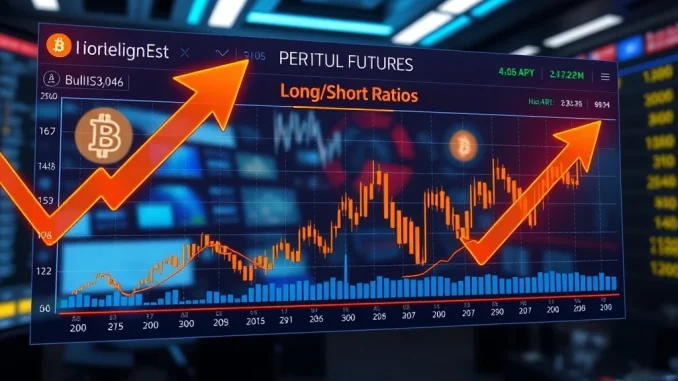
Market analysts consistently examine long-short ratios for **BTC perpetual futures** to assess trader positioning. This particular metric represents the ratio of open long positions to open short positions. Consequently, a ratio above 1.0 indicates more long positions, suggesting a bullish sentiment. Conversely, a ratio below 1.0 points to a higher number of short positions, signaling a bearish outlook. Over the past 24 hours, the aggregate data provides a clear picture of trader sentiment.
Across all tracked cryptocurrency exchanges, the combined 24-hour **Bitcoin long-short ratio** shows a slight lean towards bearish sentiment. Specifically, long positions accounted for 47.3% of the total, while short positions made up 52.7%. This imbalance suggests that more traders anticipated a downward price movement for Bitcoin during this period. Therefore, this data offers a preliminary indication of market expectations.
Deep Dive into Bitcoin Long-Short Ratio Across Top Exchanges
Analyzing individual exchanges offers a more granular perspective on **Bitcoin long-short ratio** dynamics. Different platforms often exhibit varying trader behaviors and liquidity profiles. Consequently, understanding these variations can refine one’s market assessment. The top three exchanges by trading volume for BTC perpetual futures show distinct, yet largely consistent, trends.
- Binance: On Binance, long positions constituted 46.85%, while short positions were 53.15%. This ratio closely mirrors the overall market sentiment, indicating a strong bearish bias among its large user base.
- Bybit: Bybit traders showed an even stronger bearish preference. Here, long positions were 45.78%, and short positions reached 54.22%. This suggests a particularly cautious or pessimistic outlook from Bybit’s derivatives traders.
- Gate.io: Gate.io presented a slightly less pronounced bearish stance compared to the other two. Long positions stood at 47.24%, with short positions at 52.76%. Nevertheless, it still reflected a net bearish sentiment.
These figures collectively paint a picture of cautious market sentiment. Traders, on balance, positioned themselves for potential price declines. This consistent trend across major platforms reinforces the observed bearish inclination in the **futures market analysis**.
Decoding Crypto Market Sentiment from Futures Data
The long-short ratio serves as a vital indicator for deciphering **crypto market sentiment**. When short positions significantly outweigh long positions, it often suggests a lack of confidence in an asset’s immediate price appreciation. Conversely, a predominance of long positions typically signals strong bullish conviction. However, it is important to note that extreme ratios can sometimes precede market reversals. For instance, an excessively high short ratio might indicate an oversold market, potentially leading to a short squeeze.
Currently, the slight majority of short positions indicates a prevailing bearish or at least cautious sentiment among **BTC perpetual futures** traders. This does not necessarily guarantee a price drop, but it highlights the immediate expectations of a significant portion of the market. Furthermore, this data helps traders anticipate potential price movements. Savvy investors often use this information to confirm their own analyses or to identify contrarian opportunities. Therefore, it is a key component of comprehensive market evaluation.
The Significance of BTC Trading Data for Strategic Decisions
Access to real-time **BTC trading data**, particularly long-short ratios, empowers traders to make more informed strategic decisions. This data provides a quantitative measure of market conviction. For example, if a trader is considering a long position, a heavily skewed short ratio might prompt them to exercise caution or adjust their entry point. Conversely, a strong long bias could validate a bullish strategy.
Beyond simple directional bets, this data aids in risk management. Traders can use the long-short ratio to set stop-loss levels or take-profit targets more strategically. Moreover, understanding the aggregate positioning helps in avoiding emotional trading decisions. Instead, decisions become rooted in observable market behavior. Ultimately, integrating **futures market analysis** into a trading strategy can enhance its robustness and potential for success. It offers a window into the collective mindset of the derivatives market participants.
Navigating the Futures Market Analysis Landscape
While the long-short ratio is a powerful tool, it represents just one facet of comprehensive **futures market analysis**. Experienced traders also consider other critical metrics. For instance, funding rates on perpetual futures contracts indicate the cost of holding long or short positions. Positive funding rates suggest longs pay shorts, signaling bullishness, while negative rates suggest the opposite. Similarly, open interest, which measures the total number of outstanding derivatives contracts, reveals liquidity and market participation levels.
A holistic approach involves combining long-short ratios with these other indicators. This provides a more nuanced understanding of market dynamics. Furthermore, traders must also factor in macroeconomic news, regulatory developments, and on-chain analytics. The cryptocurrency market, particularly Bitcoin, is highly volatile. Therefore, relying on a single indicator can lead to incomplete conclusions. Instead, a multi-faceted analytical framework offers greater predictive power and mitigates risks. This comprehensive view is essential for sustained success in the derivatives space.
Impact of Funding Rates and Open Interest on BTC Perpetual Futures
Understanding **BTC perpetual futures** goes beyond just long-short ratios. Funding rates, for example, play a crucial role. Positive funding rates mean long position holders pay short position holders. This typically signals a strong demand for long positions, indicating bullish sentiment. Conversely, negative funding rates suggest short position holders pay longs, often pointing to bearish sentiment. Extreme funding rates, whether positive or negative, can also signal potential market exhaustion or reversals.
Open interest is another key metric. It reflects the total number of outstanding derivatives contracts that have not been settled. A rising open interest alongside a rising price can indicate strong upward momentum. Conversely, a falling open interest with a falling price can signal a weakening trend. When open interest rises during a price consolidation, it suggests increasing market participation and potential for a significant move. Therefore, combining long-short ratios with funding rates and open interest provides a more complete picture of **crypto market sentiment** and potential future price action.
The Broader Implications for Bitcoin’s Price Trajectory
The consistent bearish tilt in the 24-hour **Bitcoin long-short ratio** across major exchanges carries significant implications. It suggests that a substantial portion of the market expects a price correction or continued downtrend. This collective expectation can, at times, become a self-fulfilling prophecy. However, it also creates conditions for potential short squeezes if unexpected positive news emerges or if buying pressure suddenly increases. Traders closely monitor these dynamics for early signals of trend changes.
While this data provides a short-term outlook, it contributes to the overall narrative of **BTC trading data**. Long-term investors may use this information to gauge periods of heightened volatility or potential entry/exit points for their spot holdings. Ultimately, understanding how derivatives traders are positioning themselves offers a valuable layer of insight into Bitcoin’s complex market structure. It helps both short-term speculators and long-term holders make more informed decisions amidst market fluctuations.
Conclusion: Navigating Bitcoin’s Futures Landscape with Data
The 24-hour long-short ratios for **BTC perpetual futures** offer a critical snapshot of prevailing market sentiment. The data clearly indicates a slight bearish inclination among traders across major exchanges like Binance, Bybit, and Gate.io. This preference for short positions suggests caution, if not outright pessimism, regarding Bitcoin’s immediate price trajectory. However, it is essential to integrate this information with other metrics like funding rates and open interest for a comprehensive **futures market analysis**. Such a holistic approach provides a more robust understanding of market dynamics and potential future movements. Consequently, informed decisions become possible, enhancing trading strategies in the volatile cryptocurrency landscape.
Frequently Asked Questions (FAQs)
What is a long-short ratio in BTC perpetual futures?
The long-short ratio compares the number of open long positions (bets on price increase) to open short positions (bets on price decrease) in Bitcoin perpetual futures contracts. It helps gauge the prevailing sentiment among derivatives traders.
How is the long-short ratio calculated?
It is calculated by dividing the total volume or number of long positions by the total volume or number of short positions. A ratio below 1.0 indicates more short positions, while a ratio above 1.0 indicates more long positions.
What does a high short percentage (like 52.7%) indicate?
A high short percentage, such as 52.7% as observed, indicates that a majority of traders are currently betting on a decrease in Bitcoin’s price. This generally reflects a bearish sentiment in the market for that specific period.
Why do different exchanges have slightly different long-short ratios?
Differences arise due to varying trader demographics, liquidity pools, and trading strategies prevalent on each exchange. While overall trends often align, specific platform dynamics can cause minor variations in the ratios.
How can traders use BTC perpetual futures long-short ratios?
Traders use these ratios to gauge market sentiment, confirm their own analyses, identify potential contrarian trading opportunities, and manage risk. It serves as one of several indicators to inform strategic decisions in the futures market.
Are long-short ratios always accurate predictors of price movements?
No, long-short ratios are not always accurate predictors. They reflect current sentiment, which can change rapidly. Extreme ratios can sometimes signal reversals, and they should always be used in conjunction with other technical and fundamental analysis tools for a more complete picture.