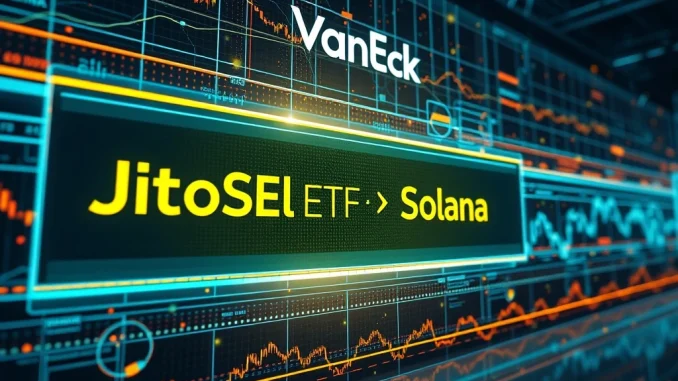
The cryptocurrency world constantly evolves, bringing innovative financial products to market. Recently, a significant development emerged that could reshape investment opportunities within the Solana ecosystem. Jito has officially submitted an S-1 filing for the proposed VanEck JitoSOL ETF, marking a pioneering step. This action signals the potential arrival of a new, regulated investment vehicle. It could offer investors direct exposure to Solana’s liquid staking token, JitoSOL, through a familiar exchange-traded fund structure. This move represents a crucial milestone for both Jito and the broader Solana community, potentially opening doors for greater institutional adoption.
JitoSOL ETF: A New Horizon for Solana Investment
The news of the proposed JitoSOL ETF filing has generated considerable excitement. Understanding Jito and JitoSOL is essential to grasp the full implications. Jito operates as a liquid staking protocol built on the Solana blockchain. It allows users to stake their SOL tokens while receiving jitoSOL in return. This jitoSOL token represents their staked SOL plus any accrued staking rewards. Crucially, it remains liquid, meaning holders can use it across various decentralized finance (DeFi) applications. This provides flexibility often absent in traditional staking.
Liquid staking solutions like JitoSOL address a key challenge in proof-of-stake networks. They enable participants to earn staking rewards without locking up their capital entirely. Instead, they receive a liquid derivative. This derivative can then be traded, lent, or used as collateral. The proposed JitoSOL ETF aims to package this innovative asset into a traditional financial product. This makes it accessible to a wider range of investors, including those who prefer regulated investment vehicles over direct crypto holdings.
Understanding the Jito S-1 Filing and Its Implications
An S-1 filing is a preliminary registration form submitted to the U.S. Securities and Exchange Commission (SEC). Companies use it when they intend to offer new securities to the public. For an ETF, this document outlines the fund’s structure, investment objectives, risks, and management. The submission of a Jito S-1 filing by Jito for a VanEck ETF is therefore a critical regulatory step. It initiates a formal review process by the SEC.
This filing indicates a serious intent to launch the product. It details how the ETF would operate, including its underlying assets (JitoSOL), custody arrangements, and redemption mechanisms. Furthermore, it addresses potential risks associated with investing in a liquid staking token and the broader cryptocurrency market. Investors can review this document to understand the proposed fund’s mechanics. The SEC’s review will focus on investor protection and market integrity. This rigorous process ensures transparency and compliance for any new financial product entering the market.
VanEck’s Growing Interest in Crypto ETFs
VanEck stands as a well-established global investment manager. It possesses a long history in both traditional and innovative financial products. The firm has consistently shown a keen interest in the digital asset space. VanEck has previously launched several crypto-related products, including Bitcoin and Ethereum futures ETFs. This track record positions them as a key player in bringing digital assets to mainstream finance. Their involvement lends significant credibility to the proposed JitoSOL ETF.
The decision by VanEck to pursue a Solana ETF, specifically one focused on JitoSOL, highlights a strategic move. It demonstrates their belief in the long-term potential of the Solana ecosystem and liquid staking derivatives. This initiative follows the success and regulatory clarity achieved by spot Bitcoin ETFs earlier this year. It suggests a broader trend of institutional adoption and the maturing of the crypto market. VanEck’s expertise in navigating complex regulatory landscapes will be invaluable during the SEC review process for this innovative product.
The Broader Impact of a Solana ETF on the Market
The potential approval of a Solana ETF could have profound implications for the entire cryptocurrency market. First, it would provide a regulated and easily accessible avenue for traditional investors to gain exposure to Solana. Many institutional investors face restrictions against directly holding cryptocurrencies. An ETF structure bypasses these hurdles. This could unlock significant capital flows into the Solana ecosystem. Increased institutional participation typically brings greater liquidity and stability to an asset class.
Secondly, a Solana-focused ETF would further legitimize the asset class. Following Bitcoin and Ethereum ETFs, a Solana product would signal that regulators and traditional finance view a broader range of cryptocurrencies as viable investment assets. This validation can attract more retail investors who might be hesitant to navigate direct crypto purchases. Ultimately, it contributes to the mainstream acceptance of digital assets. This development could also spur innovation within the Solana network. Developers might find more resources and interest flowing into the ecosystem.
Navigating the Path Ahead for Crypto ETFs
The journey from S-1 filing to actual launch is often complex. Several hurdles remain for the proposed JitoSOL ETF. Regulatory approval from the SEC is the primary challenge. The SEC meticulously reviews each filing, considering market manipulation risks, investor protection, and custody solutions. Furthermore, the market’s reception to such a product will be crucial. While there is strong demand for diversified crypto exposure, the specifics of a liquid staking ETF might require additional investor education.
Despite these challenges, the filing itself is a bullish signal. It indicates growing confidence from major financial institutions in the long-term viability of specific altcoins and their derivatives. The success of spot Bitcoin ETFs provides a precedent, potentially paving the way for other asset-backed crypto ETFs. As the digital asset landscape matures, we expect to see more innovative products like the JitoSOL ETF emerge. These offerings bridge the gap between traditional finance and the rapidly evolving world of decentralized technologies. The coming months will reveal the trajectory of this exciting new investment opportunity.
Frequently Asked Questions (FAQs)
What is the JitoSOL ETF?
The JitoSOL ETF is a proposed exchange-traded fund that aims to provide investors with exposure to JitoSOL. JitoSOL is a liquid staking token on the Solana blockchain. It represents staked SOL tokens and their accrued rewards, allowing for liquidity while earning staking yield.
What is an S-1 filing?
An S-1 filing is a registration form submitted to the U.S. Securities and Exchange Commission (SEC) by companies planning to offer new securities to the public. For an ETF, it outlines the fund’s structure, investment objectives, risks, and management team, initiating the SEC’s review process.
Why is VanEck involved in a Solana ETF?
VanEck is a global investment manager with a history of launching innovative financial products, including other crypto-related ETFs. Their involvement in a Solana ETF demonstrates their belief in the Solana ecosystem’s potential and their strategy to offer diversified crypto investment opportunities to traditional investors.
How could a Solana ETF impact the crypto market?
A Solana ETF could significantly boost institutional adoption of Solana, providing a regulated investment vehicle for traditional finance. It could also enhance market liquidity, legitimize Solana as a viable investment asset, and attract more mainstream investors to the cryptocurrency space.
What are the next steps for the JitoSOL ETF after the S-1 filing?
Following the S-1 filing, the SEC will review the proposal. This process involves potential requests for amendments and public comments. The ETF can only launch after the SEC approves the filing, which can take several months, depending on regulatory considerations and market conditions.
How does JitoSOL differ from regular SOL?
Regular SOL is the native cryptocurrency of the Solana blockchain. JitoSOL is a liquid staking derivative of SOL. When you stake SOL through Jito, you receive JitoSOL, which remains liquid and can be used in DeFi, unlike directly staked SOL which is typically locked.