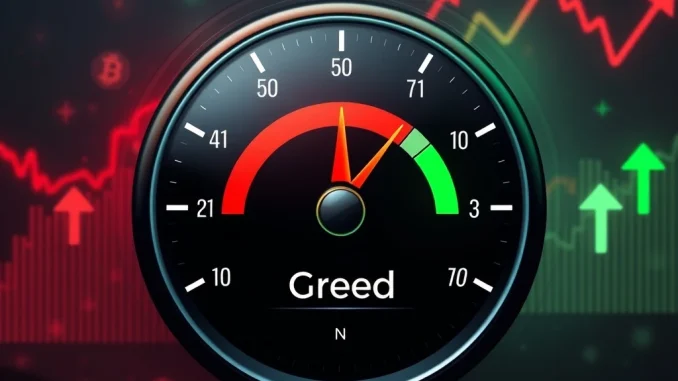
Understanding the collective mood of the cryptocurrency market is crucial for informed decision-making. The Crypto Fear & Greed Index serves as a valuable barometer. This index provides a snapshot of current market sentiment. It helps investors gauge whether the market is overly fearful or excessively greedy. A recent update shows the index at 56. It has dropped four points from the previous day. Despite this dip, the index firmly remains within the ‘Greed’ zone.
Understanding the Crypto Fear & Greed Index
The Crypto Fear & Greed Index is a powerful tool. It helps assess overall market sentiment. This index ranges from 0 to 100. A score of 0 indicates ‘Extreme Fear.’ Conversely, a score of 100 signals ‘Extreme Greed.’ The index provides a quick visual cue for market participants. Therefore, it helps them understand the prevailing emotional state of the market. Its creators, Alternative, aim to distil complex market data into a simple metric. This simplifies market analysis for many.
The index does not predict future prices. Instead, it reflects current investor psychology. Historically, periods of extreme fear often precede market bottoms. Similarly, extreme greed can sometimes signal market tops. Therefore, many investors use this index as a contrarian indicator. They might consider buying during extreme fear. They might also consider selling during extreme greed. However, it is essential to combine this tool with other analyses.
Key Factors Driving Market Sentiment
The Crypto Fear & Greed Index compiles data from six distinct factors. Each factor contributes a specific weight to the final score. These components aim to capture a comprehensive view of market sentiment. They offer insights into various aspects of investor behavior. Currently, surveys are paused, but the other five factors continue to provide valuable data.
- Volatility (25%): This measures the current volatility and maximum drawdowns of Bitcoin. High volatility often suggests a fearful or uncertain market. Conversely, lower volatility can indicate stability.
- Market Momentum/Volume (25%): This factor analyzes current market volume and momentum. It compares current values with average values over 30 and 90 days. Strong, consistent buying volume often signals greed. Weak volume might suggest fear.
- Social Media (15%): This component scans various social media platforms. It looks for specific keywords and sentiment analysis. High engagement and positive sentiment usually indicate greed. Negative or low engagement suggests fear.
- Surveys (15%): (Currently paused) This factor typically involves polling investors. It asks about their perception of the market. Survey results offer direct insights into investor confidence.
- Bitcoin Dominance (10%): This measures Bitcoin’s market cap share relative to the entire crypto market. Rising Bitcoin dominance can indicate fear. Investors often move to Bitcoin as a ‘safe haven.’ Falling dominance suggests ‘altcoin season’ or a shift towards riskier assets.
- Google Trends (10%): This analyzes search query data for crypto-related terms. Increasing search volume for terms like ‘Bitcoin price manipulation’ might indicate fear. Terms like ‘how to buy crypto’ might signal rising public interest and greed.
The Significance of the ‘Greed’ Zone
The index currently sits at 56. This reading places it squarely in the Greed Zone. A score between 50 and 74 signifies ‘Greed.’ This suggests that investors are generally feeling optimistic. They might be more willing to take on risk. Furthermore, a score of 56 indicates a moderate level of greed. It is not ‘Extreme Greed,’ which begins at 75. This implies that while optimism exists, it has not yet reached euphoric levels.
A slight drop from 60 to 56 suggests a minor cooling. This could be a healthy correction in sentiment. It prevents the market from becoming excessively overheated. Therefore, it is important to observe trends, not just single data points. Sustained periods in the greed zone can precede market corrections. However, short-term fluctuations are common.
Navigating Cryptocurrency Volatility with the Index
Cryptocurrency markets are known for their cryptocurrency volatility. Prices can swing wildly in short periods. The Crypto Fear & Greed Index helps contextualize these movements. When the index shows extreme fear, prices might be near a bottom. This is because panic selling often drives prices down. Conversely, extreme greed often accompanies rapid price increases. This is fueled by FOMO (Fear Of Missing Out).
For example, a sudden surge in volatility while the index is in ‘Extreme Greed’ might signal caution. It could suggest that a price correction is imminent. Conversely, if volatility is high but the index shows ‘Extreme Fear,’ it might be an opportunity. Astute investors often look for such divergences. They use the index to identify potential entry or exit points. However, past performance does not guarantee future results.
Bitcoin Dominance and Its Influence
Bitcoin Dominance is a crucial factor within the index. It provides insights into capital flow within the crypto ecosystem. When Bitcoin dominance rises, it often means investors are consolidating their holdings. They are moving away from altcoins. This typically happens during periods of market uncertainty or fear. Bitcoin is perceived as a safer asset due to its larger market cap and liquidity.
Conversely, when Bitcoin dominance falls, it often signals increased risk appetite. Funds flow into altcoins, leading to ‘altcoin seasons.’ This generally occurs during periods of greed or strong bullish sentiment. The index incorporates this metric. Therefore, it offers a more nuanced view of overall market sentiment. A shift in Bitcoin dominance can significantly impact the index’s reading. This reflects changing investor preferences.
Future Outlook and Investor Considerations
The Crypto Fear & Greed Index remains a vital tool for crypto investors. Its current position in the ‘Greed’ zone suggests continued optimism. However, the slight drop indicates a healthy re-evaluation. Market participants should continue to monitor this index. They should also consider other fundamental and technical indicators. This comprehensive approach is essential for navigating the dynamic crypto landscape.
Furthermore, understanding the underlying factors of the index is key. It helps in making informed decisions. Investors should avoid making impulsive choices based solely on this index. Instead, use it as part of a broader strategy. This includes managing risk and setting clear investment goals. The crypto market is ever-evolving. Staying informed and adaptable remains paramount.
Frequently Asked Questions (FAQs)
What is the Crypto Fear & Greed Index?
The Crypto Fear & Greed Index is a tool that measures the current sentiment of the cryptocurrency market. It ranges from 0 (Extreme Fear) to 100 (Extreme Greed), helping investors gauge the prevailing emotional state of the market.
How is the Crypto Fear & Greed Index calculated?
The index considers six main factors: volatility (25%), market momentum/volume (25%), social media (15%), surveys (15%), Bitcoin dominance (10%), and Google Trends (10%). These factors are weighted and combined to produce a single score.
What does it mean if the index is in the ‘Greed’ zone?
A reading in the ‘Greed’ zone (typically 50-74) indicates that investors are generally optimistic and more willing to take risks. While it suggests positive sentiment, extreme greed can sometimes precede market corrections.
Is the Crypto Fear & Greed Index a reliable trading indicator?
The index is a valuable sentiment indicator, but it should not be used as the sole basis for trading decisions. It is best utilized as a complementary tool alongside fundamental analysis, technical analysis, and risk management strategies.
Why is Bitcoin Dominance a factor in the index?
Bitcoin dominance reflects the market share of Bitcoin compared to the total crypto market. It helps indicate whether investors are moving towards ‘safer’ assets (Bitcoin) during fear, or towards altcoins during periods of greed, thus providing insight into overall market sentiment.
Are the survey results always included in the index?
No, as noted in the article, the survey component of the Crypto Fear & Greed Index is sometimes paused. The index continues to function by weighting the remaining active factors accordingly.