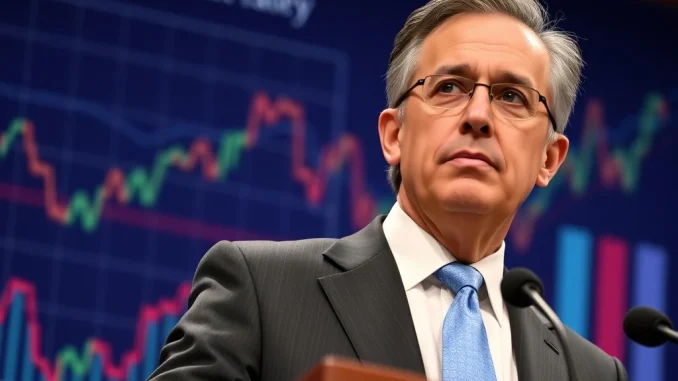
The financial world constantly scrutinizes every pronouncement from the Federal Reserve. Consequently, when a prominent official speaks, markets listen intently. Recently, St. Louis Federal Reserve President Alberto Musalem delivered a significant message. He indicated that a substantial 50 basis point Fed rate cut is not currently justified. This statement, shared by Walter Bloomberg on X, immediately resonated across economic sectors. For those invested in cryptocurrencies, understanding the Fed’s stance on interest rate policy is crucial. Changes in traditional financial markets often ripple into the digital asset space, impacting liquidity and investor sentiment. Therefore, this cautious outlook from a key Fed voice merits close examination.
Understanding the St. Louis Fed’s Stance on Interest Rate Policy
St. Louis Federal Reserve President Alberto Musalem’s recent remarks highlight a cautious approach to monetary easing. He explicitly stated that current economic data does not support a half-point interest rate reduction. This perspective underscores the Federal Reserve’s commitment to data-dependent decision-making. Musalem’s comments provide insight into the ongoing debate within the Federal Open Market Committee (FOMC). They reflect a careful assessment of inflation trends and labor market conditions. The Fed’s primary goals, price stability and maximum employment, guide these decisions. Therefore, any move on interest rates must align with progress towards these dual mandates. The Fed aims to avoid both overheating the economy and stifling growth unnecessarily.
The concept of a 50 basis point cut signifies a significant shift in monetary policy. Such a move would typically signal a strong belief that inflation is under control. It would also suggest that economic growth needs a substantial boost. However, Musalem’s statement suggests that such conditions are not yet met. He implies that while some disinflation has occurred, the overall picture remains too uncertain for aggressive easing. This cautious stance is not unique among Fed officials. Many policymakers advocate for patience, preferring to see sustained evidence of inflation returning to the Fed’s 2% target. They also monitor the resilience of the labor market closely. Consequently, market expectations for rapid rate cuts may need recalibration based on these official signals.
Why Economic Data Guides Fed Rate Cut Decisions
The Federal Reserve’s approach to monetary policy is inherently data-driven. Policymakers meticulously analyze a broad array of economic data before making any adjustments to the federal funds rate. Key indicators include inflation metrics, labor market statistics, and measures of economic growth. For instance, the Consumer Price Index (CPI) and the Personal Consumption Expenditures (PCE) price index are crucial for assessing inflation. These reports provide vital information on price changes for goods and services. Furthermore, the unemployment rate, non-farm payrolls, and wage growth figures offer a comprehensive view of the labor market’s health. Strong employment numbers can indicate a robust economy, potentially fueling inflation. Conversely, weakening job data might signal an impending slowdown.
Gross Domestic Product (GDP) reports also provide a snapshot of overall economic activity. A strong GDP suggests healthy growth, which could support higher interest rates. Conversely, slowing GDP might necessitate rate cuts to stimulate activity. The Fed’s dual mandate requires balancing price stability with maximum sustainable employment. Therefore, a careful evaluation of all these data points is essential. For example, if inflation remains stubbornly above target, even with some signs of cooling, the Fed may maintain a restrictive stance. This helps to ensure that inflationary pressures are fully subdued. Conversely, if the labor market shows unexpected weakness, it might prompt a reassessment of policy. This comprehensive approach ensures that policy decisions are well-informed and responsive to economic realities.
Alberto Musalem’s Perspective and the Broader Federal Reserve View
Alberto Musalem, as President of the St. Louis Federal Reserve, brings a significant voice to the FOMC discussions. His recent comments align with a more hawkish segment of the Federal Reserve. This group emphasizes the need for continued vigilance against inflation. Musalem’s background in finance and economics provides a robust framework for his analysis. He likely focuses on core inflation measures and the services sector, which have shown stickier price pressures. His view suggests that the current level of economic activity, coupled with persistent inflation, does not yet warrant a rapid loosening of monetary conditions. This stance contrasts with market sentiment, which often anticipates earlier and more aggressive rate cuts.
Within the Federal Reserve, a diversity of opinions exists regarding the appropriate path for interest rates. Some officials might lean towards cutting rates sooner to avoid a recession. Others, like Musalem, prioritize ensuring inflation is firmly on its way back to 2%. This internal debate is healthy and contributes to a robust policy-making process. The Fed operates by consensus, meaning decisions are made after thorough discussion among all FOMC members. Musalem’s statement provides a clear signal about one significant viewpoint within that committee. It suggests that patience remains a virtue for many policymakers. Therefore, significant evidence of sustained disinflation and a cooling labor market will likely be required before substantial rate cuts materialize.
The Impact of Monetary Policy on Markets and the Economy
A potential Fed rate cut, or the lack thereof, profoundly impacts financial markets and the broader economy. When interest rates are high, borrowing costs increase for consumers and businesses. This can slow down economic activity, curb inflation, and potentially lead to job losses. Conversely, lower interest rates make borrowing cheaper, encouraging spending and investment. This can stimulate economic growth and employment. Musalem’s cautious stance suggests that the Fed is not yet ready to provide this significant stimulus. Consequently, businesses may continue to face higher borrowing costs, potentially impacting their expansion plans and hiring decisions. Consumers might also find loans for homes, cars, and other purchases more expensive.
For financial markets, the implications are multifaceted. Bond yields tend to move in tandem with interest rate expectations. If the Fed maintains higher rates, bond yields may remain elevated, making fixed-income investments more attractive relative to equities. Stock markets, on the other hand, often react positively to expectations of lower rates. This is because lower rates can boost corporate profits and make future earnings more valuable. However, if the Fed signals a ‘higher for longer’ approach, it can create headwinds for equity valuations. For the cryptocurrency market, Fed policy indirectly affects liquidity and risk appetite. Higher interest rates in traditional finance can draw capital away from riskier assets like crypto. Conversely, an easing cycle can make digital assets more appealing as investors seek higher returns. Musalem’s comments, therefore, suggest continued pressure on risk assets, at least in the short term, as the cost of capital remains elevated.
Navigating Future Federal Reserve Policy Shifts
The path forward for the Federal Reserve’s monetary policy remains uncertain, yet signals from officials like the St. Louis Fed President provide valuable clues. Market participants must now carefully monitor incoming economic data. Key reports on inflation, employment, and consumer spending will heavily influence the Fed’s next moves. For example, a significant downturn in the labor market could prompt a more dovish stance. Conversely, a resurgence in inflation would solidify the argument for maintaining higher rates. The Fed’s upcoming meetings will be critical. Each statement and press conference will offer further insights into the collective thinking of the FOMC. Furthermore, the summary of economic projections, released periodically, will provide updated forecasts from individual Fed members.
The Federal Reserve aims for a ‘soft landing,’ where inflation returns to target without triggering a severe recession. This delicate balancing act requires flexibility and a willingness to adapt policy based on evolving conditions. Musalem’s comments reinforce the idea that the Fed will not rush into aggressive rate cuts. Instead, they will proceed cautiously, ensuring that any policy adjustments are warranted by concrete evidence. Therefore, investors and businesses should prepare for a period where interest rates remain at levels that support disinflation. This implies continued focus on managing costs and optimizing capital allocation. Ultimately, the Fed’s decisions will hinge on the sustained performance of the U.S. economy against its dual mandate objectives.
In conclusion, St. Louis Federal Reserve President Alberto Musalem’s firm stance against a 50 basis point Fed rate cut underscores the central bank’s commitment to data-driven policy. His remarks signal a continued cautious approach to monetary easing. This perspective emphasizes the importance of sustained progress on inflation and labor market stability. For market participants, including those in the cryptocurrency space, this means adapting to a potential ‘higher for longer’ interest rate environment. The Federal Reserve will undoubtedly continue to scrutinize every piece of incoming economic data. Their ultimate goal remains achieving price stability and maximum employment, guiding their careful calibration of interest rate policy. Therefore, ongoing vigilance of Fed communications and economic reports will be essential for navigating the evolving financial landscape.
Frequently Asked Questions (FAQs)
Q1: What is a basis point, and what does a 50 bp cut mean?
A basis point (bp) is a common unit of measure in finance. One basis point equals one-hundredth of one percent (0.01%). Therefore, a 50 basis point cut means a reduction of 0.50% in the interest rate. This is a significant adjustment, indicating a substantial shift in monetary policy.
Q2: Why is the St. Louis Fed President’s opinion important?
The St. Louis Fed President, Alberto Musalem, is a voting member of the Federal Open Market Committee (FOMC). The FOMC sets the federal funds rate, which is the benchmark for interest rates across the U.S. economy. His public statements provide valuable insight into the collective thinking and potential future direction of the Fed’s monetary policy.
Q3: What specific economic data does the Federal Reserve consider for interest rate decisions?
The Federal Reserve considers a wide range of economic data. Key indicators include inflation measures like the Consumer Price Index (CPI) and Personal Consumption Expenditures (PCE) price index, labor market data such as the unemployment rate and non-farm payrolls, and economic growth indicators like Gross Domestic Product (GDP). They also monitor wage growth, consumer spending, and business investment.
Q4: How do Fed interest rate decisions indirectly affect the cryptocurrency market?
Fed interest rate decisions influence the broader economic environment and investor sentiment. Higher interest rates in traditional finance can make riskier assets, including cryptocurrencies, less attractive by increasing the cost of capital and reducing overall liquidity in the market. Conversely, lower rates can make risk assets more appealing as investors seek higher returns.
Q5: What is the Federal Reserve’s dual mandate?
The Federal Reserve operates under a dual mandate from Congress. Its two primary goals are to achieve maximum sustainable employment and to maintain price stability. This means keeping inflation at a healthy, low level, typically targeted at 2% over the long run, while also supporting a strong job market.
Q6: What is the ‘higher for longer’ narrative in monetary policy?
The ‘higher for longer’ narrative suggests that the Federal Reserve will maintain elevated interest rates for an extended period. This approach aims to ensure that inflation is thoroughly brought under control and does not rebound. It implies a slower pace of rate cuts than markets might initially anticipate, reflecting a cautious and data-dependent stance.