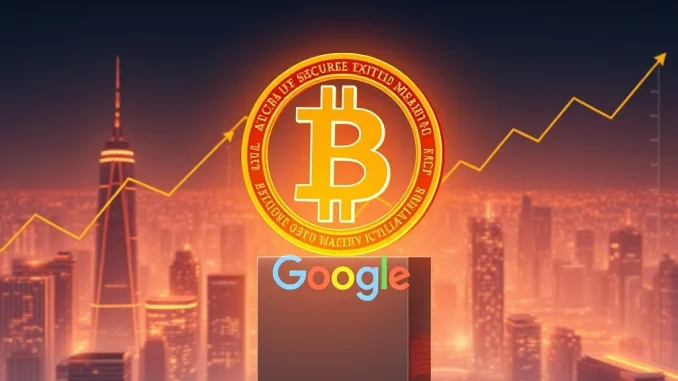
Bitcoin continues to shatter expectations. The cryptocurrency recently achieved an astounding milestone. Its Bitcoin market cap surged past a tech giant. This event marks a significant moment in financial history. It underscores Bitcoin’s growing influence globally.
Bitcoin’s Historic Global Ranking Achievement
Watcher.Guru reported this groundbreaking development on X. Bitcoin (BTC) has officially overtaken Google. It now ranks as the world’s fifth-largest asset by market capitalization. This remarkable feat highlights Bitcoin’s expanding reach. It also solidifies its position in the global financial landscape. Furthermore, this Bitcoin global ranking demonstrates the increasing acceptance of digital currencies.
According to CoinMarketCap, this achievement occurred amidst a period of significant price movement. The digital asset showed robust performance. Its market valuation now stands among the world’s most valuable entities. This includes companies like Microsoft and Apple. Clearly, Bitcoin is no longer a niche investment. It has become a formidable financial force.
Understanding the Soaring BTC Price
At the time of the report, the BTC price was $121,578. This represented a notable 5.31% increase over 24 hours. Such rapid price appreciation often accompanies major market cap milestones. Several factors contribute to these price surges. These include:
- Increased institutional investment
- Growing retail adoption
- The finite supply of Bitcoin creating scarcity
This inherent scarcity often drives up its value. Investors closely monitor these price movements. They indicate broader market sentiment.
Market analysts constantly evaluate Bitcoin’s performance. They consider macroeconomic factors. Geopolitical events can also influence its value. Understanding these dynamics is crucial. It helps investors make informed decisions. The current BTC price reflects strong buyer confidence. This confidence follows a period of sustained growth. It shows a maturing market for cryptocurrencies.
Bitcoin as a Leading Cryptocurrency Asset
Bitcoin’s journey from an obscure digital experiment to a dominant cryptocurrency asset is remarkable. Its decentralized nature appeals to many. No single entity controls it. This provides a level of autonomy. It contrasts sharply with traditional currencies. Furthermore, its blockchain technology ensures transparency. Every transaction is recorded publicly. This enhances trust and security.
The status of Bitcoin as a leading cryptocurrency asset continues to grow. Its network effect is powerful. More users and businesses adopt it daily. This widespread adoption strengthens its utility. It also increases its overall value. Bitcoin has set a precedent for other digital currencies. It paved the way for innovation in the blockchain space. Its leadership is undeniable in this sector.
The Narrative of Digital Gold
The concept of Bitcoin as digital gold gains further traction with each milestone. Like gold, Bitcoin possesses a finite supply. Only 21 million Bitcoins will ever exist. This scarcity makes it an attractive store of value. Many investors now view it as a hedge. They use it against inflation and economic uncertainty. Its performance often mirrors that of traditional safe-haven assets.
Historically, gold has served as a global reserve asset. Bitcoin now offers a modern, digital alternative. Its portability and divisibility surpass physical gold. This makes it more accessible for global transactions. Therefore, its role as digital gold strengthens. This narrative resonates with a new generation of investors. They seek innovative ways to preserve wealth.
Implications for the Global Financial Landscape
Bitcoin’s ascent to the fifth-largest global asset challenges established financial norms. It forces a reevaluation of traditional asset classes. Central banks and financial institutions are taking notice. They are exploring digital currencies themselves. This shift indicates a broader acceptance. Digital assets are moving into mainstream finance. They are no longer on the fringes.
The increased market capitalization also attracts more institutional investors. These large players bring significant capital. They also bring increased legitimacy. Consequently, the cryptocurrency market matures rapidly. This growth creates new opportunities. It also presents new regulatory challenges. Policymakers worldwide are adapting to this new reality. They aim to integrate digital assets safely.
The Road Ahead for Bitcoin and Digital Assets
Experts predict continued volatility in the cryptocurrency market. However, the long-term outlook remains positive for many. Regulatory clarity will be crucial for sustained growth. Governments worldwide are developing frameworks. These frameworks aim to manage digital assets. Such clarity can reduce market uncertainty. It can also foster greater adoption.
Innovation in the blockchain space will also drive future adoption. New technologies are emerging constantly. These advancements improve scalability and efficiency. Bitcoin leads this technological revolution. Its foundational role influences the entire industry. As a result, its position as a top global asset seems secure. Its influence will likely continue to expand.
Bitcoin’s remarkable climb to the fifth-largest global asset is a testament to its resilience. It underscores its profound potential. This achievement signifies a pivotal moment. It marks Bitcoin’s evolution into a cornerstone of global finance. Its journey continues to reshape our understanding of value and wealth.
Frequently Asked Questions (FAQs)
1. What is Bitcoin’s current market cap ranking?
Bitcoin has achieved the rank of the world’s fifth-largest asset by market capitalization. It recently surpassed Google in this metric. This places it among the most valuable entities globally.
2. How does Bitcoin’s market cap compare to Google’s?
Bitcoin’s market capitalization has now exceeded that of Google (Alphabet Inc.). This indicates a significant shift in the global asset landscape. It highlights the immense value now attributed to this digital asset.
3. What factors contribute to Bitcoin’s price movements?
Several factors influence Bitcoin’s price. These include institutional adoption, retail investor demand, its finite supply, macroeconomic conditions, and regulatory developments. Market sentiment also plays a crucial role.
4. Is Bitcoin considered “digital gold”?
Yes, many investors and analysts consider Bitcoin as “digital gold.” This comparison stems from its limited supply of 21 million coins, similar to gold’s scarcity. It often serves as a hedge against inflation and economic instability.
5. What does this achievement mean for the future of cryptocurrencies?
Bitcoin’s rise to the fifth-largest global asset signals increasing mainstream acceptance for cryptocurrencies. It validates their potential as legitimate financial instruments. This milestone could pave the way for broader institutional investment and regulatory clarity across the entire crypto market.
6. Where can I track the current BTC price?
You can track the current BTC price on various cryptocurrency data platforms. CoinMarketCap and CoinGecko are popular choices. These platforms provide real-time price updates, market capitalization data, and trading volumes.