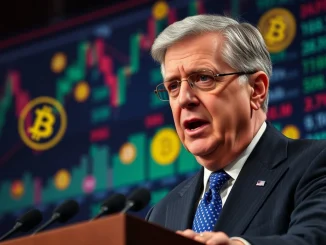
The financial world constantly watches the Federal Reserve. Its decisions significantly influence global markets. For cryptocurrency enthusiasts, understanding the Fed’s stance on interest rates is crucial. Changes in monetary policy often trigger volatility across digital assets. Recently, Atlanta Fed President **Raphael Bostic** offered a significant insight. He projected a single **Fed rate cut** in 2025. This outlook provides a glimpse into the central bank’s cautious approach. It highlights the importance of economic conditions, especially **labor market stability**, in shaping future policy moves. This article delves into Bostic’s perspective and its wider implications for the **US economy outlook** and the crypto landscape.
Raphael Bostic’s Prudent Fed Rate Cut Outlook
Atlanta Federal Reserve President Raphael Bostic recently shared his economic projections. He indicated that one **interest rate cut** in 2025 remains appropriate. This statement, reported by JinSe Finance, offers a measured view on the Fed’s future actions. Bostic emphasized a critical condition for this cut: a stable labor market. His perspective underscores the Fed’s data-dependent strategy. Central bankers closely monitor economic indicators. They adjust policies based on incoming information. Therefore, Bostic’s cautious forecast reflects the current economic uncertainties. It suggests a patient approach to monetary easing. He believes that the economy can continue to grow steadily. Meanwhile, inflation should gradually move towards the Fed’s target. This single rate cut projection contrasts with earlier, more aggressive market expectations. Many investors had hoped for multiple cuts in the near term. However, Bostic’s comments temper those expectations. They align with a more conservative view among some Fed officials. This outlook provides clarity for market participants. It helps them prepare for a potentially slower pace of rate adjustments.
Decoding the US Economy Outlook: Factors Influencing Monetary Policy
The Federal Reserve operates under a dual mandate. It aims to achieve maximum employment and price stability. These goals guide all its monetary policy decisions. To fulfill this mandate, the Fed analyzes a wide range of economic data. Key indicators include inflation rates, GDP growth, and consumer spending. Furthermore, global economic conditions also play a role. The **US economy outlook** remains a complex picture. Recent data shows resilience in some sectors. Other areas, however, exhibit signs of cooling. For instance, inflation has eased from its peak. Yet, it still remains above the Fed’s long-term target of 2%. This persistent inflation makes the Fed hesitant to cut rates too quickly. Premature cuts could reignite inflationary pressures. Conversely, keeping rates too high for too long risks stifling economic growth. It might even push the economy into a recession. Therefore, the Fed must carefully balance these risks. Bostic’s projection of a single **Fed rate cut** reflects this delicate balance. It suggests that while progress is being made, the path to full price stability is not yet complete. This measured approach seeks to ensure a soft landing for the economy. It avoids drastic policy shifts that could destabilize markets.
The Crucial Role of Labor Market Stability in Fed Decisions
The health of the labor market is paramount for the Federal Reserve. It serves as a key barometer for economic strength. Bostic’s statement explicitly tied the potential **interest rate cut** to a stable labor market. This emphasis is not new. The Fed constantly scrutinizes various labor market metrics. These include the unemployment rate, job growth figures, and wage increases. A strong labor market typically indicates a healthy economy. It supports consumer spending and overall economic activity. However, an excessively tight labor market can fuel inflation. It drives up wages and production costs. Currently, the U.S. labor market remains robust. Unemployment rates are historically low. Job creation continues, albeit at a slower pace than before. Wage growth has also shown some moderation. This suggests a gradual rebalancing. Bostic’s focus on **labor market stability** indicates the Fed’s desire. They want to see continued strength without inflationary overheating. Any significant weakening in employment figures could alter the Fed’s plans. Conversely, unexpected surges in wage growth might also delay cuts. Therefore, future labor reports will be closely watched. They will offer critical clues about the timing and magnitude of any rate adjustments. This condition highlights the Fed’s commitment. They want to ensure sustained economic health, not just temporary relief.
How a Potential 2025 Interest Rate Cut Impacts Cryptocurrency Markets
Monetary policy decisions by the Federal Reserve have far-reaching effects. They extend well beyond traditional finance. Cryptocurrency markets are particularly sensitive to these shifts. Historically, lower interest rates tend to favor riskier assets. This includes digital currencies like Bitcoin and Ethereum. When interest rates are high, borrowing costs increase. This makes traditional, safer investments, like bonds, more attractive. Investors may then shift capital away from volatile assets. Conversely, a projected **Fed rate cut** signals a potentially more accommodative monetary environment. Lower rates reduce the cost of capital. This encourages borrowing and investment. It also decreases the appeal of fixed-income assets. Consequently, investors may seek higher returns in risk assets. Cryptocurrencies, known for their growth potential, often benefit from this “risk-on” sentiment. A single **interest rate cut** in 2025, as suggested by Raphael Bostic, might not trigger an immediate crypto bull run. However, it signals a trend. It indicates the Fed’s confidence in disinflation. It also suggests a move towards easier financial conditions. This gradual easing can provide a supportive backdrop for crypto valuations. It could attract new capital into the digital asset space. Therefore, market participants closely monitor these macroeconomic signals. They integrate them into their investment strategies. Understanding the Fed’s cautious optimism is key for navigating the evolving crypto landscape.
Navigating the Future: What This Means for Investors and the Broader Economy
The prospect of a single **interest rate cut** in 2025 carries significant implications. For investors, it suggests a continued need for vigilance. The Fed’s data-dependent approach means forecasts can change. Economic reports, especially those on inflation and employment, will dictate policy. Therefore, staying informed is paramount. For the broader economy, a cautious easing could support sustained growth. Lower borrowing costs might stimulate business investment. They could also ease financial burdens for consumers. However, the exact timing and magnitude of the cut remain uncertain. They hinge on the continued stability of the **labor market stability** and inflation trends. If inflation proves stickier than anticipated, the Fed might delay even this single cut. Conversely, a sudden economic downturn could prompt more aggressive easing. Raphael Bostic’s outlook offers a realistic perspective. It acknowledges progress while emphasizing ongoing challenges. It signals a shift from tightening to a more neutral stance. This transition is crucial for long-term economic health. It aims to prevent both recession and a resurgence of inflation. Investors should consider these nuances. They must adapt their strategies to a dynamic economic environment. The Fed’s measured approach underscores a commitment to long-term stability.
Conclusion
Raphael Bostic’s projection of a single **Fed rate cut** in 2025 provides a key insight into the Federal Reserve’s current thinking. His emphasis on **labor market stability** highlights the cautious and data-dependent nature of monetary policy. While this outlook suggests a slower pace of easing than some markets anticipate, it signals a gradual move towards more accommodative conditions. For the cryptocurrency market, this measured approach could provide a supportive macroeconomic backdrop, fostering a more stable environment for digital assets. Investors and market watchers must continue to monitor economic data closely, as the Fed’s ultimate decisions will hinge on the evolving **US economy outlook**. The path ahead remains contingent on robust economic indicators, ensuring that any future **interest rate cut** serves to solidify long-term economic health and price stability.
Frequently Asked Questions (FAQs)
Q1: What did Fed’s Raphael Bostic say about interest rates?
Atlanta Fed President Raphael Bostic stated that one **interest rate cut** in 2025 remains appropriate. He explicitly linked this potential cut to the condition of a stable U.S. **labor market stability**. This outlook suggests a cautious and data-dependent approach to monetary policy by the Federal Reserve.
Q2: How does a single Fed rate cut impact the US economy outlook?
A single **Fed rate cut** generally signals the central bank’s confidence in disinflation and economic stability. It can lower borrowing costs for businesses and consumers, potentially stimulating investment and spending. This cautious easing aims to support economic growth without reigniting inflation, contributing to a stable **US economy outlook**.
Q3: Why is labor market stability crucial for the Federal Reserve?
**Labor market stability** is a primary focus for the Federal Reserve because it directly relates to its dual mandate of maximum employment and price stability. A strong, stable job market supports consumer demand, but excessive wage growth can fuel inflation. Therefore, the Fed monitors employment figures closely to ensure economic health without overheating.
Q4: What are the implications of Bostic’s forecast for cryptocurrency markets?
Bostic’s forecast of a single **interest rate cut** in 2025, while cautious, suggests a move towards easier financial conditions. Historically, lower interest rates make riskier assets like cryptocurrencies more attractive compared to traditional, safer investments. This could create a more favorable macroeconomic environment for digital assets, potentially attracting new capital.
Q5: How does the Fed decide on interest rate cuts?
The Federal Reserve bases its decisions on comprehensive economic data. This includes inflation rates, employment figures, wage growth, GDP, and consumer spending. Fed officials, like **Raphael Bostic**, assess these indicators to determine if conditions align with their dual mandate of price stability and maximum employment. They aim for a data-dependent approach, adjusting policy as economic circumstances evolve.