The financial world consistently monitors shifts in economic leadership. Therefore, recent revelations regarding the future of the Federal Reserve (Fed) Chair are drawing significant attention across global markets, including the cryptocurrency sector. Understanding the implications of leadership at the Fed is crucial for predicting market movements and investor sentiment. This update directly impacts the broader economic outlook, influencing everything from interest rates to digital asset valuations.
Donald Trump’s Stance on Jerome Powell’s Future
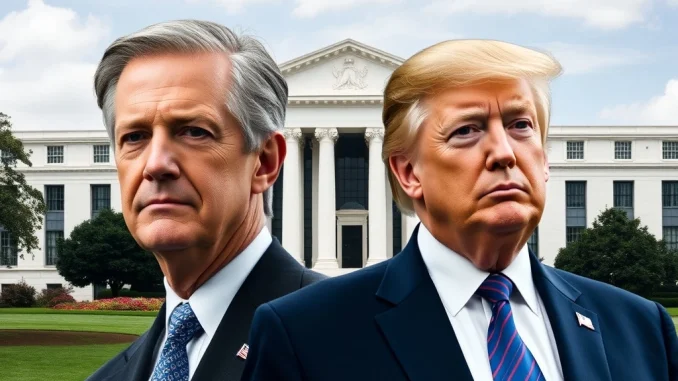
Recent reports indicate a pivotal development regarding the leadership of the United States central bank. U.S. Treasury Secretary Scott Bessent has confirmed that President Donald Trump has no plans to remove current Federal Reserve Chair Jerome Powell. This statement, reported by Walter Bloomberg, clarifies a long-standing point of speculation. Bessent also revealed that the interview process for the next Fed Chair is already underway. This suggests a methodical approach to future leadership, regardless of the immediate decision concerning Powell.
Many observers closely watch these signals. Bessent’s comments provide clarity on Trump’s current intentions. Historically, presidents have appointed their preferred candidates to lead the Fed. However, the current situation presents a unique dynamic. The continuity or change in leadership at the Fed profoundly impacts financial markets. Investors, consequently, seek any information that sheds light on these critical decisions. The stability of the Fed’s leadership often underpins market confidence.
Jerome Powell’s Tenure and Challenges
Jerome Powell assumed the role of Fed Chair in February 2018. His tenure has been marked by significant economic challenges and policy shifts. Initially appointed by Donald Trump, Powell later faced public criticism from the then-President over interest rate decisions. Despite this, Powell has steered the central bank through unprecedented periods. Key highlights of his chairmanship include:
- Navigating the economic fallout from the COVID-19 pandemic.
- Implementing aggressive quantitative easing measures.
- Initiating a rapid series of interest rate hikes to combat surging inflation.
- Addressing concerns about banking sector stability.
These actions demonstrate his commitment to the Fed’s dual mandate: maximizing employment and maintaining price stability. Furthermore, his independent stance, even when facing political pressure, has defined his leadership style. Financial markets have reacted to each of his policy announcements. Therefore, his continued presence or eventual departure holds substantial weight for economic forecasts.
The Federal Reserve’s Critical Role
The Federal Reserve operates as the central banking system of the United States. Its responsibilities are vast and impactful. Primarily, the Fed manages the nation’s monetary policy. It also supervises and regulates banking institutions. Additionally, it maintains the stability of the financial system. Finally, it provides financial services to depository institutions, the U.S. government, and foreign official institutions. The Fed’s decisions directly influence interest rates, inflation, and economic growth. Consequently, its leadership is a matter of intense public and market interest.
A change in Fed Chair can signal a shift in monetary policy direction. This, in turn, affects borrowing costs for businesses and consumers. It also influences investment decisions. For instance, higher interest rates can make borrowing more expensive. This may slow economic activity. Conversely, lower rates can stimulate growth. The independence of the Federal Reserve from political influence is a cornerstone of its effectiveness. However, presidential preferences inevitably play a role in the selection process.
Understanding Monetary Policy and Its Impact
Monetary policy refers to the actions a central bank undertakes to influence the availability and cost of money and credit to help promote national economic goals. In the U.S., the Federal Reserve employs several tools to achieve its objectives. These tools include:
- **The Federal Funds Rate:** This target rate influences other interest rates in the economy.
- **Open Market Operations:** The buying and selling of government securities to control the money supply.
- **Discount Rate:** The interest rate at which commercial banks can borrow money from the Fed.
- **Reserve Requirements:** The amount of funds banks must hold in reserve.
Changes in monetary policy ripple through the entire economy. For example, when the Fed raises interest rates, it aims to cool inflation. This action can increase the cost of mortgages, car loans, and business investments. Ultimately, this can lead to slower economic growth. Conversely, when the Fed lowers rates, it encourages spending and investment, stimulating the economy. Therefore, the future of the Fed Chair is directly tied to the direction of these critical policies.
The Ongoing Fed Chair Interview Process
Scott Bessent’s revelation about ongoing interviews for the next Fed Chair highlights the thoroughness of the selection process. While President Trump has indicated no immediate plans to remove Jerome Powell, preparing for future leadership is standard practice. The process typically involves extensive vetting of potential candidates. These candidates must possess deep economic knowledge and leadership capabilities. They also require a clear understanding of the Fed’s mandate.
Potential candidates are often senior economists, former central bankers, or highly respected financial professionals. The President nominates the Fed Chair, and the Senate confirms the nomination. This process ensures a robust review. The interviews likely focus on candidates’ views on inflation, employment, financial stability, and the Fed’s independence. This forward-looking approach ensures a smooth transition whenever a change in leadership occurs. Ultimately, the chosen individual will shape the nation’s economic trajectory for years.
Implications for Financial Markets and Beyond
The stability of the Fed’s leadership, and the continuity of its monetary policy, are paramount for financial market confidence. Uncertainty regarding the Fed Chair can lead to market volatility. Conversely, clarity often brings stability. Scott Bessent’s statement, therefore, offers some reassurance to investors. The fact that President Donald Trump reportedly has no immediate plans to dismiss Jerome Powell could be interpreted positively by markets seeking predictability.
However, the ongoing interview process for the next Fed Chair indicates that a change remains a future possibility. This prospect will keep market participants watchful. Any signals regarding potential candidates or shifts in policy philosophy will be scrutinized. For the cryptocurrency market, specifically, Fed policy is a significant external factor. Interest rate hikes, for instance, can make traditional assets more attractive, potentially drawing capital away from riskier assets like cryptocurrencies. Conversely, a more accommodative monetary policy might favor digital assets. Consequently, understanding these dynamics is vital for investors.
Conclusion: A Steady Hand Amidst Transition
Scott Bessent’s recent comments offer a clearer picture of President Donald Trump’s intentions regarding the Federal Reserve leadership. While Jerome Powell remains at the helm for now, the commencement of interviews for the next Fed Chair signals a proactive approach to future economic stewardship. This development underscores the critical importance of the Fed’s role in maintaining economic stability and guiding monetary policy. As the nation approaches a significant election cycle, the leadership of the central bank remains a central point of interest for policymakers, economists, and investors alike. The decisions made regarding the Fed’s top position will undoubtedly shape the economic landscape for years to come.
Frequently Asked Questions (FAQs)
Q1: What did U.S. Treasury Secretary Scott Bessent say about Jerome Powell?
Scott Bessent stated that President Donald Trump has no current plans to remove Federal Reserve Chair Jerome Powell. He also confirmed that the interview process for the next Fed Chair has already begun.
Q2: Why is the Federal Reserve Chair position so important?
The Fed Chair leads the central bank, which sets monetary policy for the U.S. This policy directly influences interest rates, inflation, and economic growth, affecting everything from job markets to investment opportunities. Therefore, the Fed Chair plays a crucial role in the nation’s economic health.
Q3: Has Donald Trump criticized Jerome Powell in the past?
Yes, during his previous presidency, Donald Trump frequently criticized Jerome Powell, particularly over the Fed’s decisions to raise interest rates. These criticisms often highlighted a divergence in economic philosophy.
Q4: How does Federal Reserve monetary policy impact cryptocurrency markets?
Federal Reserve monetary policy significantly influences broader financial markets. For instance, higher interest rates can make traditional, less risky investments more appealing, potentially reducing investor appetite for cryptocurrencies. Conversely, a more accommodative policy, such as lower rates, might encourage investment in digital assets due to increased liquidity and a search for higher returns.
Q5: What is the process for selecting a new Fed Chair?
The President of the United States nominates the Federal Reserve Chair. This nomination then requires confirmation by the U.S. Senate. The selection process typically involves extensive interviews and vetting to ensure the candidate possesses the necessary economic expertise and leadership qualities.
Q6: What does the ongoing interview process for the next Fed Chair imply?
The ongoing interview process indicates a proactive approach to future leadership succession at the Federal Reserve. It suggests that while Jerome Powell’s immediate removal is not planned, preparations are underway for a potential transition, ensuring continuity and stability in the central bank’s operations whenever the time comes for a new appointment.