The cryptocurrency market often experiences dynamic shifts. Consequently, exchanges frequently update their offerings. Recently, OKX, a prominent global crypto exchange, made a significant announcement. This update directly impacts many traders. OKX will delist 21 specific margin trading pairs. This action is scheduled for mid-August. Therefore, traders must understand these changes. This **OKX delisting** will occur in two phases. It is crucial for users to review their positions. Preparation is key to navigating these adjustments effectively.
Understanding the **OKX Delisting** Announcement
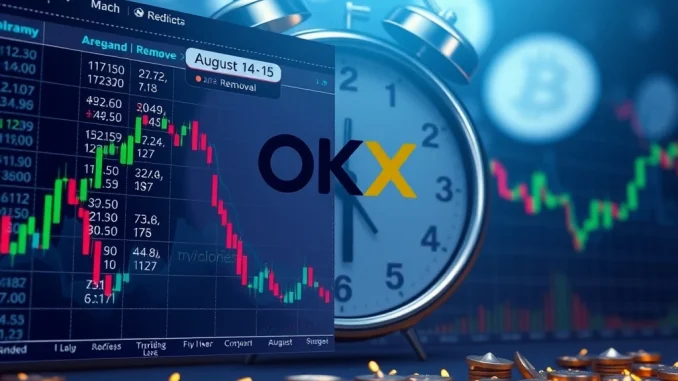
OKX officially announced the removal of 21 margin trading pairs. This decision was published on its official website. The delisting process will unfold over two days. Specifically, these dates are August 14 and August 15. The affected pairs include a wide range of popular cryptocurrencies. This includes both major and altcoin assets. Traders utilizing these pairs for margin trading should take immediate notice.
The first phase of the delisting targets several pairs. These will be removed on August 14. The timeframe for this action is between 06:00 and 10:00 UTC. The pairs include:
- AAVE/USDC
- ADA/USDC
- ALGO/USDT
- APE/USDC
- APT/USDC
- ATOM/USDC
- AVAX/USDC
- BCH/USDC
- CHZ/USDC
- DOT/USDC
- LINK/USDC
- NEAR/USDC
The second phase follows swiftly. It will occur on August 15. This delisting also takes place between 06:00 and 10:00 UTC. This group includes other widely traded assets. These are some of the most liquid pairs in the market. The affected pairs are:
- OP/USDC
- SAND/USDC
- UNI/USDC
- XRP/USDC
- DOGE/USDC
- LTC/USDC
- SOL/USDC
- ETH/USDC
- BTC/USDC
This comprehensive list indicates a strategic decision by OKX. The exchange aims to optimize its trading environment. Furthermore, it seeks to enhance user experience. Users holding positions in these **margin trading pairs** must act quickly. They should close out their positions. Alternatively, they can adjust their strategies before the specified times. Failure to do so could result in automatic settlement. This might lead to unexpected outcomes for traders.
Why Exchanges Delist **Margin Trading Pairs**?
Delisting trading pairs is a common practice among cryptocurrency exchanges. This action is not unusual. Various factors drive such decisions. Exchanges aim to maintain a healthy and efficient marketplace. Thus, they regularly review listed assets. Several key reasons often lead to a **trading pair delisting**.
Firstly, low liquidity can be a major factor. Pairs with insufficient trading volume become inefficient. They can also lead to price manipulation. Exchanges prefer highly liquid assets. These provide better price discovery and execution for users. Secondly, poor project performance plays a role. If a cryptocurrency project fails to meet its roadmap, its token value may decline. Such assets can pose risks to traders. Exchanges may remove them to protect their users.
Thirdly, regulatory compliance is paramount. The crypto regulatory landscape is constantly evolving. Exchanges must adhere to new rules. Some tokens might fall out of compliance in certain jurisdictions. This forces exchanges to delist them. Fourthly, market demand shifts. User interest in certain assets can wane over time. Exchanges respond by removing less popular pairs. This allows them to focus resources on more demanded assets. Finally, security concerns can prompt delisting. If a token’s underlying blockchain or smart contract reveals vulnerabilities, it poses a risk. Exchanges prioritize user security. Therefore, they may remove such assets promptly.
OKX has not provided specific reasons for each delisted pair. However, these general principles apply. The exchange likely conducted a thorough review. This ensures a robust and compliant trading platform. This move reflects OKX’s commitment. They aim to provide a secure and high-quality trading experience. This proactive approach helps manage market risks. It also aligns with global best practices for **crypto exchange updates**.
Immediate Actions for Traders: Navigating the **Trading Pair Delisting**
For traders with open positions in the affected **margin trading pairs**, immediate action is necessary. Ignoring these announcements can lead to financial losses. Understanding the process is vital. OKX will automatically settle any open positions. This occurs at the delisting time. This automatic settlement happens at the prevailing market price. This price might not be favorable. Therefore, proactive management is crucial.
Here are key steps traders should take:
- Review Open Positions: Identify all active margin trades involving the listed pairs. Check both long and short positions.
- Close Positions: Manually close all affected positions before the deadline. This gives you control over the exit price. It also prevents unexpected liquidations.
- Transfer Assets: If you hold the underlying assets (e.g., AAVE, ADA, BTC, ETH) in your margin account, consider transferring them. Move them to your spot account. This protects them from automatic margin settlement.
- Monitor Market Conditions: Prices can become volatile near delisting times. Be aware of potential rapid price movements. Plan your actions accordingly.
- Understand Settlement: Know that if you do not close your positions, OKX will do it for you. This will happen at the market price at the moment of delisting. This might not be ideal.
Furthermore, traders should always stay informed. Regularly check official announcements from OKX. Subscribe to their newsletters or follow their social media. This ensures you receive timely updates. This proactive approach minimizes potential disruptions. It also helps manage risk effectively. Adapting to such **crypto exchange updates** is a fundamental part of responsible trading. It reinforces the importance of diligence in the volatile crypto market.
The Broader Context of **Crypto Exchange Updates**
Delistings are a natural part of the cryptocurrency ecosystem. They reflect the market’s continuous evolution. Exchanges regularly review their listings. This ensures they offer a relevant and secure trading environment. Such **crypto exchange updates** are not unique to OKX. Many platforms undertake similar reviews. This includes both large and small exchanges. They strive to maintain high standards for their users.
These updates often aim to improve market quality. Removing illiquid or underperforming assets helps. It can consolidate liquidity into more robust pairs. This benefits traders. It provides deeper order books. It also reduces slippage. Furthermore, delistings can be a response to changing regulatory landscapes. As governments around the world develop clearer rules for crypto, exchanges must adapt. Compliance is critical for long-term sustainability. Failure to comply can lead to severe penalties. It can also damage an exchange’s reputation.
Moreover, delistings signal an exchange’s commitment to asset quality. By removing projects that no longer meet certain criteria, exchanges protect their users. They shield them from potential scams or failing projects. This helps maintain trust in the platform. It also promotes a healthier overall market. While delistings can cause temporary inconvenience for some traders, they are often a necessary measure. They contribute to the maturation of the digital asset space. Therefore, traders should view these updates as part of the normal operational cycle. They are a sign of a dynamic and responsive market.
Implications for the **OKX Exchange** and Its Users
This recent **OKX delisting** announcement highlights the exchange’s ongoing efforts. OKX aims to refine its product offerings. It also seeks to enhance the user experience. By removing these specific **margin trading pairs**, OKX is streamlining its services. This could lead to a more focused and efficient trading platform. For existing users, this means a potential shift in their trading strategies. They might need to explore alternative pairs. They might also need to adjust their risk management protocols.
The decision underscores OKX’s dedication to maintaining a robust trading environment. It reflects a proactive approach to market management. This helps ensure that the platform remains competitive. It also provides a secure space for its global user base. Furthermore, such strategic moves can strengthen an exchange’s position. They build user confidence. This happens by demonstrating a commitment to quality and compliance. In the long run, this benefits the entire OKX community. It fosters a more reliable and trustworthy trading ecosystem.
Users should interpret this action as a positive step towards a more optimized platform. It emphasizes the importance of adaptability in crypto trading. The **OKX exchange** will continue to support a vast array of other trading pairs. It will also introduce new opportunities. Traders are encouraged to explore these. They should diversify their portfolios. This helps mitigate risks associated with specific asset changes. Ultimately, OKX’s move aims to fortify its position as a leading crypto trading venue. It does so by prioritizing platform integrity and user safety.
In conclusion, OKX’s decision to delist 21 margin trading pairs is a significant development. It requires immediate attention from affected traders. This move is part of a broader strategy. Exchanges regularly optimize their offerings. They also adapt to market dynamics and regulatory demands. Traders must remain vigilant. They should always stay informed about such **crypto exchange updates**. Proactive management of positions is crucial. This ensures a smooth transition. It also helps minimize potential risks. By understanding the reasons behind these actions and responding appropriately, traders can continue to navigate the exciting yet challenging world of cryptocurrency effectively.
Frequently Asked Questions (FAQs)
Q1: Why is OKX delisting these margin trading pairs?
A1: OKX, like other exchanges, regularly reviews its listings. Delistings can occur due to factors like low liquidity, poor project performance, regulatory compliance issues, or shifting market demand. While specific reasons for each pair were not given, these general principles guide such decisions.
Q2: What should I do if I have open positions in the delisted **margin trading pairs**?
A2: You should immediately review and close all your open margin positions involving these pairs before the specified delisting times (August 14-15, 06:00-10:00 UTC). If you do not, OKX will automatically settle them at the prevailing market price, which may not be favorable.
Q3: Will the underlying assets (e.g., BTC, ETH, ADA) also be delisted from spot trading?
A3: The announcement specifically mentions delisting of *margin trading pairs*. This does not necessarily mean the underlying assets will be removed from spot trading or other services on OKX. Always refer to the official OKX announcement for precise details on which services are affected.
Q4: How can I stay informed about future **OKX delisting** announcements?
A4: To stay updated, regularly check the official OKX website’s announcements section. You can also follow their official social media channels and subscribe to their newsletters. Timely information is crucial for managing your trades effectively.
Q5: Does this **trading pair delisting** affect all OKX users globally?
A5: Yes, the delisting of these specific margin trading pairs applies globally to all users who have access to margin trading on the OKX platform. It is a platform-wide change for the listed pairs.
Q6: What does this mean for the future of **OKX exchange**?
A6: This delisting indicates OKX’s commitment to maintaining a healthy, secure, and compliant trading environment. It suggests the exchange is actively optimizing its offerings to provide a better experience for its users and adapt to market and regulatory changes. It’s a routine part of exchange operations.