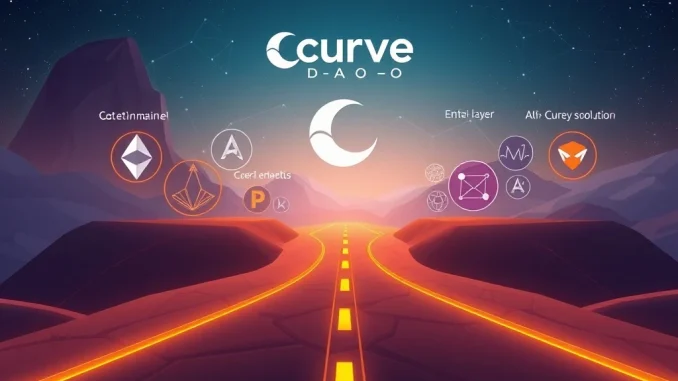
The decentralized finance (DeFi) world is buzzing with a pivotal discussion unfolding within the Curve DAO community. A recent proposal has sparked a crucial rethink regarding the protocol’s strategy for Layer-2 integrations, raising fundamental questions about efficiency and profitability in the ever-evolving blockchain landscape. This move underscores a growing trend among major DeFi protocols to scrutinize the actual value derived from scaling solutions, especially concerning the capture of blockchain fees.
Curve DAO’s Crucial Decision: Why the Rethink?
At the heart of this significant debate is a proposal put forth by Curve DAO community member, “Phil_00LLAMA,” as reported by Protos. The core assertion of this proposal is straightforward yet impactful: the work invested in developing and maintaining connections to various Layer-2 networks yields minimal network fees for the Curve protocol when compared to the robust revenue generated on the Ethereum mainnet. For a leading automated market maker (AMM) like Curve, which plays a vital role in stablecoin and asset swaps, understanding where its economic value is truly captured is paramount.
This isn’t merely a technical discussion; it’s a strategic one that could redefine how major DeFi players approach DeFi scaling. The proposal highlights a critical challenge: while Layer-2 solutions are designed to reduce transaction costs and increase throughput for users, they might not always translate into substantial direct revenue streams for the underlying protocols that integrate with them. The question becomes: at what point does the operational overhead of supporting multiple L2s outweigh the tangible benefits to the DAO?
The Debate Around Layer-2 Integrations: Are They Worth It?
Layer-2 integrations have long been championed as the panacea for Ethereum’s scalability woes. By processing transactions off-chain and then settling them on the mainnet, L2s like Arbitrum, Optimism, and Polygon offer significantly lower gas fees and faster transaction speeds, making DeFi more accessible to a wider user base. For Curve, integrating with these solutions was a logical step to expand its reach and improve user experience.
However, Phil_00LLAMA’s proposal challenges this widely accepted narrative, at least from a protocol revenue perspective. The argument posits that while users benefit from reduced gas costs on L2s, the fee structure or volume on these networks might not be generating sufficient protocol fees for Curve DAO to justify the ongoing development, maintenance, and liquidity management efforts. This raises a pertinent question for the entire DeFi ecosystem:
- User Benefit vs. Protocol Revenue: Is there a disconnect between the benefits users derive from L2s (cheaper transactions) and the direct financial gain for the protocols operating on them?
- Liquidity Fragmentation: Does spreading liquidity across multiple L2s dilute the value proposition and operational efficiency compared to concentrating it on the Ethereum mainnet?
- Development Overhead: Is the engineering and operational cost of supporting new Layer-2 integrations becoming a drag on resources that could be better deployed elsewhere?
Ethereum Mainnet vs. L2s: A Deep Dive into Network Fees
To truly understand the proposal’s rationale, it’s essential to examine the differing dynamics of network fees on the Ethereum mainnet versus Layer-2 solutions. On Ethereum, users pay gas fees directly to miners (soon validators) for transaction processing. A portion of these fees, along with trading fees within protocols, contributes to the overall economic activity that protocols like Curve can tap into.
Layer-2 networks, while dramatically reducing user-paid gas fees, often do so by batching transactions and submitting them to the mainnet as a single, compressed transaction. While this is efficient for users, the mechanism by which protocols earn revenue from L2 activity can differ. If the primary source of protocol revenue is derived from a percentage of transaction volume or specific fee models that are more lucrative on the high-value, high-liquidity Ethereum mainnet, then L2 activity, even if high in volume, might not translate into equivalent protocol earnings.
Consider the following comparison:
| Aspect | Ethereum Mainnet | Layer-2 Networks |
|---|---|---|
| User Gas Fees | Typically Higher | Significantly Lower |
| Transaction Speed | Can be Slower (during congestion) | Much Faster |
| Protocol Revenue Potential (for Curve) | Potentially Higher (from concentrated liquidity & high-value swaps) | Potentially Lower (per transaction, or less aggregated value) |
| Liquidity Concentration | High (single, dominant pool) | Fragmented (across multiple L2s) |
| Development & Maintenance Cost | Lower (single chain focus) | Higher (multiple chain support) |
This table illustrates the dilemma. While L2s offer undeniable user benefits, the economic model for the protocol itself might not always align perfectly, leading to questions about sustainable DeFi scaling strategies.
The Broader Implications for DeFi Scaling
The Curve DAO proposal is not an isolated incident; it reflects a broader introspection within the DeFi space regarding the long-term viability and strategic necessity of extensive Layer-2 integrations. As the ecosystem matures, protocols are moving beyond simply adopting the latest tech to critically evaluating its return on investment (ROI).
This discussion could pave the way for a more nuanced approach to scaling. Instead of a blanket strategy of integrating with every new L2, protocols might become more selective, focusing on those that offer a clear path to sustainable revenue or truly exceptional user acquisition. It also highlights the importance of robust data analytics for DAOs to understand where their value is truly being generated and consumed.
Actionable Insight for Protocols: Develop clear metrics and key performance indicators (KPIs) to evaluate the effectiveness of L2 deployments, focusing not just on user activity but also on the direct economic benefit to the protocol treasury and stakeholders. This will be crucial for effective DeFi scaling decisions moving forward.
Navigating Blockchain Fees: What’s Next for Curve?
The proposal by Phil_00LLAMA will now be subject to the democratic governance process of Curve DAO. The community will weigh the arguments, considering the balance between user experience, developer resources, and the generation of sustainable blockchain fees for the protocol’s longevity.
Possible outcomes could include:
- Cessation of New L2 Work: Halting further development on new Layer-2 integrations to reallocate resources to more profitable ventures or to optimize existing mainnet operations.
- Re-evaluation of Existing L2s: A deeper dive into the performance of current L2 deployments, potentially leading to the sunsetting of underperforming integrations.
- Focus on Mainnet Optimization: Renewed emphasis on enhancing the Curve experience and fee generation on the Ethereum mainnet, which remains its primary revenue driver.
- Alternative Scaling Strategies: Exploring other forms of scaling or revenue generation that do not involve extensive L2 development.
Regardless of the specific outcome, this proposal marks a significant moment for Curve and the wider DeFi landscape. It signals a maturation of the industry, where strategic decisions are increasingly driven by economic realities and a clear understanding of where value is truly accrued.
Conclusion: A Strategic Pivot for DeFi’s Future?
The debate within the Curve DAO community over Layer-2 integrations and their impact on network fees is more than just an internal discussion; it’s a bellwether for the entire decentralized finance space. It forces a critical examination of the widely held belief that more integrations automatically equate to more success. As protocols mature, the focus shifts from simply being present everywhere to being strategically present where the most value is generated and captured.
This crucial rethink by Curve could inspire other major protocols to conduct similar assessments, leading to a more efficient, sustainable, and economically sound future for DeFi scaling. The ultimate decision by the Curve community will undoubtedly provide valuable insights into the evolving dynamics of blockchain profitability and the delicate balance between innovation, accessibility, and financial sustainability.
Frequently Asked Questions (FAQs)
1. What is Curve DAO?
Curve DAO is the decentralized autonomous organization governing Curve Finance, a leading decentralized exchange (DEX) primarily known for its efficient stablecoin swaps and low slippage for large trades. It’s a foundational protocol within the DeFi ecosystem.
2. What are Layer-2 integrations in blockchain?
Layer-2 integrations are scaling solutions built on top of a base blockchain (like Ethereum’s mainnet) to increase transaction throughput and reduce fees. They process transactions off-chain and then batch them for final settlement on the mainnet, making the network more efficient.
3. Why is Curve rethinking its Layer-2 strategy?
A community proposal suggests that the development and maintenance work for Layer-2 integrations are yielding minimal network fees for Curve DAO compared to the revenue generated on the Ethereum mainnet. The proposal questions the return on investment for these scaling efforts from a protocol’s perspective.
4. How do network fees impact DeFi protocols?
Network fees (gas fees) are paid by users for transactions. While lower user fees are desirable, protocols often rely on a portion of transaction volume or specific fee models to generate revenue for their treasury, liquidity providers, or stakers. If L2s significantly reduce these captured fees for the protocol, it impacts their economic sustainability.
5. What could be the outcome of this Curve DAO proposal?
The Curve DAO community will vote on the proposal. Possible outcomes include ceasing work on new Layer-2 integrations, re-evaluating existing ones, or a renewed focus on optimizing operations and fee generation on the Ethereum mainnet. The decision will be made through decentralized governance.
6. Is this Layer-2 re-evaluation unique to Curve, or a broader DeFi trend?
While this specific proposal is from Curve DAO, the underlying questions about the economic viability and strategic necessity of Layer-2 integrations for protocols are becoming a broader discussion across the DeFi space. Many protocols are now scrutinizing the ROI of their scaling efforts beyond just user adoption metrics.