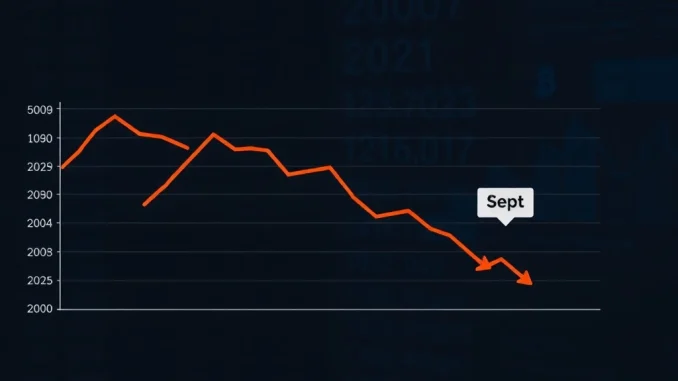
Are you ready for the late summer crypto rollercoaster? For many in the crypto world, August and September often bring a sense of trepidation, especially when it comes to the Bitcoin price. A striking piece of data from Lookonchain on X reveals a historical pattern that demands attention: Bitcoin has experienced a price decline in August and September in 8 of the past 12 years. That’s a significant 67% historical probability of price drops during these months. But what does this mean for you, and how should you navigate these potentially choppy waters?
Decoding the Bitcoin August-September Trend
The statistic is stark: a two-thirds chance that Bitcoin will trend downwards in the twin months of August and September. This isn’t just a casual observation; it’s a pattern that has emerged consistently over more than a decade of Bitcoin’s existence. While past performance is never a guarantee of future results, such a strong historical tendency warrants careful consideration for anyone involved in the crypto market.
Let’s break down what this 67% probability signifies:
- Consistent Pattern: In 8 out of the last 12 years, investors who held Bitcoin through August and September likely saw their portfolios shrink, at least temporarily.
- Not Every Year: It’s important to note that it’s not a 100% certainty. There have been years where Bitcoin bucked the trend and saw gains during this period. These exceptions highlight the unpredictable nature of markets.
- Implied Volatility: The recurring decline suggests that these months are often characterized by increased selling pressure or reduced buying interest compared to other periods.
To illustrate this historical tendency, consider the following hypothetical, generalized table reflecting the frequency of these declines:
| Period | Bitcoin Performance | Outcome (Decline/Gain) |
|---|---|---|
| August-September (Year 1) | Significant Drop | Decline |
| August-September (Year 2) | Modest Gain | Gain |
| August-September (Year 3) | Sharp Correction | Decline |
| … (5 more years of decline) | … | Decline |
| … (2 more years of gain) | … | Gain |
This table is illustrative and does not reflect specific year-on-year data but highlights the observed frequency of declines versus gains during this specific two-month window.
Why Does Bitcoin Decline Historically in Late Summer?
Understanding the ‘why’ behind the August September Bitcoin trend is crucial, though often speculative. There isn’t one definitive answer, but several theories circulate within the crypto community and traditional finance that might contribute to this seasonal weakness:
- The ‘Sell in May and Go Away’ Effect: This old adage from traditional markets suggests that investors often sell off assets in late spring/early summer and return after the summer holidays. While Bitcoin doesn’t perfectly align with this, the effect might extend into late summer as people return from vacations and reassess their portfolios. Lower trading volumes during summer months could also exacerbate price movements.
- End-of-Q3 Rebalancing: September marks the end of the third quarter for many institutional investors and corporations. This period often sees portfolio rebalancing, profit-taking, or liquidity adjustments, which can put downward pressure on assets, including Bitcoin.
- Macroeconomic Factors: The latter half of the year often brings renewed focus on macroeconomic data, central bank meetings, and fiscal policy announcements. Any perceived negative outlook on inflation, interest rates, or global economic growth could lead investors to de-risk, pulling funds from volatile assets like crypto.
- Psychological Factors: Human behavior plays a significant role in market movements. If enough investors are aware of this historical trend, it can become a self-fulfilling prophecy, where anticipation of a dip leads to selling pressure, thus causing the dip.
It’s important to reiterate that these are theories. The crypto market is complex and influenced by a multitude of factors, making it challenging to pinpoint a single cause for any recurring pattern.
Navigating the Crypto Market: What Does This Mean for Investors?
For investors, this historical data is a signal, not a directive. It doesn’t mean you should panic sell everything, but it does suggest a need for heightened awareness and strategic planning when approaching the crypto market in August and September. Here’s what you might consider:
- For Long-Term Holders: If you’re in Bitcoin for the long haul, these dips can be viewed as potential buying opportunities. Dollar-Cost Averaging (DCA) – investing a fixed amount regularly, regardless of price – can be an effective strategy to mitigate risk during volatile periods. A dip allows you to acquire more Bitcoin at a lower average price.
- For Short-Term Traders: Traders might use this historical insight to adjust their strategies. This could involve tightening stop-loss orders, taking partial profits before the period, or even exploring short-selling opportunities if they believe the trend will continue. However, trading is inherently risky and requires significant expertise.
- Risk Management: Regardless of your investment horizon, always prioritize risk management. Never invest more than you can afford to lose. Diversifying your portfolio beyond just Bitcoin can also help cushion the impact of a decline in any single asset.
Beyond Historical Bitcoin Data: A Holistic View
While the historical Bitcoin data for August and September is compelling, it’s crucial to remember that the market is constantly evolving. Relying solely on past patterns without considering current conditions can be a costly mistake. Many other powerful forces influence Bitcoin’s trajectory:
- Macroeconomic Climate: Global inflation, interest rate hikes by central banks, and geopolitical tensions can overshadow any seasonal trends. Bitcoin’s role as a potential inflation hedge or a risk asset often depends on the prevailing macro environment.
- Regulatory Developments: News regarding Bitcoin ETFs, new crypto regulations, or government stances on digital assets can trigger significant price swings, overriding historical seasonality.
- Technological Advancements & Halving Cycles: Bitcoin’s own network developments, upgrades, and its programmed halving events (which reduce the supply of new Bitcoin) have historically been major catalysts for bull runs. These long-term cycles often dwarf short-term seasonal effects.
- Institutional Adoption: Increased interest and investment from large institutions, corporations, and even sovereign nations can provide strong upward momentum, defying historical norms.
A comprehensive market analysis always involves looking at these broader factors in conjunction with historical trends.
Preparing for Potential Bitcoin Price Swings: Actionable Insights
So, what can you do to prepare for the potential Bitcoin price volatility in the coming months? Here are some actionable insights:
- Stay Informed, Not Alarmed: Keep up-to-date with reliable crypto news and macroeconomic developments. Understand the difference between historical probability and guaranteed outcomes.
- Review Your Investment Strategy: Take this opportunity to revisit your long-term goals. Are you comfortable with your current Bitcoin allocation? Is your risk tolerance aligned with your portfolio?
- Consider Dollar-Cost Averaging (DCA): If you plan to accumulate more Bitcoin, setting up a regular DCA schedule can help you buy dips without trying to time the market perfectly.
- Set Price Alerts: Use exchange features to set price alerts for key levels. This allows you to react quickly to significant movements, whether up or down.
- Practice Emotional Discipline: Markets can be volatile, and historical patterns can induce fear or greed. Stick to your pre-defined strategy and avoid making impulsive decisions based on short-term fluctuations.
- Diversify Wisely: While Bitcoin is the king, consider diversifying into other strong projects if it aligns with your investment thesis and risk appetite.
Conclusion
The historical data from Lookonchain provides a compelling warning: Bitcoin has indeed faced a significant probability of decline in August and September over the past 12 years. This recurring trend, with a 67% chance of a Bitcoin decline, is a valuable piece of information for any investor navigating the dynamic crypto market. While the reasons behind this seasonality are speculative, ranging from traditional market habits to macroeconomic shifts, the pattern itself serves as a reminder to approach these months with caution and a well-thought-out strategy.
However, it’s paramount to remember that historical performance is not an indicator of future results. The crypto landscape is constantly evolving, influenced by a myriad of factors beyond just seasonal trends. By combining an awareness of historical patterns with a comprehensive understanding of current market dynamics, macroeconomic conditions, and your personal risk tolerance, you can make more informed decisions and potentially turn anticipated volatility into an opportunity. Stay vigilant, stay informed, and always invest responsibly.
Frequently Asked Questions (FAQs)
Q1: Is Bitcoin’s August-September decline guaranteed?
No, the historical data indicates a 67% probability of decline, meaning it has happened in 8 out of the last 12 years. This is a strong tendency, but not a guarantee. There have been years where Bitcoin saw gains during these months, highlighting the market’s inherent unpredictability.
Q2: What are the main reasons for seasonal crypto trends like the August-September decline?
Several theories exist, including an extension of the ‘Sell in May and Go Away’ effect from traditional finance, lower trading volumes during summer holidays, end-of-Q3 institutional rebalancing, and a renewed focus on macroeconomic factors after the summer. Psychological factors, where awareness of the trend influences selling, can also play a role.
Q3: How can investors protect themselves during a potential Bitcoin decline?
Investors can employ several strategies: practicing Dollar-Cost Averaging (DCA) to buy dips, setting clear stop-loss orders for short-term trades, diversifying their portfolio, and prioritizing robust risk management. It’s also crucial to avoid emotional decisions and stick to a predefined investment plan.
Q4: Does this historical trend apply to other cryptocurrencies as well?
While Bitcoin often leads the market, its seasonal trends can influence altcoins, especially those with high correlation to Bitcoin. However, altcoins also have their own unique fundamentals and catalysts, so their performance may vary. It’s always best to research individual assets.
Q5: Where can I find reliable Bitcoin market analysis and historical data?
Reputable sources include established crypto news outlets, blockchain analytics firms like Lookonchain (as cited), financial news services, and academic research papers focusing on cryptocurrency market behavior. Always cross-reference information and be wary of sources promising guaranteed returns.