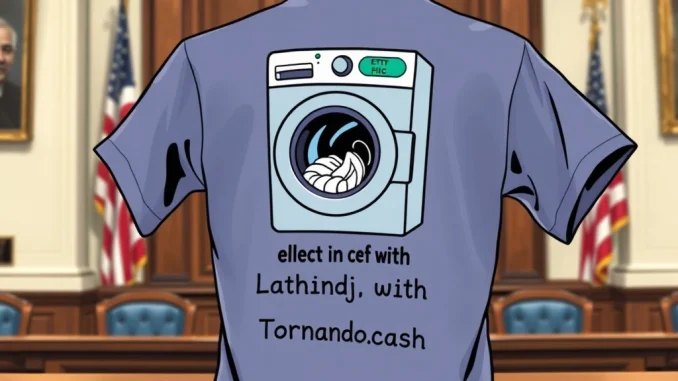
The Tornado Cash trial has taken a dramatic turn as a simple T-shirt becomes the center of a legal battle over criminal intent in the world of decentralized finance. Could this case redefine crypto liability for developers?
Tornado Cash Trial: When a T-Shirt Becomes Evidence
The courtroom drama surrounding Roman Storm’s alleged involvement with Tornado Cash reached new heights when prosecutors presented a 2019 T-shirt as evidence. The shirt, featuring the phrase “I keep my Ether clean with Tornado.cash” alongside a cartoon washing machine, has become a flashpoint in this landmark crypto liability case.
Criminal Intent or Satire? The Great Crypto Debate
The prosecution and defense have starkly different interpretations of the T-shirt’s significance:
- Prosecution view: Evidence of awareness and endorsement of money laundering
- Defense view: Mere satire reflecting crypto culture’s dark humor
- Legal implications: Could set precedent for developer liability in DeFi
Decentralized Finance Meets Traditional Law
This case highlights three critical challenges in applying traditional legal frameworks to decentralized technologies:
- The difficulty of assigning liability in open-source projects
- The tension between privacy and regulatory compliance
- The interpretation of crypto culture by traditional legal systems
What This Means for Crypto Liability Going Forward
The outcome of this trial could have far-reaching consequences for the cryptocurrency industry. A conviction might:
- Chill innovation in privacy-focused protocols
- Force developers to implement more compliance measures
- Create legal uncertainty around open-source contributions
FAQs About the Tornado Cash Trial
Q: What charges does Roman Storm face?
A: Storm is charged with money laundering, conspiracy to operate an unlicensed money transmitter, and sanctions violations.
Q: Why is the T-shirt significant?
A: Prosecutors argue it shows awareness of illicit use, while the defense claims it’s just crypto culture satire.
Q: How does this affect other DeFi developers?
A: The verdict could set precedent for developer liability in decentralized finance projects.
Q: What’s the defense’s main argument?
A: They compare it to holding banking app developers responsible for financial scams.