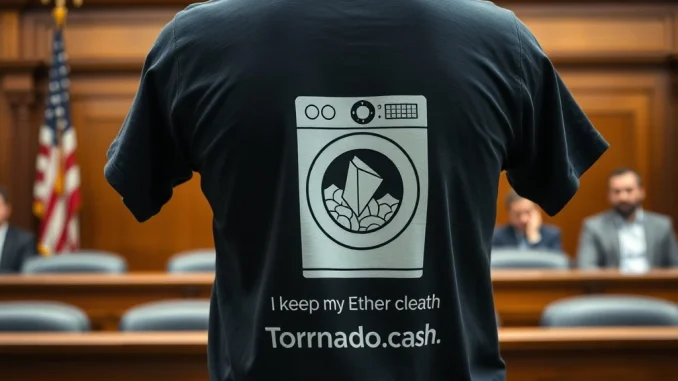
In a dramatic twist, a simple T-shirt has become the centerpiece of a high-stakes legal battle involving Tornado Cash, a decentralized cryptocurrency mixer. Prosecutors claim the shirt proves intent to launder money, while the defense argues it’s just a meme. The outcome could reshape the future of DeFi.
Tornado Cash T-Shirt: Evidence or Just a Meme?
The controversial T-shirt, featuring a washing machine and the phrase ‘I keep my Ether clean with Tornado.cash,’ was worn by co-founder Roman Storm at a 2019 crypto event. Prosecutors allege this demonstrates knowledge of money laundering activities, while the defense maintains it was satirical humor.
DeFi Liability: Where Should Developers Draw the Line?
This case raises critical questions about responsibility in decentralized finance:
- Can developers be held accountable for how their tools are used?
- Should privacy-focused technologies face stricter regulation?
- How do we balance innovation with crime prevention?
The Legal Battle Over Tornado Cash’s Future
The prosecution argues that Tornado Cash was designed to facilitate financial crime, pointing to its use by hackers and sanctioned entities. The defense counters that the platform serves legitimate privacy needs and that developers can’t control user behavior.
What This Means for Cryptocurrency Regulation
A conviction could establish precedent for:
| Potential Outcome | Impact |
|---|---|
| Prosecution win | Tighter AML/KYC rules for DeFi |
| Defense win | Stronger protections for open-source developers |
FAQs
Q: What charges does Roman Storm face?
A: Storm is charged with money laundering, conspiracy to operate an unlicensed money transmitter, and sanctions violations.
Q: Why is the T-shirt significant?
A: Prosecutors claim it shows awareness of money laundering, while the defense argues it was just a joke.
Q: What is Tornado Cash?
A: It’s a decentralized cryptocurrency mixer that anonymizes transactions by randomizing transaction paths.
Q: Could this case affect other DeFi projects?
A: Yes, the outcome may set precedent for how courts view developer liability in decentralized systems.