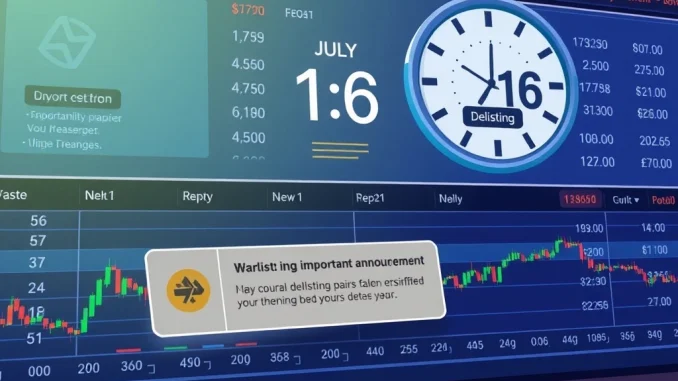
In a crucial announcement that has captured the attention of the cryptocurrency community, leading global exchange Bybit has confirmed the imminent removal of four specific spot trading pairs from its platform. This Bybit delisting, set for July 16 at 08:00 UTC, affects WWY/USDT, XETA/USDT, VRTX/USDT, and FAR/USDT. For active participants in crypto trading, understanding the implications and taking prompt action is paramount.
What Does This Bybit Delisting Mean for Your Assets?
When a cryptocurrency exchange like Bybit decides to delist certain spot trading pairs, it essentially means that trading for those specific assets against their paired counterpart (in this case, USDT) will cease. For traders holding these tokens on the Bybit exchange, this is not just a routine update; it’s a call to action. It signifies the end of active trading support for these particular assets on the platform, requiring users to manage their holdings proactively before the deadline.
The immediate impact is that any open orders for these pairs will be canceled, and users will no longer be able to buy or sell them through Bybit’s spot market. While withdrawals of the underlying assets (WWY, XETA, VRTX, FAR) typically remain available for a period after delisting, the ability to trade them on Bybit vanishes. This makes it critical for users to decide whether to withdraw their funds to a private wallet or another exchange, or to convert them to a supported asset before the delisting date.
Why Do Exchanges Announce a Digital Asset Delisting?
The decision to initiate a digital asset delisting is a multifaceted one, driven by various factors aimed at maintaining a healthy and compliant trading environment. While Bybit’s specific reasons for delisting these four pairs haven’t been explicitly detailed beyond the announcement, common justifications across the industry include:
- Low Liquidity: If a trading pair consistently demonstrates low trading volume and shallow order books, it can lead to poor user experience, significant price slippage, and makes the market susceptible to manipulation. Exchanges prefer to allocate resources to more liquid assets.
- Project Inactivity or Development Concerns: Projects that show a lack of development, community engagement, or fail to meet their roadmap milestones often face delisting. Exchanges aim to list projects with long-term viability.
- Regulatory Scrutiny: Evolving regulatory landscapes can prompt exchanges to delist assets that might be deemed securities in certain jurisdictions or fail to comply with new guidelines.
- Security Vulnerabilities: If a project’s blockchain or smart contract is found to have critical vulnerabilities, or if there are concerns about potential exploits, exchanges may delist to protect user funds.
- Market Manipulation Concerns: Any suspicion of wash trading, pump-and-dump schemes, or other illicit activities associated with a particular asset can lead to its removal.
- Failure to Meet Listing Criteria: Exchanges often have ongoing listing requirements related to technology, team, community, and market performance. Failure to continuously meet these criteria can trigger a delisting review.
Actionable Steps for Bybit Exchange Users
If you hold any of the affected tokens – WWY, XETA, VRTX, or FAR – on the Bybit exchange, immediate action is required. Here’s a breakdown of what you should do:
- Review Your Holdings: Log into your Bybit account and check your spot wallet for any balances of WWY, XETA, VRTX, or FAR. Identify any open orders related to these pairs.
- Close Open Orders: All open orders for WWY/USDT, XETA/USDT, VRTX/USDT, and FAR/USDT will be automatically canceled by Bybit at the delisting time. However, it’s good practice to cancel them manually beforehand if you still have time to execute a trade.
-
Consider Your Options:
- Sell Before Deadline: If you wish to liquidate your holdings, you must sell them for USDT or another supported cryptocurrency on Bybit before July 16, 08:00 UTC. Be mindful of liquidity and potential price volatility as the deadline approaches.
- Withdraw Your Assets: If you prefer to hold the tokens, you should withdraw them to a private wallet (like MetaMask, Trust Wallet, or a hardware wallet) or to another exchange that still supports these assets. Ensure the receiving wallet/exchange supports the specific network of the token.
- Stay Informed: Keep an eye on Bybit’s official announcements page or their social media channels for any further updates regarding withdrawal periods or other related information.
It’s crucial to act swiftly. Missing the deadline could result in your assets becoming inaccessible for trading on Bybit, and while withdrawals are usually supported for a period, there’s always a risk associated with delays.
The Broader Landscape of Crypto Trading and Delistings
Delistings are a natural, albeit sometimes inconvenient, part of the dynamic crypto trading ecosystem. They reflect the continuous evolution and maturation of the market. As the industry grows, exchanges are increasingly focused on offering high-quality, liquid, and compliant assets to their users. This ongoing curation process helps filter out projects that no longer meet performance standards or pose undue risks.
For traders, such announcements serve as a stark reminder of the importance of due diligence. While the allure of quick gains in spot trading pairs is strong, understanding the underlying project, its liquidity, and the exchange’s policies is equally vital. Diversifying your portfolio and not keeping all your assets on a single exchange or in a single low-liquidity asset can mitigate risks associated with sudden market shifts or exchange decisions like a digital asset delisting.
This move by Bybit underscores its commitment to maintaining a robust and secure trading environment. By removing underperforming or problematic assets, the Bybit exchange aims to streamline its offerings and focus resources on more active and promising cryptocurrencies, ultimately benefiting the overall user experience.
Navigating the Future: Best Practices for Traders
In the fast-paced world of crypto trading, staying ahead requires more than just market analysis. Here are some best practices that can help you navigate future delistings and other market events:
- Regularly Check Exchange Announcements: Make it a habit to check the official news or announcement sections of the exchanges you use. This is the primary way exchanges communicate critical updates.
- Understand Liquidity: Before investing heavily in any altcoin, check its trading volume and liquidity across multiple exchanges. Low liquidity is a red flag.
- Research Projects Thoroughly: Go beyond price charts. Understand the project’s utility, team, development activity, and community support. A strong fundamental analysis can hint at a project’s long-term viability.
- Don’t Keep All Funds on Exchanges: For long-term holdings, consider moving your assets to a hardware wallet or a secure software wallet. Exchanges are for trading, not for long-term storage.
- Set Alerts: Many exchanges and crypto tracking apps allow you to set price or news alerts for your holdings. Utilize these tools to stay informed.
The Bybit delisting of these four spot trading pairs is a timely reminder for all participants in the digital asset space to remain vigilant and proactive. While such events can be disruptive, they are also part of the natural cleansing process of an evolving market, pushing towards greater maturity and stability.
Conclusion: Act Now to Secure Your Assets
The announcement from Bybit regarding the delisting of WWY/USDT, XETA/USDT, VRTX/USDT, and FAR/USDT on July 16, 08:00 UTC, is a critical piece of information for anyone involved with these specific tokens on the platform. This Bybit delisting highlights the dynamic nature of the cryptocurrency market and the continuous efforts by exchanges to maintain a robust and secure trading environment. Users are strongly urged to take immediate action, whether by selling their holdings or withdrawing them to external wallets, to avoid any potential inconvenience or loss of access to their funds. Staying informed and acting decisively are your best tools in navigating the ever-changing landscape of crypto trading.
Frequently Asked Questions (FAQs)
Q1: What exactly does it mean when Bybit delists a trading pair?
A1: When Bybit delists a trading pair, it means that active trading for that specific cryptocurrency against its paired asset (e.g., WWY/USDT) will no longer be supported on the Bybit spot market. Users will not be able to place new buy or sell orders for these pairs after the announced date and time.
Q2: Which specific trading pairs are being delisted by Bybit?
A2: Bybit is delisting four spot trading pairs: WWY/USDT, XETA/USDT, VRTX/USDT, and FAR/USDT.
Q3: What is the deadline for the Bybit delisting?
A3: The delisting will occur on July 16 at 08:00 UTC. It is crucial for users to complete any necessary actions before this time.
Q4: What should I do if I hold these tokens on Bybit?
A4: You have two primary options: either sell your tokens for USDT (or another supported cryptocurrency) on Bybit before the deadline, or withdraw them to a private wallet or another cryptocurrency exchange that supports these tokens.
Q5: Will I still be able to withdraw my tokens after the delisting date?
A5: Typically, exchanges allow a withdrawal period after delisting. However, the specific duration for withdrawals will be announced by Bybit. It’s always best practice to withdraw your assets as soon as possible after a delisting announcement to avoid any potential issues.
Q6: Why do cryptocurrency exchanges delist tokens?
A6: Exchanges delist tokens for various reasons, including low trading volume and liquidity, lack of project development or community support, regulatory concerns, security vulnerabilities, or failure to meet the exchange’s ongoing listing criteria.