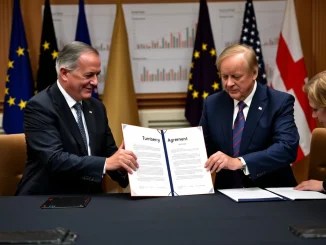
In a world where global economic shifts can ripple through every market, including the dynamic realm of cryptocurrencies, news of stability and cooperation often brings a sigh of relief. A significant development recently emerged from Scotland, where the United States and the European Union announced a landmark US EU trade deal, effectively pulling back from the brink of a potentially devastating trade war. This agreement, far from just a political handshake, carries profound implications for international trade, supply chains, and ultimately, the broader financial landscape that influences digital assets.
What Does the Landmark US EU Trade Deal Entail?
The core of this monumental US EU trade deal revolves around a critical 15% tariff reduction on most EU goods entering the U.S. This marks a significant departure from the 30% rate previously threatened, showcasing a strategic compromise by both parties. But it’s not just about tariffs. The agreement is multifaceted, encompassing:
- Tariff Reduction: A 15% tariff on most EU imports to the U.S., a substantial cut from the previously considered 30% rate.
- Massive Investment: A commitment from the EU to invest a staggering $600 billion into the U.S. economy, focusing on key sectors like infrastructure, technology, and green energy.
- Increased Purchases: EU pledges to increase purchases of American energy products by $750 billion and expand defense equipment procurement.
- Market Access: Zero-tariff access for specific U.S. goods into European markets, aiming to boost American exports.
This framework aligns the U.S. approach with its existing trade model with Japan, promoting consistency in trans-Pacific and transatlantic strategies. For businesses and consumers on both sides of the Atlantic, this translates into greater predictability and potentially lower costs.
How Was a Potentially Destructive Trade War Averted?
The specter of a full-scale trade war averted was perhaps the most critical outcome of these negotiations. For months, escalating tensions threatened to trigger retaliatory measures, destabilizing global supply chains and driving up consumer prices across Europe and the U.S. Analysts had warned that a 30% tariff scenario could have led to severe economic fallout, impacting everything from automotive manufacturing to agricultural exports.
The agreement serves as a crucial buffer against such economic turmoil. By reaching a middle ground, both Washington and Brussels demonstrated a willingness to prioritize economic stability over rigid demands. This compromise not only safeguards existing economic ties but also creates a more predictable environment for businesses, allowing them to plan investments and operations without the constant threat of sudden tariff hikes. The relief felt across industries, from major corporations to small businesses relying on international trade, is palpable.
What is the Immediate Tariff Cut Impact on Key Sectors?
The 15% tariff cut impact is particularly significant for sectors that were at the heart of previous trade disputes.
- Automotive Industry: A critical sector for German and French manufacturers, automotive imports faced the threat of steep tariffs. The 15% rate represents a pragmatic middle ground, preventing a major blow to European carmakers while still addressing U.S. concerns. This stability is vital for a global industry with complex supply chains.
- Agricultural Exports: The EU’s commitment to zero-tariff access for U.S. goods into European markets is a boon for American agricultural producers. Farmers, especially those exporting to key European markets like Germany, France, and Italy, stand to benefit from increased competitiveness and market access. This move could alleviate long-standing frictions in agricultural trade, which have often been flashpoints in transatlantic relations.
- Energy and Defense: The pledges for increased purchases of U.S. energy products ($750 billion) and expanded defense procurement highlight a strategic shift. These commitments reflect a broader effort to strengthen transatlantic economic and security ties, aligning trade policy with geopolitical considerations.
Strengthening Transatlantic Trade and Economic Ties
Beyond the immediate economic benefits, this agreement signifies a renewed commitment to strengthening transatlantic trade. The deal, announced during a high-profile summit in Scotland, underscores its diplomatic importance. President Trump hailed it as “the biggest deal ever made,” while EU officials emphasized its role in preserving stability in global trade amid rising protectionism worldwide.
This pact moves beyond mere trade figures; it reinforces a strategic economic partnership. The focus on investment in U.S. infrastructure, technology, and green energy sectors, coupled with increased energy and defense procurement, illustrates a deeper alignment of economic goals. This proactive approach aims to build resilience in both economies, fostering growth and innovation in critical areas. For the U.S., it secures long-term access to lucrative European markets and bolsters domestic industries. For the EU, it provides a crucial buffer against potential future trade escalations and ensures continued access to the American market.
What Lies Ahead for the US-EU Economic Partnership?
While the initial reaction to the deal has been largely positive, the success of this economic partnership hinges on its effective implementation. Both sides now face the challenge of navigating internal political hurdles.
- U.S. Internal Challenges: U.S. lawmakers from both parties have expressed concerns about potential job losses in certain industries or the specifics of market access. Transparency in the deal’s details, as called for by figures like Speaker of the House Nancy Pelosi, will be crucial for garnering domestic support.
- EU Member State Compliance: EU member states must align their economic policies to meet the ambitious investment targets and procurement commitments. Ensuring compliance and equitable distribution of benefits across the diverse bloc will require careful coordination.
Despite these potential caveats, the agreement sets a more predictable environment for businesses and investors. It avoids the worst-case scenarios of a full-blown trade war, which could have severely disrupted global supply chains and triggered widespread retaliatory measures. If formalized effectively through legislative and regulatory processes, this agreement could serve as a blueprint for future transatlantic cooperation, mitigating trade conflicts and reinforcing the economic partnership between the world’s two largest economies. This stability, in turn, contributes to a more predictable global financial environment, indirectly benefiting even nascent markets like cryptocurrency by reducing systemic risks.
Conclusion: A New Chapter for Global Trade Stability
The finalization of the US EU trade deal represents a significant diplomatic and economic achievement. By cutting tariffs, committing to substantial investments, and opening markets, both the United States and the European Union have successfully navigated a period of intense trade friction, averting a damaging trade war. This breakthrough not only secures immediate economic benefits but also lays the groundwork for a more stable and cooperative transatlantic relationship. As the world continues to grapple with economic uncertainties, such agreements highlight the power of negotiation and compromise in fostering global stability, a foundational element for all financial markets.
Frequently Asked Questions (FAQs)
Q1: What are the key financial components of the US EU Trade Deal?
The deal includes a 15% tariff reduction on most EU goods entering the U.S., a commitment from the EU to invest $600 billion in the U.S. economy, and pledges to purchase $750 billion in U.S. energy products, along with expanded defense procurement.
Q2: How does this agreement prevent a trade war?
By establishing a mutually agreed-upon tariff rate (15% instead of a threatened 30%) and significant investment commitments, the deal provides a framework for economic cooperation, effectively de-escalating tensions and preventing retaliatory measures that could have severely disrupted global supply chains and increased consumer prices.
Q3: Which sectors are most impacted by the tariff cut?
Key sectors benefiting include the automotive industry, particularly German and French manufacturers, which avoid higher tariffs. American agricultural exports also gain significantly from zero-tariff access to European markets, especially in Germany, France, and Italy.
Q4: What are the long-term implications for transatlantic trade?
The deal aims to strengthen the transatlantic economic partnership, fostering stability and predictability. It encourages investment in strategic sectors like green energy and technology, potentially serving as a blueprint for future cooperation and mitigating risks of trade conflicts between the world’s two largest economies.
Q5: What challenges might the US EU Trade Deal face during implementation?
Challenges include navigating internal political hurdles in both the U.S. (e.g., concerns over job losses, calls for transparency) and the EU (e.g., ensuring compliance with member states’ economic policies and meeting ambitious investment targets).