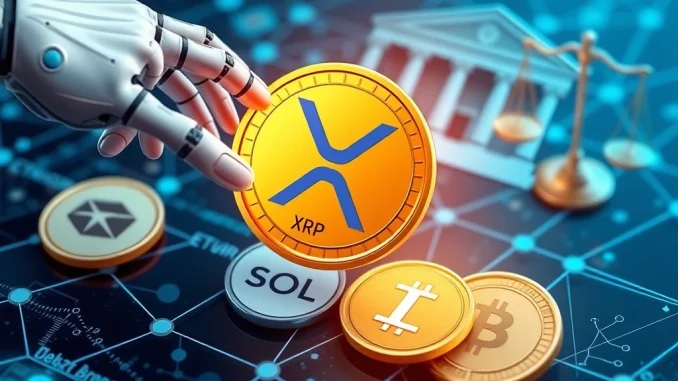
In a surprising turn of events for the crypto world, recent XRP News has left many investors and enthusiasts questioning the future trajectory of one of the market’s most prominent digital assets. AI-generated altcoin rankings for 2025 have notably excluded XRP, a decision that has sent ripples through the community. This unexpected omission is largely attributed to two critical factors: ongoing SEC Legal Uncertainty and XRP’s perceived limited DeFi Integration. While XRP reached record highs recently amidst ETF speculation, its absence from these top-tier lists highlights a shifting landscape in how altcoins are evaluated.
Why Was XRP Excluded? Unpacking the SEC Legal Uncertainty
The shadow of regulatory challenges continues to loom large over XRP. Ripple’s prolonged legal battle with the U.S. Securities and Exchange Commission (SEC) over whether XRP constitutes a security has created significant market uncertainty. While Ripple secured a partial legal victory in February 2025, narrowing the SEC’s claims, the broader case remains unresolved. This protracted legal saga has a tangible impact:
- Investor Hesitation: Analysts suggest that the SEC’s aggressive stance encourages institutional investors to favor tokens with clearer legal frameworks, contributing to XRP’s omission from prominent AI rankings.
- Regulatory Scrutiny: Beyond the SEC case, broader regulatory developments, such as the recently signed GENIUS Act establishing a federal stablecoin framework, signal a tightening regulatory environment. This increased scrutiny could extend to altcoins like XRP, further complicating its position.
This persistent SEC Legal Uncertainty remains a central impediment to XRP’s full market acceptance and its standing in algorithmically generated lists that prioritize regulatory clarity and stability.
The DeFi Divide: Why XRP’s DeFi Integration Lags
The exclusion also reflects evolving criteria in Altcoin Rankings, where decentralized finance (DeFi) activity increasingly influences evaluations. While platforms like Ethereum (ETH) and Solana (SOL) have seen robust ecosystem growth with decentralized exchanges and lending protocols, XRP’s historical focus has been different.
- Enterprise vs. Ecosystem: XRP has primarily targeted enterprise solutions for banks and financial institutions, focusing on cross-border payments. This niche, while commercially viable, has offered limited appeal to the broader developer and user bases driving DeFi’s expansion.
- Evolving Metrics: The divergence highlights the evolving criteria for altcoin rankings, which now emphasize active innovation in blockchain applications and robust developer communities building decentralized solutions. XRP’s more centralized, enterprise-centric approach means its DeFi Integration lags behind its peers in this critical area.
This gap in DeFi adoption is a key reason why AI models, which likely weigh ecosystem activity heavily, have overlooked XRP in their top-tier lists.
Navigating the Future: What’s Next for Ripple and XRP?
Market reactions to XRP’s exclusion have been mixed. While a slight dip in prices was noted, the asset stabilized as speculation about ETF approvals resurfaced. A crypto research firm predicted that Ripple’s partial legal victory could reignite investor interest, particularly if definitive regulatory clarity emerges by year-end. However, the Binance Crypto Fear & Greed Index indicates that XRP’s legal uncertainties continue to exacerbate volatility, complicating its position in rankings that prioritize stability.
Despite these challenges, XRP’s foundational role in cross-border transactions remains strong, with over 400 financial institutions globally utilizing Ripple’s technology. Ripple’s leadership, including CEO Brad Garlinghouse, continues to emphasize this enterprise adoption. Garlinghouse has stated, “The momentum we’re seeing around institutional adoption of XRP—even under regulatory headwinds—proves the global demand for faster, regulatory-compliant cross-border payment rails.” This commitment to its core utility is unwavering for Ripple.
Beyond the Rankings: The Enduring Role of XRP News
The exclusion of XRP from AI’s Altcoin Rankings serves as a crucial reminder of the dynamic interplay between legal clarity, ecosystem development, and market sentiment in the crypto space. While the rankings underscore a growing preference for projects demonstrating innovation in DeFi and blockchain applications—areas where XRP has historically lagged—it doesn’t diminish XRP’s established utility in cross-border payments.
As the regulatory landscape evolves and technological use cases expand, investor priorities will likely continue to shift toward assets that align with both compliance standards and innovative blockchain applications. For XRP, the path forward likely involves a continued focus on its enterprise solutions, while also exploring avenues for broader ecosystem development to appeal to the evolving metrics used by AI and human analysts alike.
Frequently Asked Questions (FAQs)
Q1: Why was XRP excluded from AI’s 2025 altcoin rankings?
XRP was primarily excluded due to ongoing legal uncertainties surrounding its classification as a security by the U.S. SEC, and its lagging integration into decentralized finance (DeFi) ecosystems compared to other leading altcoins like Ethereum and Solana.
Q2: How does the SEC legal battle impact XRP’s market position?
The prolonged legal battle with the SEC creates significant regulatory uncertainty, deterring institutional investors who prefer tokens with clearer legal frameworks. This uncertainty contributes to volatility and can affect its inclusion in top market rankings.
Q3: What is the significance of DeFi integration for altcoin rankings?
DeFi activity, including decentralized exchanges and lending protocols, has become a key metric for evaluating altcoins. Projects with robust DeFi ecosystems are often favored in rankings as they demonstrate active innovation, developer engagement, and broader utility beyond enterprise solutions.
Q4: Does XRP’s exclusion mean it’s no longer a viable cryptocurrency?
Not necessarily. While the exclusion highlights challenges in certain evaluation metrics, XRP maintains a strong foundational role in cross-border payments, with over 400 financial institutions using Ripple’s technology. Its utility for enterprise solutions remains intact.
Q5: What is Ripple’s strategy moving forward despite these challenges?
Ripple continues to focus on its core strength: payments innovation and providing regulatory-compliant cross-border solutions. CEO Brad Garlinghouse emphasizes the global demand for faster, compliant payment rails, indicating a commitment to its enterprise-focused utility.