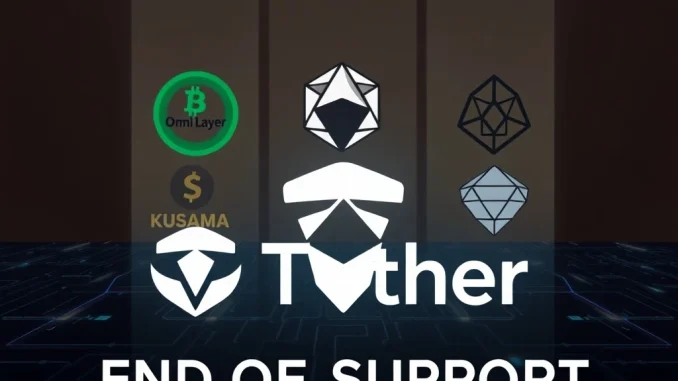
In a significant announcement that has rippled through the cryptocurrency world, Tether, the dominant issuer of the Tether USDT stablecoin, has declared its intention to cease support for redemptions and freeze all remaining tokens on five specific, older blockchains. This pivotal decision, effective September 1, signals a strategic shift for the world’s largest stablecoin, aiming to streamline operations and adapt to the ever-evolving landscape of user demand.
Understanding the USDT Delisting: Which Blockchains Are Affected?
The news from Tether’s official website outlines a clear path forward: a strategic withdrawal from several less-utilized networks. The blockchains slated for this USDT delisting include:
- Omni Layer: The original home of USDT, built on the Bitcoin blockchain.
- Bitcoin Cash SLP (Simple Ledger Protocol): A token protocol on the Bitcoin Cash network.
- Kusama: Polkadot’s canary network, often used for experimental deployments.
- EOS: A prominent blockchain platform known for its dApp capabilities.
- Algorand: A pure proof-of-stake blockchain designed for speed and scalability.
This move is not a sudden, arbitrary decision but a calculated step as part of Tether’s broader strategy to enhance efficiency and focus resources where they matter most. For users holding USDT on these specific chains, understanding the implications and taking necessary actions before the September 1 deadline is crucial.
Why Are These Blockchain Changes Happening Now?
Tether’s announcement isn’t just about cutting ties; it’s about optimizing for the future. The company explicitly states its reasons: simplifying operations, adapting to evolving user demand, and concentrating on blockchains with higher activity and engagement. But what does this truly mean for the broader ecosystem?
- Operational Simplification: Supporting and maintaining USDT across numerous blockchains, especially those with dwindling activity, consumes significant resources. By consolidating, Tether can allocate more effort to enhancing its services on more active networks, potentially leading to better stability and security.
- Evolving User Demand: The crypto landscape is dynamic. Over the years, user preferences have shifted dramatically. While Omni Layer was once groundbreaking, newer, faster, and often cheaper blockchains like Tron, Ethereum (Layer 2s), and Solana have become the preferred rails for stablecoin transactions. Tether is simply following its users.
- Concentration on High-Activity Chains: By focusing on blockchains with robust liquidity, strong developer communities, and high transaction volumes, Tether can ensure its blockchain changes contribute to a more resilient and efficient stablecoin ecosystem. This strategic pivot allows Tether to dedicate more resources to innovation and stability on networks that truly drive the bulk of stablecoin usage.
This rationalization is a sign of maturity in the stablecoin market, where efficiency and user alignment are paramount.
What Does This USDT Delisting Mean for Your Crypto Market Impact?
While the news might sound alarming, the actual crypto market impact for the vast majority of USDT users is expected to be minimal. The five affected blockchains collectively represent a very small fraction of the total USDT supply and daily transaction volume. Most USDT is held and traded on networks like Tron and Ethereum.
However, for those who do hold USDT on these specific chains, the implications are direct:
- For Holders: If you have USDT on Omni Layer, Bitcoin Cash SLP, Kusama, EOS, or Algorand, you will need to move your funds to a supported blockchain (e.g., Tron, Ethereum, Solana, Avalanche, Polygon) or redeem them directly with Tether before September 1. After this date, these tokens will be frozen, making them inaccessible.
- For Exchanges and Wallets: Platforms that currently support USDT on these chains will need to cease support and inform their users. Many have likely already begun this process.
- Overall Market Sentiment: While not a major shock, this move reinforces the idea that even dominant players like Tether are constantly optimizing their operations. It signals a lean towards efficiency and away from legacy infrastructure, which can be seen as a positive for the long-term health of the stablecoin market.
This decision underscores the importance of staying informed about the platforms you use and understanding the underlying blockchain infrastructure.
The Evolution of the USDT Stablecoin Ecosystem
The journey of the USDT stablecoin is a testament to the rapid evolution of the crypto space. Launched on the Omni Layer in 2014, USDT pioneered the concept of a fiat-pegged digital asset. Over the years, Tether expanded its reach to numerous other blockchains, adapting to technological advancements and user demands.
This latest move isn’t a retreat but a refinement. Tether is shedding legacy baggage to focus on more robust and widely adopted networks. The future of USDT clearly lies on chains that offer:
- High Throughput: Ability to process a large number of transactions quickly.
- Low Fees: Making micro-transactions and everyday use more feasible.
- Strong Developer Ecosystems: Ensuring continued innovation and security.
- Widespread Adoption: Availability across numerous exchanges and decentralized applications (dApps).
By concentrating its efforts, Tether aims to maintain its position as the leading stablecoin, ensuring liquidity and accessibility where it matters most for the vast majority of its users.
A Closer Look at Omni Layer and the Other Affected Chains
Each of the five blockchains being phased out has its own story and significance in the crypto world, even if their role in the Tether USDT ecosystem is diminishing:
- Omni Layer: As the original blockchain for USDT, Omni holds historical significance. However, its reliance on the Bitcoin network means slower transaction speeds and higher fees compared to newer chains, making it less ideal for the rapid, low-cost transfers often associated with stablecoins.
- Bitcoin Cash SLP: While Bitcoin Cash aimed to offer faster and cheaper transactions than Bitcoin, its SLP token standard didn’t gain widespread adoption for stablecoins compared to ERC-20 or TRC-20.
- Kusama: Being Polkadot’s experimental network, Kusama is designed for rapid iteration and testing. Its dynamic nature might not align with Tether’s need for long-term, static stability for its primary deployments.
- EOS: Once a highly anticipated ‘Ethereum killer,’ EOS faced challenges with decentralization and network congestion, which might have impacted its suitability for a major stablecoin like USDT in the long run.
- Algorand: Despite its strong technical foundations and focus on scalability and security, Algorand has struggled to capture the same level of stablecoin transaction volume as its competitors, leading Tether to re-evaluate its presence.
It’s important to note that Tether’s decision to end support for USDT on these chains does not imply that these blockchains themselves are failing or becoming obsolete. It simply means that, from Tether’s strategic perspective, supporting USDT on these particular networks no longer aligns with their operational efficiencies or user distribution goals.
Navigating the Transition: Actionable Insights for Users
If you’re one of the users affected by this USDT delisting, here’s what you need to do:
- Identify Your USDT Holdings: Check all your cryptocurrency wallets, exchange accounts, and any decentralized applications to see if you hold USDT on Omni Layer, Bitcoin Cash SLP, Kusama, EOS, or Algorand.
- Transfer Funds Promptly: The safest and easiest option is to transfer your USDT from these affected chains to a supported blockchain like Tron (TRC-20), Ethereum (ERC-20), Solana, Avalanche, or Polygon. Most major exchanges support USDT on these active networks.
- Understand Redemption Options: If you prefer to redeem your USDT for fiat currency, you can do so directly through Tether’s official platform, provided you meet their minimum redemption requirements and KYC/AML procedures. Ensure you initiate this process well before the September 1 deadline.
- Stay Informed: Follow Tether’s official announcements and your preferred exchange’s news to ensure you have the latest information regarding the transition.
- Avoid Last-Minute Panic: While the deadline is September 1, it’s always advisable to complete such transfers or redemptions well in advance to avoid potential network congestion or technical issues closer to the date.
Summary: A Strategic Evolution for Tether
Tether’s decision to end support for Tether USDT on Omni Layer, Bitcoin Cash SLP, Kusama, EOS, and Algorand by September 1 is a strategic move to streamline its operations and concentrate resources on more active and engaged blockchains. This USDT delisting reflects the dynamic nature of the crypto market and Tether’s commitment to adapting to evolving user demand. While it necessitates action from a small segment of users, the overall crypto market impact is expected to be minimal, reinforcing the robustness of the USDT stablecoin ecosystem on its primary networks. It’s a clear signal that efficiency and user-centricity will continue to drive the future of stablecoin development and deployment, ensuring the longevity and utility of the world’s leading stablecoin.
Frequently Asked Questions (FAQs)
1. Which blockchains are affected by Tether’s decision to end USDT support?
Tether will end support for USDT on five blockchains: Omni Layer, Bitcoin Cash SLP, Kusama, EOS, and Algorand.
2. What does “ending support” mean for my Tether USDT on these chains?
After September 1, 2024, Tether will no longer support redemptions for USDT on these specific blockchains, and any remaining tokens on them will be frozen. This means you won’t be able to move or redeem them.
3. What should I do if I hold USDT on Omni Layer, Bitcoin Cash SLP, Kusama, EOS, or Algorand?
You should transfer your USDT from these affected blockchains to a supported blockchain (such as Tron, Ethereum, Solana, Avalanche, or Polygon) or redeem them directly with Tether before September 1, 2024. Act well in advance of the deadline.
4. Why is Tether making these blockchain changes?
Tether stated its reasons are to simplify operations, adapt to evolving user demand, and concentrate its resources on blockchains with higher activity and engagement, ensuring greater efficiency and stability for the USDT stablecoin.
5. Does this decision affect USDT on other popular blockchains like Ethereum or Tron?
No, this decision specifically targets the five mentioned older or less-utilized blockchains. USDT on major, high-activity blockchains like Ethereum (ERC-20), Tron (TRC-20), Solana, Avalanche, and Polygon remains fully supported and unaffected.
6. What is the deadline for these changes?
The changes will become effective on September 1, 2024. Users are advised to take necessary actions well before this date.