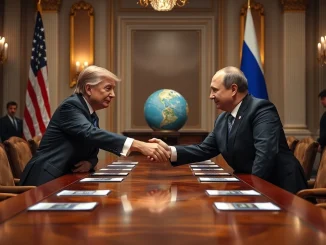
In a move that sent ripples of relief and optimism across financial markets, including a notable Bitcoin surge, the United States and the European Union recently announced a landmark trade agreement. This pivotal deal, struck on July 14, 2025, has successfully averted a potentially devastating tariff war, reshaping the landscape of transatlantic economic relations and offering a glimpse into the future of the global economy.
The Landmark US-EU Trade Pact: What’s the Deal?
After months of high-stakes negotiations, President Donald Trump and European Commission President Ursula von der Leyen confirmed a significant trade agreement designed to rebalance economic ties between the two major blocs. This pact, hailed as one of the largest U.S. trade agreements in decades, introduces a 15% flat tariff on EU imports into the U.S. Crucially, it also grants tariff-free access for U.S. exports to the EU. The agreement’s framework aims to reduce the bilateral trade deficit and foster greater stability in the global economy.
Key Provisions of the Agreement:
- A 15% flat tariff on EU imports to the U.S.
- Tariff-free access for U.S. exports to the EU.
- A substantial $600 billion investment by the EU into U.S. markets.
- EU commitment to purchase significant amounts of U.S. military equipment and energy.
- Maintenance of existing steel tariffs by the EU, accepting the 15% rate as a pragmatic compromise.
Averted Tariff War: A Strategic Retreat from Conflict
The immediate and most significant outcome of this agreement is the successful avoidance of a full-blown tariff war. Earlier in 2025, President Trump had threatened imposing 30% tariffs, a move that would have severely destabilized global trade. The acceptance of a 15% rate, while still a form of calibrated protectionism, signals a strategic shift from aggressive confrontation to a more measured approach. This pragmatic compromise by both sides underscores a shared desire to prevent retaliatory measures that could have spiraled into widespread economic disruption.
President Trump emphasized the deal’s role in “uniting” the two economies, highlighting its potential to boost American manufacturing and address long-standing U.S. demands for rebalanced trade. European Commission President von der Leyen echoed this sentiment, describing the deal as critical for “rebalancing trade between the two economies.”
Impact on Transatlantic Trade and Beyond
This trade pact is set to profoundly impact transatlantic trade. For the U.S., it promises expanded export opportunities and a reduction in trade deficits, potentially strengthening economic growth. The EU’s commitment to invest $600 billion in U.S. markets and purchase U.S. military equipment and energy addresses key American demands, reflecting a pragmatic alignment with Trump’s transactional diplomacy approach.
However, the 15% tariff on EU imports may temper European enthusiasm, potentially leading to a gradual reduction in demand for American goods in some sectors. While the agreement stabilizes transatlantic trade for now, its long-term success hinges on enforceable commitments to expand market access and address non-tariff barriers that often impede trade more subtly than tariffs.
The Bitcoin Surge: A Market Indicator of Reduced Uncertainty
In a fascinating turn of events, the announcement of the US-EU Trade Pact had an immediate and positive effect on cryptocurrency markets. Bitcoin, often seen as a bellwether for investor sentiment regarding global stability, surged past $119,000 following the news. This significant Bitcoin surge underscores how major geopolitical and economic developments directly influence the broader financial landscape, including digital assets. Investors reacted swiftly to the reduced trade uncertainty, flocking to assets perceived as benefiting from increased global stability and economic cooperation.
This market reaction highlights the interconnectedness of traditional finance and the crypto world, where clarity on trade relations can translate into immediate price movements for cryptocurrencies. The pact’s timing, ahead of an August tariff deadline, temporarily alleviated market concerns, contributing to the positive sentiment.
Challenges and Unresolved Issues for the Global Economy
Despite the immediate relief, the pact is not without its complexities and unresolved issues. Notably, it excludes resolutions for longstanding disputes in critical sectors like agriculture and steel, which President Trump has repeatedly criticized. The absence of detailed sectoral agreements may limit its effectiveness in truly reducing structural trade deficits.
Furthermore, the flat 15% tariff rate does not account for product-specific sensitivities, potentially creating winners and losers within the U.S. manufacturing sector and the EU’s export economy. These unresolved issues leave room for future friction, particularly if economic or political tensions resurface. European officials, while accepting the deal, remain cautious, emphasizing the need for deeper cooperation on issues like regulatory alignment and non-tariff barriers for true long-term stability.
Looking Ahead: Durability and Diplomacy
The US-EU Trade Pact is a significant milestone in President Trump’s efforts to reshape U.S. trade relations, balancing protectionist instincts with pragmatic diplomacy. His approach, which leveraged tariff threats to extract concessions, mirrors strategies seen with other major economies but focuses more narrowly on tariff adjustments rather than comprehensive regulatory changes.
While the agreement has temporarily stabilized transatlantic trade, its durability remains uncertain. Trump’s unpredictable trade policies and the EU’s multilateralist stance could collide again, especially if economic or political pressures resurface. For now, however, the deal stands as a testament to the power of negotiation in averting a full-scale trade war and fostering a degree of optimism for the global economy.
Frequently Asked Questions (FAQs)
Q1: What is the primary objective of the new US-EU Trade Pact?
The primary objective of the US-EU Trade Pact is to avert a potential trade war, rebalance transatlantic economic relations by reducing the bilateral trade deficit, and stabilize global economic dynamics through a structured agreement on tariffs and investments.
Q2: How does the 15% tariff on EU imports impact trade?
The 15% flat tariff on EU imports into the U.S. is a key component of the deal, aiming to reduce the trade deficit. While it avoids the higher 30% tariffs previously threatened, it represents a calibrated protectionist measure that may temper European demand for U.S. goods in the long run.
Q3: Why did Bitcoin surge after the trade pact announcement?
Bitcoin surged past $119,000 because the US-EU Trade Pact significantly reduced global trade uncertainty. Investors often view Bitcoin and other cryptocurrencies as beneficiaries of increased economic stability and reduced geopolitical tensions, leading to positive market reactions.
Q4: What are the main unresolved issues within the trade agreement?
The pact notably excludes resolutions for long-standing disputes in key sectors such as agriculture and steel. Additionally, the flat tariff rate does not account for product-specific sensitivities, and broader issues like non-tariff barriers and regulatory alignment still require deeper cooperation.
Q5: What is the long-term outlook for this Transatlantic Trade agreement?
While the agreement provides immediate stability, its long-term durability is uncertain. Future success depends on enforceable commitments to expand market access and address non-tariff barriers. The differing diplomatic approaches of the U.S. and EU, along with potential resurfacing economic or political tensions, could challenge its longevity.