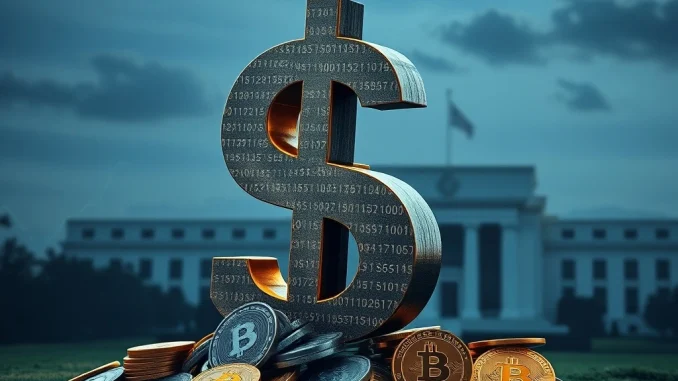
Are you tracking the pulse of the crypto market? Then you’ve likely felt the tremor of a brewing storm: a powerful debate centered on the future of the U.S. dollar, fueled by the explosive growth of stablecoins and the Federal Reserve’s delicate monetary policy. For those invested in Bitcoin, this isn’t just academic; it’s a critical discussion that could reshape your portfolio and the global financial landscape as we know it.
The Unprecedented Rise of Stablecoins: A New Financial Frontier?
The digital asset world is buzzing, and much of that energy stems from the rapid expansion of stablecoins. These cryptocurrencies, designed to maintain a stable value relative to a fiat currency (most commonly the U.S. dollar), have moved beyond mere crypto trading tools. They are increasingly becoming a cornerstone for cross-border transactions, liquidity management, and even a potential alternative to traditional banking rails.
But what does this mean for the mighty dollar? Financial analyst Max Keiser has voiced a bold warning: the burgeoning use of dollar-linked stablecoins could dramatically accelerate the growth of the M2 money supply. This isn’t just financial jargon; it’s a direct challenge to the dollar’s long-held stability. Keiser suggests this could potentially halve the dollar’s purchasing power, fundamentally altering its role in international markets.
- What are Stablecoins? Digital assets pegged to a stable asset like the U.S. dollar, gold, or other fiat currencies, aiming to minimize price volatility.
- Their Role: Facilitate faster, cheaper international transactions, offer a safe haven within crypto markets, and bridge the gap between traditional finance and decentralized ecosystems.
- Key Players: Tether (USDT), USD Coin (USDC), and Binance USD (BUSD) are among the largest and most widely used stablecoins.
Is the Dollar’s Purchasing Power at Risk? Unpacking the M2 Money Supply Debate
The core of this debate revolves around the M2 money supply. This broad measure of money includes cash, checking deposits, savings deposits, and money market securities. When the M2 supply expands too quickly without corresponding economic growth, it can lead to inflation and a decrease in the dollar’s purchasing power.
As of May 2025, the measured M2 expansion reached $21.9 trillion. While the Federal Reserve has maintained interest rates with a cautious approach, Keiser argues that this very caution limits the pace at which the dollar’s value might erode. He provocatively suggests that a future administration, seeking to boost liquidity or achieve export-driven economic goals, might even leverage stablecoins to effectively double the M2 money supply. Such a move, while injecting liquidity, would likely further depreciate the dollar’s value, intensifying the concern about the dollar’s purchasing power.
This scenario isn’t just theoretical. Federal Reserve data already indicates that the sheer growth of the M2 money supply has been outpaced by the explosive surge in stablecoin adoption. This divergence highlights a critical shift: money is increasingly flowing into digital channels that operate somewhat independently of traditional banking systems, raising questions about the efficacy of conventional monetary policy tools.
Federal Reserve Policy: Navigating Inflation and Digital Assets
The Fed policy stands at a critical juncture. Traditionally, the Federal Reserve’s primary tools for managing inflation and economic stability have been interest rate adjustments and quantitative easing/tightening. However, the rise of digital assets, particularly stablecoins, introduces new complexities into this equation.
While the Fed remains focused on its dual mandate of maximum employment and price stability, the growing influence of stablecoins presents a unique challenge. How do you manage a money supply when a significant portion of it is circulating outside the direct purview of commercial banks and traditional financial institutions? The Fed’s emphasis on maintaining dollar swap lines underscores its commitment to the dollar’s global dominance, yet the evolving landscape suggests a need for new frameworks.
Regulators remain cautious, grappling with how to integrate these digital instruments into existing financial systems without introducing systemic risks. The balance between fostering technological innovation and safeguarding the stability of established financial frameworks is a tightrope walk for policymakers worldwide.
Bitcoin’s Strategic Role: A Hedge Against Economic Volatility?
Amidst concerns about the dollar’s future and the potential for a declining dollar purchasing power, Bitcoin is increasingly being positioned as a strategic reserve asset. Keiser posits that if the dollar’s value continues to erode due to aggressive stablecoin-fueled M2 expansion, it could catalyze increased adoption of Bitcoin as a hedge.
Interestingly, this isn’t just speculation. Stablecoin issuers themselves are reportedly acquiring Bitcoin to hedge against potential policy shifts and market volatility. This strategic move by those at the forefront of the stablecoin revolution lends significant weight to Bitcoin’s growing role as a store of value.
Moreover, institutional engagement in the crypto space is undeniable. By February 2025, over 3,300 institutional entities were reportedly holding shares in U.S. spot Bitcoin ETFs. This influx of traditional finance into digital assets reflects a broader trend: the integration of cryptocurrencies into mainstream investment strategies, viewing Bitcoin as a potential safeguard against currency debasement and economic uncertainty.
What Are the Global Implications of This Shift?
The interplay between stablecoins, monetary policy, and the potential re-evaluation of reserve assets has profound implications for global finance. The dollar’s long-term dominance, while currently strong, faces a new kind of pressure from decentralized alternatives and digital currencies.
If stablecoins continue to gain traction as a tool for cross-border transactions, redirecting flows away from traditional fiat channels, it could gradually chip away at the dollar’s unparalleled global standing. This isn’t necessarily an overnight collapse but rather a gradual recalibration of power dynamics in the international monetary system.
Public reactions to these analyses are, predictably, mixed. Some, like user Michael Jay, point to strategic moves such as Trump Media’s reported $2 billion Bitcoin acquisition as evidence of a shift towards digital assets. Others express strong support for policies that embrace stablecoin adoption, seeing it as a path to greater financial efficiency. Critics, however, raise complex questions about the underlying mechanisms, particularly the role of Bitcoin as collateral in stablecoin reserves.
The implications are still unfolding, demanding careful calibration from policymakers. They must navigate the complexities of fostering innovation while safeguarding the stability of existing financial frameworks. The dollar’s trajectory and the Fed’s response to these evolving dynamics will undoubtedly remain central to discussions on the future of global currency systems.
In conclusion, the convergence of stablecoin proliferation and Federal Reserve policy is setting the stage for a transformative period in global finance. The debate over the dollar’s purchasing power is more than just an academic exercise; it’s a live discussion with real implications for investors and economies worldwide. As stablecoins gain ground and institutions increasingly look to Bitcoin as a hedge, the future of money appears poised for a fascinating evolution.
Frequently Asked Questions (FAQs)
1. How could stablecoins potentially impact the U.S. dollar’s purchasing power?
Stablecoins, particularly those pegged to the dollar, can accelerate the M2 money supply growth if they are used extensively as a parallel currency system. If this growth outpaces economic productivity, it could lead to inflation and reduce the dollar’s purchasing power, similar to how traditional fiat currency expansion can devalue a currency.
2. What is the M2 money supply, and why is it relevant to this debate?
The M2 money supply is a broad measure of the total amount of money in circulation, including physical cash, checking accounts, savings accounts, and money market accounts. It’s relevant because rapid expansion of M2, especially if fueled by stablecoins outside direct Fed control, can dilute the value of each dollar, impacting its purchasing power.
3. How is Bitcoin positioned as a hedge against dollar depreciation?
Bitcoin is often seen as a hedge due to its decentralized nature, finite supply, and independence from traditional monetary policy. If the dollar’s value erodes due to inflation or excessive money supply expansion, investors may flock to Bitcoin as a ‘digital gold’ or a store of value that is not subject to the same inflationary pressures.
4. What is the Federal Reserve’s stance on stablecoins and digital assets?
The Federal Reserve generally adopts a cautious approach, acknowledging the innovation stablecoins offer while emphasizing the need for robust regulation to manage potential risks to financial stability, consumer protection, and illicit finance. They are actively studying digital currencies and their implications for monetary policy.
5. What does institutional adoption of Bitcoin ETFs signify?
Institutional adoption of Bitcoin ETFs signifies a growing mainstream acceptance and integration of digital assets into traditional financial portfolios. It suggests that large financial entities are increasingly viewing Bitcoin as a legitimate asset class for diversification, hedging, and long-term investment, rather than just a speculative tool.
6. How might future government policies interact with stablecoin growth?
Future government policies could either accelerate or restrict stablecoin growth. Some analysts suggest a government might leverage stablecoins to boost liquidity. Conversely, strict regulations, taxation, or outright bans could limit their expansion. The interplay will depend on the balance policymakers strike between innovation, risk management, and national economic objectives.