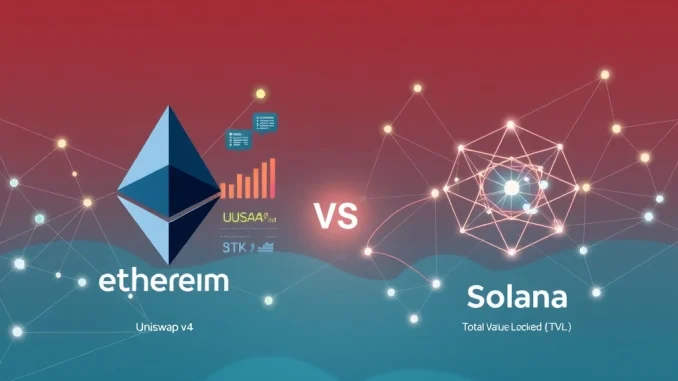
The world of decentralized finance (DeFi) is buzzing with a major development: Uniswap v4, a cornerstone of the Ethereum DeFi landscape, has officially surpassed a remarkable $1 billion in Total Value Locked (TVL). This significant milestone highlights Ethereum’s continued innovation and its foundational role in the crypto economy. However, despite this impressive achievement, the broader narrative still points to Solana maintaining a formidable lead in several critical DeFi metrics. This ongoing rivalry between two of the industry’s most prominent blockchain ecosystems sets the stage for an exciting future in decentralized finance.
Ethereum DeFi’s Latest Leap: Uniswap v4 Hits $1 Billion TVL
Uniswap v4’s journey to over $1 billion in TVL marks a pivotal moment for the Ethereum network. This isn’t just a number; it’s a testament to the protocol’s evolving design and its growing appeal to developers and liquidity providers. At its core, Uniswap v4 introduces a reimagined “Hooks” architecture and a modular liquidity design. This innovative approach transforms Uniswap from a standard automated market maker (AMM) into a versatile, foundational DeFi infrastructure layer.
What makes Uniswap v4 so impactful?
- Customizable Liquidity Pools: The “Hooks” architecture allows for highly tailored liquidity pools, enabling a new level of flexibility.
- Advanced Features: Users and developers can integrate features like dynamic fees, on-chain limit orders, and Time-Weighted Average Price (TWAP) oracles directly into liquidity pools.
- Enhanced Utility: This modularity expands Uniswap’s utility beyond simple token swaps, fostering a more sophisticated and efficient trading environment within the Ethereum DeFi ecosystem.
The rapid accumulation of Uniswap v4 TVL underscores strong confidence in Ethereum’s ability to innovate and adapt, attracting substantial capital and developer talent.
Why is Uniswap v4 TVL a Game-Changer for Ethereum?
Reaching $1 billion in Uniswap v4 TVL is more than just a headline; it signals robust activity and adoption within the protocol. This landmark achievement reflects the successful implementation of its new architecture, which encourages deeper engagement from various market participants. The cumulative trading volume on Uniswap v4 has already exceeded an impressive $110 billion, with significant activity concentrated on both the Ethereum mainnet and the Unichain blockchain.
A key indicator of v4’s success is the deployment of over 2,500 Hooks. These custom smart contracts enable advanced liquidity management strategies and expand the protocol’s functionality significantly. We’re already seeing the emergence of specialized applications built on this framework:
- Bunni: This protocol has recorded over $1 billion in cumulative trading volume.
- EulerSwap: Another notable protocol, also exceeding $1 billion in cumulative trading volume.
These examples highlight how Uniswap v4 is fostering a vibrant ecosystem of specialized applications, further solidifying its role as a crucial liquidity backbone for Ethereum DeFi. The innovation demonstrated by these protocols showcases the power of v4’s modular design in unlocking new possibilities for decentralized finance.
The Solana DeFi Ecosystem: A Formidable Contender
Despite Uniswap v4’s impressive strides, the narrative shifts when we look at the broader DeFi landscape, where the Solana DeFi ecosystem continues to pose a significant challenge to Ethereum’s long-standing dominance. Solana’s leading decentralized exchange (DEX), Raydium, currently boasts over $2.3 billion in TVL. This figure not only surpasses Uniswap v4’s current TVL but also underscores a broader trend of capital shifting towards Solana’s high-performance environment.
What gives Solana its edge?
- Faster Execution Speeds: Solana’s architecture allows for significantly higher transaction throughput, leading to quicker trade executions.
- Lower Transaction Costs: Gas fees on Solana are notoriously low compared to Ethereum, making it more cost-effective for frequent transactions.
- User Preference: These advantages make Solana a preferred environment for high-frequency traders and yield farmers who prioritize efficiency and minimal costs.
Solana’s ability to attract and retain institutional-grade liquidity, as evidenced by Raydium’s TVL, directly challenges Ethereum’s traditional stronghold. The growth of the Solana DeFi ecosystem demonstrates a clear demand for performance-driven blockchain solutions in the decentralized finance space.
Decentralized Exchanges: A Battle for Supremacy
The competition between Ethereum and Solana, exemplified by Uniswap v4 and Raydium, highlights diverging priorities in the world of Decentralized Exchanges. Ethereum, with Uniswap v4, is solidifying its position as a hub for innovation through modularity and customizability. Its focus is on providing a flexible and robust framework for complex DeFi applications.
Conversely, Solana prioritizes raw performance, offering real-time execution capabilities that attract traders seeking speed and cost-effectiveness above all else. This fundamental difference sets the stage for a compelling battle for supremacy among Decentralized Exchanges.
Key points of contention in this rivalry include:
- Flexibility vs. Speed: Can Uniswap’s modular flexibility on Ethereum offset its higher fees and slower transaction finality?
- Cost-Efficiency: Will Solana’s inherent speed and lower costs continue to drive user adoption and capture a larger share of the DeFi market?
- Developer Ecosystems: Both platforms are vying for developer talent, with each offering unique advantages for building decentralized applications.
The trajectory of these platforms will undoubtedly shape the broader DeFi landscape in the coming months, influencing how users interact with and utilize decentralized financial services.
Navigating the Future of DeFi Ecosystems
The ongoing competition between Ethereum and Solana is more than just a rivalry between two blockchains; it’s a dynamic force shaping the evolution of all DeFi Ecosystems. Uniswap v4’s innovations demonstrate Ethereum’s remarkable adaptability and its commitment to remaining at the forefront of decentralized finance. It shows that despite its challenges, Ethereum continues to attract significant capital and foster groundbreaking development.
However, Solana’s performance-driven model poses a sustained and potent challenge. Its focus on speed and low transaction costs resonates deeply with a segment of the market that prioritizes efficiency for high-frequency trading and yield farming. As both DeFi Ecosystems continue to evolve, the interplay between technological innovation and user behavior will be the ultimate determinant of which platform establishes long-term leadership in decentralized finance.
This evolving landscape offers exciting opportunities for users and developers alike. The pressure from competition drives both networks to improve, ultimately benefiting the entire DeFi space through better technology, lower costs, and more diverse financial products. The coming months will be crucial in observing how these giants adapt and innovate, charting the course for the future of decentralized finance.
Source: [1] [Uniswap v4 Surpasses $1B TVL – But Ethereum Still Trails Solana]
Frequently Asked Questions (FAQs)
1. What is Uniswap v4’s “Hooks” architecture?
Uniswap v4’s “Hooks” architecture allows developers to execute custom code at specific points during a liquidity pool’s lifecycle, such as before or after a swap, or when liquidity is added or removed. This modular design enables highly customizable liquidity pools with features like dynamic fees, on-chain limit orders, and custom oracles, transforming Uniswap into a more flexible and powerful DeFi infrastructure.
2. How does Uniswap v4’s TVL compare to Solana’s leading DEX, Raydium?
As of the article’s date, Uniswap v4 has surpassed $1 billion in Total Value Locked (TVL). In comparison, Solana’s leading decentralized exchange, Raydium, currently holds over $2.3 billion in TVL, indicating Solana’s significant presence and user adoption in the decentralized finance space.
3. What are the main advantages of Solana over Ethereum in DeFi?
Solana’s primary advantages in DeFi include significantly faster transaction execution speeds and much lower transaction costs compared to Ethereum. These characteristics make Solana particularly attractive to high-frequency traders and yield farmers who require rapid, cost-efficient operations for their strategies.
4. What does “Total Value Locked (TVL)” mean in DeFi?
Total Value Locked (TVL) is a key metric in decentralized finance that represents the total value of assets currently staked or locked within a specific DeFi protocol or platform. It indicates the amount of capital committed to a protocol, serving as a measure of its liquidity, user adoption, and overall health within the DeFi ecosystem.
5. How might the competition between Ethereum and Solana impact the future of DeFi?
The competition between Ethereum and Solana is expected to drive significant innovation in the DeFi space. Ethereum’s focus on modularity and flexibility (like Uniswap v4’s Hooks) will push for more sophisticated applications, while Solana’s emphasis on speed and low costs will continue to attract users prioritizing efficiency. This rivalry fosters continuous improvement in technology, scalability, and user experience across all DeFi ecosystems, ultimately benefiting the broader cryptocurrency market.