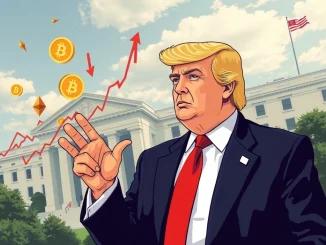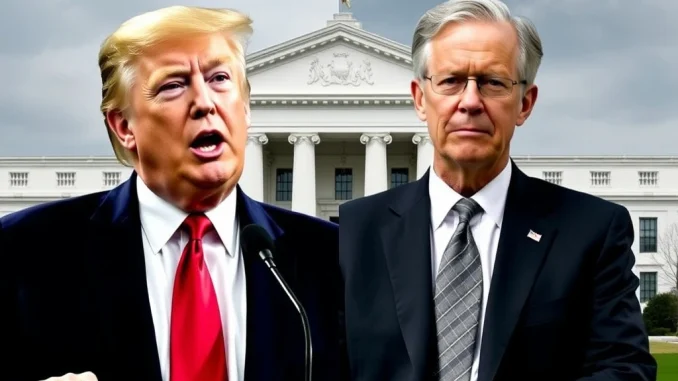
In the volatile world of cryptocurrencies, market sentiment often hinges on the broader economic landscape, with central bank decisions playing a pivotal role. The recent reaffirmation from the White House that Donald Trump will not replace Federal Reserve Chair Jerome Powell, despite their well-documented public clashes, sends a clear signal to markets, including the digital asset space. Understanding the dynamics between the executive branch and the Federal Reserve is crucial for anyone tracking economic stability and its ripple effects on crypto valuations.
Donald Trump’s Public Pressure Campaign: What’s Behind the Rhetoric?
On July 25, 2025, White House officials clarified that President Donald Trump has no intention of replacing Federal Reserve Chair Jerome Powell. This confirmation came from the Director of the U.S. Office of Management and Budget (OMB), who stated that Trump “clearly indicated no intention to fire Powell” during a meeting with congressional leaders. This reassurance followed a period of escalating public tension between the two prominent figures.
President Trump’s frustration with the Federal Reserve’s monetary policy has been a consistent theme throughout his political career. His recent high-profile visit to the Fed’s headquarters brought these disagreements to the forefront, where he publicly criticized Powell’s leadership and the central bank’s $2.5 billion renovation project. Labeling the chairman a “loser” and accusing him of “hurting young homebuyers,” Trump’s remarks underscored his desire for lower interest rates. He reiterated, “I would love for the U.S. central bank to lower interest rates.” Despite the harsh words, Trump later downplayed the possibility of removal, asserting, “I just don’t think it’s necessary” to fire Powell. This public posturing reflects longstanding disagreements over economic priorities, particularly concerning interest rate policy and its perceived impact on economic growth.
Jerome Powell and the Federal Reserve: Navigating Political Headwinds
Jerome Powell, as the Chair of the Federal Reserve, stands at the helm of the nation’s central bank, responsible for steering monetary policy. His tenure has been marked by persistent public criticism from the executive branch, a rare occurrence given the Fed’s traditional independence. The specific target of Trump’s recent ire—the Fed’s renovation project—highlights the president’s focus on perceived inefficiencies and spending, even within an independent institution.
However, it is important to remember that the Federal Reserve Board’s decision-making process is collective, not solely reliant on the Chair. As one report observed, “He’s not the sole decider on interest rates.” This collective structure helps to distribute responsibility and insulate policy from individual political pressures. Powell’s confirmation in 2018 and subsequent reappointment in 2020 garnered bipartisan support in Congress, underscoring a broader political consensus on the importance of stable leadership at the central bank. Despite the on-camera clashes, Powell continues to lead the institution through a complex economic landscape.
The Crucial Battle for Fed Independence: Why It Matters
The concept of Fed Independence is a cornerstone of modern economic governance, designed to shield monetary policy from short-term political whims. The Federal Reserve Act provides significant legal protections for the Chair, making unilateral removal by the president exceedingly difficult. Removing a Fed chair typically requires a joint resolution of Congress, a high bar that significantly limits the president’s direct leverage.
This structural autonomy is vital for maintaining credibility and stability in financial markets. An independent central bank can make decisions based on economic data and long-term objectives, rather than being swayed by electoral cycles or immediate political pressures. This institutional separation helps prevent situations where interest rates might be manipulated for political gain, potentially leading to inflation or economic instability. The recent episode, while highlighting tensions, ultimately reinforced the resilience of this independence, demonstrating the robust checks and balances in place.
Monetary Policy Under Scrutiny: Implications for the Economy and Beyond
The core of the friction between the White House and the Federal Reserve revolves around monetary policy, specifically interest rates. President Trump has consistently advocated for lower rates, believing they stimulate economic growth and benefit sectors like housing. Conversely, the Fed’s role is to balance maximum employment with price stability, often meaning carefully calibrated rate adjustments to manage inflation.
The Fed’s decisions on interest rates have far-reaching implications. For the broader economy, they influence borrowing costs for businesses and consumers, impacting investment, hiring, and spending. For financial markets, rate changes can trigger significant shifts in asset prices, from stocks and bonds to real estate. In the cryptocurrency space, lower interest rates generally make traditional investments less attractive, potentially driving capital into higher-risk, higher-reward assets like Bitcoin and altcoins. Conversely, higher rates can draw liquidity away. Thus, the stability of the Fed’s approach, even amid political pressure, provides a predictable framework that markets, including crypto, can respond to.
White House Strategy: Balancing Criticism with Stability
The administration’s messaging appears to be a calculated effort to balance public criticism with pragmatic restraint. While Donald Trump has been vocal in his critiques, his subsequent downplaying of a potential firing and the OMB’s public affirmation signal an attempt to quell speculation about leadership changes. This strategy aims to reassure markets of continuity in monetary policy while still appealing to a political base that may share his frustrations with the central bank.
Trump’s statement that he “feels good about” his relationship with Jerome Powell, despite the public spat, suggests a deliberate move to avoid destabilizing the Fed’s credibility. The White House visit, accompanied by high-profile aides, underscored an administration-wide effort to influence the Fed, but the ultimate decision to retain Powell reinforces the existing structure. This approach highlights the complex interplay between political rhetoric and institutional stability, especially concerning an entity as critical as the Federal Reserve.
As the Federal Reserve prepares for its upcoming policy meeting, the absence of a Powell replacement reinforces the status quo. However, the episode underscores the fragility of trust between the executive branch and the central bank, raising questions about the long-term implications for economic governance. For now, the Federal Reserve’s independence—and its ability to resist direct political interference—remains intact, a critical factor for both traditional and digital financial markets.
Frequently Asked Questions (FAQs)
1. Why did President Trump publicly criticize Federal Reserve Chair Jerome Powell?
President Trump’s criticisms primarily stem from his desire for lower interest rates to stimulate economic growth, a stance that often conflicted with the Federal Reserve’s more cautious approach to monetary policy aimed at controlling inflation and maintaining price stability. He also criticized the Fed’s internal operations, such as a renovation project.
2. Can a U.S. President unilaterally fire the Federal Reserve Chair?
No, a U.S. President cannot unilaterally fire the Federal Reserve Chair. The Chair, like other members of the Federal Reserve Board of Governors, serves a fixed term and can only be removed for cause, typically requiring a joint resolution of Congress. This legal protection is designed to ensure Fed Independence from political pressure.
3. How does the Federal Reserve’s independence impact the economy?
The Federal Reserve’s independence is crucial for its ability to make decisions based on economic data and long-term objectives rather than short-term political cycles. This helps maintain market confidence, prevent politically motivated inflation or deflation, and ensure stable economic growth, benefiting both traditional markets and nascent sectors like cryptocurrency.
4. What are the implications of the White House’s reaffirmation for markets?
The White House’s reaffirmation that Donald Trump will not replace Jerome Powell helps to reduce uncertainty in financial markets. It signals continuity in the leadership of the Federal Reserve, which can lead to greater stability and predictability in monetary policy, potentially easing concerns among investors in various asset classes, including cryptocurrencies.
5. How do Fed interest rate decisions affect cryptocurrency markets?
Fed interest rate decisions significantly influence the broader economic environment. Lower interest rates can make traditional investments less attractive, potentially encouraging investors to seek higher returns in riskier assets like cryptocurrencies. Conversely, higher rates can increase the appeal of safer investments and potentially draw liquidity away from digital assets, impacting their valuations.