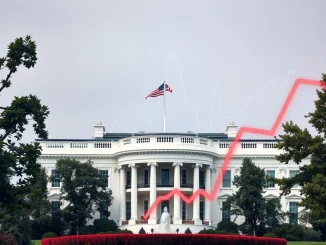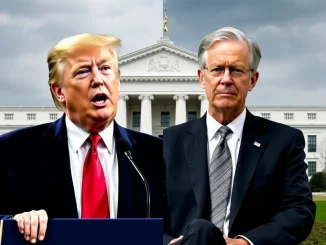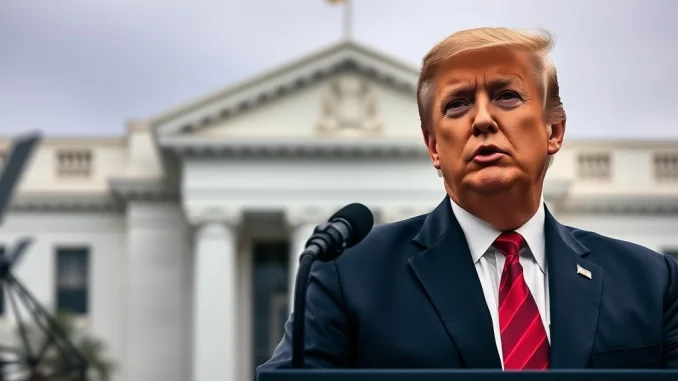
U.S. President Donald Trump has once again sent ripples through financial markets with a bold declaration: the Federal Reserve should slash interest rates to below 1%. This isn’t just a casual remark; it’s a direct challenge to the central bank’s independence and a potential game-changer for the global economy, with significant implications for the burgeoning crypto market.
What’s Behind Trump’s Demand for Drastic Fed Rate Cuts?
President Trump has been a vocal critic of the Federal Reserve’s monetary policy, consistently advocating for lower borrowing costs to fuel economic expansion. His latest demand for Fed rate cuts below 1% stems from a belief that the current rates are too high, stifling growth and making U.S. exports less competitive. He argues that such aggressive cuts are necessary to counteract global economic slowdowns and maintain America’s competitive edge. He has often pointed to the strong dollar as a disadvantage for American manufacturers and exporters, believing that lower rates would weaken the currency and boost trade.
This isn’t a new stance for the former president; throughout his previous term, he frequently pressured the Fed to adopt a more dovish approach, often contrasting the U.S. central bank’s actions with those of other major economies that maintained ultra-low or even negative rates. His philosophy centers on the idea that cheaper money directly translates to more robust economic activity, greater job creation, and a more competitive America on the global stage.
The Federal Reserve’s Stance and Historical Context of Trump Interest Rates
The Federal Reserve operates with a dual mandate: to achieve maximum employment and maintain price stability. Traditionally, it guards its independence fiercely from political pressure, making direct presidential demands like those from President Trump on interest rates a contentious issue. The Fed typically adjusts rates based on economic indicators such as inflation, employment figures, and global economic conditions, rather than political directives.
Historically, rates below 1% were seen during periods of severe economic distress, such as after the 2008 financial crisis. During that period, the Fed implemented quantitative easing and kept the federal funds rate near zero for an extended time to stimulate a recovery. Such low rates are generally considered unconventional tools, reserved for times when the economy needs extreme stimulus to avoid deflation or a deep recession. A move to sub-1% rates in a relatively healthy economy would represent an unprecedented shift in modern U.S. monetary policy.
Analyzing the Potential Economic Impact of Such a Move
A move to cut rates below 1% would have a profound economic impact. On the one hand, it could provide a significant stimulus, making borrowing cheaper for businesses and consumers, potentially boosting investment and consumption. This could lead to a surge in stock markets, real estate, and other asset classes as investors seek higher returns outside of low-yielding bonds.
However, critics warn of severe risks associated with such aggressive Fed rate cuts:
- Inflationary Pressures: Flooding the economy with cheap money can lead to too much money chasing too few goods, resulting in rising prices and a decline in purchasing power.
- Asset Bubbles: Artificially low rates can inflate asset values beyond their fundamental worth, creating ‘bubbles’ in markets like stocks or real estate that are prone to sudden, painful corrections.
- Reduced Policy Space: With rates already so low, the Fed would have limited ammunition left to combat future recessions or financial crises. This could leave the economy vulnerable to deeper downturns without effective monetary tools.
- Devaluation of Savings: Low rates penalize savers, particularly retirees, who rely on interest income from traditional bank accounts and bonds, forcing them into riskier investments.
How Could This Impact the Crypto Market?
For the crypto market, Trump’s call for sub-1% rates could be a double-edged sword, yet many analysts and investors see it as potentially bullish. Here’s why:
- Search for Yield: In a low-interest-rate environment, traditional investments like savings accounts and government bonds offer negligible returns. This often pushes investors, both institutional and retail, towards riskier, higher-yield assets, including cryptocurrencies, in their quest for meaningful returns.
- Inflation Hedge: If aggressive rate cuts lead to inflation or a weakening U.S. dollar, assets like Bitcoin, often dubbed ‘digital gold,’ could gain significant traction as a hedge against currency debasement and a store of value. The narrative of Bitcoin as a limited-supply asset becomes more compelling when fiat currencies are perceived to be losing value.
- Increased Liquidity: Cheaper money generally means more liquidity in the financial system. This abundance of capital can flow into speculative assets like crypto, driving up prices and market capitalization.
- Risk-On Sentiment: Lower rates typically foster a ‘risk-on’ environment, where investors are more willing to take on risk in pursuit of higher returns, favoring growth assets over safe havens. This sentiment often benefits the volatile yet high-potential crypto sector.
Conversely, extreme economic instability caused by such a drastic policy shift could also lead to a flight to safety, which might initially hurt risk assets like crypto. However, the prevailing sentiment leans towards a net positive impact for the crypto market in a prolonged low-interest-rate environment.
Navigating Future Monetary Policy Shifts
The ongoing debate between the White House and the Federal Reserve highlights the complexities of monetary policy in a highly politicized environment. While the Fed strives for independence, persistent public pressure from the President is unprecedented in its intensity and public nature. For investors, this creates a landscape of uncertainty, requiring careful consideration of how potential shifts in interest rates could affect their portfolios, especially within the volatile crypto space.
Understanding the interplay between political rhetoric, central bank decisions, and market reactions is crucial. Investors should remain agile, diversify their portfolios, and keep a close eye on economic indicators and Fed communications, as well as the evolving narratives within the crypto market.
Conclusion
President Trump’s audacious demand for the Federal Reserve to slash interest rates below 1% is more than just a headline; it’s a potential seismic shift in economic strategy. While the Fed’s independence remains a cornerstone of its operations, the pressure is undeniable. Should such drastic Fed rate cuts materialize, the ripple effects would be felt across every corner of the financial world, potentially ushering in a new era for traditional markets and presenting unique opportunities—and challenges—for the dynamic crypto market. Staying informed and agile will be key for navigating these evolving economic currents, especially as the debate around Trump interest rates continues to intensify.
Frequently Asked Questions (FAQs)
1. What is the Federal Reserve’s primary role?
The Federal Reserve, often called the Fed, is the central bank of the United States. Its primary roles are to conduct the nation’s monetary policy to promote maximum employment, stable prices, and moderate long-term interest rates in the U.S. economy.
2. Why does President Trump advocate for lower interest rates?
President Trump consistently advocates for lower interest rates, believing they stimulate economic growth by making borrowing cheaper for businesses and consumers. He also argues that lower rates weaken the U.S. dollar, making American exports more competitive globally.
3. How do extremely low interest rates generally affect the economy?
Extremely low interest rates aim to stimulate the economy by encouraging borrowing and spending. However, they can also lead to inflation, asset bubbles (like in housing or stock markets), and reduce the central bank’s ability to respond to future economic downturns.
4. What are the potential impacts of sub-1% rates on cryptocurrencies?
Sub-1% interest rates could positively impact cryptocurrencies by pushing investors towards riskier assets in search of higher yields. It can also strengthen the narrative of Bitcoin as an inflation hedge if the U.S. dollar weakens due to aggressive monetary policy.
5. Is it likely the Federal Reserve will cut rates below 1% based on political pressure?
The Federal Reserve maintains its independence from political pressure and typically makes decisions based on economic data and its dual mandate. While political rhetoric can influence market sentiment, the Fed’s decisions are primarily driven by its assessment of economic conditions rather than direct political demands.
6. What are the main risks associated with extremely low interest rates for investors?
For investors, extremely low interest rates can lead to diminished returns on traditional savings and bonds, potentially forcing them into higher-risk assets. This can also contribute to asset bubbles, which carry the risk of significant value corrections, impacting overall portfolio stability.